
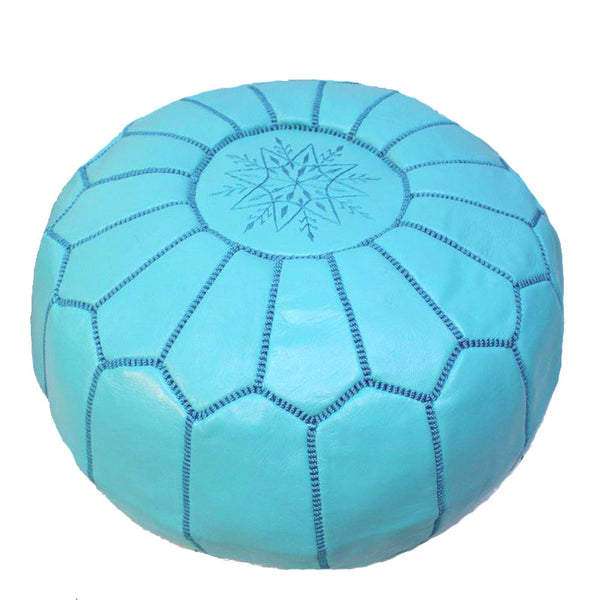


Turquoise is the colour of Moroccan tiles, of the Atlantic at Essaouira, of the glazed pottery stacked in the souks of Fès. It is one of the oldest colours in the Moroccan visual tradition — a pigment derived from copper minerals, used for centuries in zellige tilework, in painted cedarwood ceilings, in the doors of the medina. When an artisan in the Marrakech medina dyes a piece of leather turquoise, they are working within a colour tradition that stretches back a thousand years.
This pouf is made in the workshops of the Marrakech medina, where the craft of leather embroidery has been practised for generations. The leather is goat skin, vegetable-tanned in the city's famous tanneries — one of the last places in the world where this ancient process is still carried out by hand, in open-air stone vats, using natural pigments and traditional methods. The panels are cut by hand, stitched together along radiating seams, and finished with a hand-embroidered floral medallion at the centre. The zip is set by hand on the underside.
Each pouf is made individually. The turquoise will deepen and settle with use, developing a patina that is entirely its own. That is not a flaw. It is the signature of the hand.