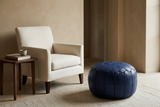

A Moroccan pouf is a low, traditionally handcrafted cushion or seat associated with Moroccan interiors and craftsmanship. Most commonly made from leather, it can be used as a footrest, occasional seat, low stool, or decorative accent. Its compact form, distinctive construction, and relationship to Moroccan craft traditions have made the leather pouf one of Morocco's best-known interior objects.
Although the terms Moroccan pouf, leather pouf, and Moroccan ottoman are often used interchangeably, they do not always describe exactly the same thing. Understanding what a Moroccan pouf is — and what distinguishes it from a generic ottoman — makes it easier to choose the right piece for your space.
What defines a Moroccan pouf?
The defining characteristic of a Moroccan pouf is its low, compact form. Unlike a conventional armchair or stool, a pouf has no back or arms and is designed to sit close to the floor.
Traditional Moroccan poufs are generally made from leather panels that are cut and assembled into a three-dimensional form. Depending on the style and workshop, the surface may be plain, embossed, tooled, embroidered, or decorated with geometric patterns.
Many leather poufs are fitted with a zipper on the underside. This allows the pouf to be transported flat and filled after arrival — a particularly practical feature when the piece is shipped internationally.
For a deeper look at Moroccan leather poufs — including their history, materials, craftsmanship, quality and authenticity — see our complete guide to Moroccan leather poufs.
What is a Moroccan pouf used for?
A Moroccan pouf is one of the most versatile pieces in a Moroccan-inspired interior. Its use depends largely on its size, shape, and firmness.
Footrest
A pouf is traditionally well suited to use as a footrest beside a sofa or armchair. Its low height makes it particularly comfortable for relaxing and creates a natural connection between seating and floor-level elements.
Occasional seating
When filled firmly, a leather pouf can also function as an occasional seat. It is best understood as low, flexible seating rather than as a replacement for a full-size chair or sofa.
Decorative accent
A pouf can also be used primarily as a decorative object. The leather surface, colour, stitching, embossing, or embroidery can introduce texture and Moroccan craftsmanship into a room without requiring a large piece of furniture.
Low table or tray stand
A firm, flat-topped pouf can support a tray and serve as a temporary low table for books, tea, or decorative objects. This use is particularly effective with square or rectangular forms.
Moroccan pouf vs. Moroccan ottoman
The words pouf and ottoman are often used interchangeably in online furniture retail, but they describe slightly different concepts.
Pouf generally refers to a low, soft or semi-firm seat without a back or arms. The term is widely used for compact floor-level pieces.
Ottoman is a broader furniture category referring to a low upholstered piece that can function as a footrest, seat, or occasional table.
A Moroccan leather pouf can therefore function as an ottoman, but an ottoman does not necessarily have anything Moroccan about it. It may be factory-made, upholstered in fabric, or designed in an entirely different tradition.
For a more detailed comparison of form, function, dimensions, and use, see Moroccan Pouf vs Ottoman: What's the Difference?.
What are Moroccan poufs made from?
Leather is the material most strongly associated with the traditional Moroccan pouf sold internationally. Depending on the style and workshop, different animal hides may be used.
Sheepskin can produce a softer and more supple surface and is commonly associated with certain rounded pouf styles.
Goatskin is valued for its fine grain, strength, and suppleness and is used across Moroccan leather craftsmanship.
Cowhide can provide a heavier and more structured material, particularly for larger or more substantial leather pieces.
The type and quality of leather affect the character, flexibility, appearance, and longevity of the finished pouf. For a detailed explanation of Moroccan leather quality and how to assess it, see our complete Moroccan leather poufs guide.
Embroidered and embossed Moroccan poufs
Moroccan poufs are available in a wide range of surface treatments, and these treatments can significantly change their appearance.
Embossed and tooled poufs
Embossed or tooled poufs feature patterns worked directly into the leather. Geometric, floral, arabesque, and other decorative forms can be created by pressing or working tools into the leather surface.
The result is generally more graphic and architectural, with the leather itself remaining the dominant visual element.
Embroidered poufs
Embroidered poufs introduce threadwork into the leather surface. Floral and geometric motifs can be stitched onto individual leather panels before those panels are assembled into the finished form.
The combination of leather and embroidery gives these poufs a more textile-like character and introduces additional colour and surface texture.
The specific techniques, materials, and regional traditions behind Moroccan leather decoration are explored in greater detail in our Moroccan leather poufs guide.
Do Moroccan poufs come stuffed?
Many Moroccan leather poufs are sold unstuffed. This is particularly common for pieces shipped internationally because the empty leather shell can be folded or compressed for transport, substantially reducing shipping volume and weight.
The zipper on the underside allows the buyer to fill the pouf after arrival. Common filling materials include cotton, wool fibres, fabric scraps, old clothing, or other suitable textiles.
The amount and type of filling determine how firm the pouf becomes. A pouf intended primarily as a footrest can be softer, while one intended for occasional seating should be filled more firmly.
What size is a Moroccan pouf?
There is no single standard size for a Moroccan pouf. Dimensions vary according to the shape, workshop, design, and intended use.
As a general reference:
- Round poufs: approximately 30–35 cm high and 38–42 cm in diameter.
- Square poufs: approximately 38–42 cm high and around 48–52 cm wide.
- Larger poufs and ottomans: dimensions vary considerably and are better suited to larger seating arrangements or use as low tables.
The final dimensions can also change slightly depending on how firmly the pouf is filled.
Why are Moroccan leather poufs so widely used in interiors?
The appeal of the Moroccan pouf lies partly in its versatility. It occupies little visual space, can be moved easily, and can perform several functions within the same room.
Its leather surface also introduces a natural material and handcrafted texture into contemporary interiors. Depending on the colour and decoration, a Moroccan pouf can complement minimalist, traditional, eclectic, Mediterranean, or contemporary spaces.
Rather than functioning only as a decorative symbol of Morocco, a well-made pouf can therefore work as a genuinely practical piece of furniture.
Choosing the right Moroccan pouf
The best pouf depends on how you intend to use it.
- For a footrest: choose a lower, comfortably filled pouf.
- For occasional seating: choose a firmer construction and adequate height.
- For a decorative accent: focus on the leather colour, surface treatment, embroidery, and proportions.
- For use beside a sofa: consider the height of your existing seating before choosing the pouf.
- For a low table: a firm square or rectangular form combined with a tray is usually the most practical option.
If you want to compare leather quality, construction, authenticity, and value before buying, continue to our complete guide to Moroccan leather poufs.
"The Moroccan pouf is a good example of how a craft object can become part of contemporary life without losing the qualities that made it useful in the first place. Its form is simple, its uses are many, and its character comes from the material and the hands that shaped it."