
A Moroccan leather pouf is one of the most versatile pieces in any home. It works as a footrest, extra seating, a side table, a floor cushion, and a sculptural object — often all in the same week. The question is not whether it fits your home. It is how to make the most of it.
Here are 10 ways to style a Moroccan pouf, with practical tips for each.
1. As a Living Room Footrest
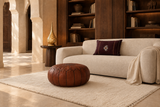
The most common use — and for good reason. A Moroccan pouf placed in front of a sofa or armchair gives you a comfortable footrest that doubles as a design statement. The key is proportion: a round pouf works best with a curved or low-profile sofa, while a square pouf pairs well with a structured, angular sofa.
Styling tip: Position the pouf slightly off-centre rather than directly in front of the sofa. It looks more relaxed and intentional.
Best for this use:
- Round Traditional Tabouret — the classic choice, works with any sofa style
- Square Lilya — structured and architectural, ideal with angular sofas
- Square Embossed — adds geometric texture to a neutral living room
- Tile Design — a statement piece that anchors the room
- Mosaic Design — rich surface detail, works as a focal point

2. As Extra Seating for Guests
A pouf is the most elegant solution to the perennial problem of not having enough seats. Unlike folding chairs or floor cushions, a leather pouf looks good when not in use — it is part of the room, not stored away in a cupboard.
Styling tip: Keep two matching poufs under a console table or beside a fireplace. They are invisible until needed, then pulled out instantly.
Best for this use:
- Blue of Marrakesh — round, compact, easy to move
- Flowers Design — decorative enough to display, practical enough to use
- ZigZag Design — graphic and contemporary, pairs well with modern interiors
- Round Traditional — lightweight and stackable in pairs
- Fuchsia Tabouret — a bold accent that doubles as a conversation piece

3. As a Coffee Table
A round pouf topped with a tray becomes a fully functional coffee table — and a far more interesting one than most. Use a round wooden tray, a brass Moroccan tray, or a simple slate board. Place a candle, a small plant, and a book on top.
Styling tip: The tray should be slightly smaller than the pouf's diameter so it sits securely without overhanging. A 35–40 cm tray works well on most standard round poufs.
Best for this use:
- Round Traditional Tabouret — flat top surface, ideal tray base
- Tile Design — the surface pattern makes the tray optional
- Mosaic Design — works beautifully as a standalone coffee table centrepiece
- Square Embossed — stable flat top, suits a rectangular tray
- Square Lilya — structured shape holds a tray without shifting

For a complete guide to using a leather ottoman as a coffee table replacement — sizing, tray selection, and full styling advice — see [Leather Ottomans: The Stylish Alternative to Traditional Coffee Tables →]
4. At the Foot of the Bed
A pouf at the foot of the bed adds warmth and texture to a bedroom without the bulk of a bench. It is particularly effective in smaller bedrooms where a full bench would feel heavy.
Styling tip: Choose a pouf colour that picks up a tone from your bedding or rug. A tan leather pouf works with almost any neutral bedroom palette; a fuchsia or blue pouf adds a deliberate accent.
Best for this use:
- Square Lilya — low profile, sits neatly at the foot of the bed
- Blue of Marrakesh — adds a jewel-tone accent to neutral bedding
- Rectangular Large Pouf — spans the full width of a double or king bed
- XL Ottoman — functions as a full bench replacement in larger bedrooms
- Square Embossed — pairs well with linen or cotton bedding in earthy tones

5. In a Reading Nook
A pouf is the natural companion to a reading chair. It gives you somewhere to rest your feet, set down a cup of tea, or stack a few books. In a bay window or alcove, a pouf and a good lamp are all you need to create a dedicated reading corner.
Styling tip: Layer a small wool throw over the pouf when not in use. It adds texture and makes the nook feel more inviting.
Best for this use:
- Round Traditional Tabouret — compact and comfortable underfoot
- Flowers Design — adds warmth and craft detail to a quiet corner
- ZigZag Design — graphic pattern adds visual interest without overwhelming a small space
- Fuchsia Tabouret — a pop of colour in an otherwise neutral reading nook

6. In a Child's Room or Playroom
A leather pouf is one of the few adult design objects that works equally well in a child's room. It is durable, easy to clean, low to the ground, and provides flexible seating for reading, playing, or watching a screen.
Styling tip: Choose a bold colour — fuchsia, blue, or a patterned embroidered pouf — that adds energy to the room without clashing with the rest of the decor.
Best for this use:
- Blue of Marrakesh — vibrant, durable, easy to wipe clean
- Fuchsia Tabouret — bold colour that children love
- Flowers Design — playful embroidery without being childish
- ZigZag Design — graphic and fun, works in a modern playroom
- Round Traditional — lightweight enough for children to move themselves

For the full case on why leather ottomans are a safer choice for families with young children — rounded edges, cushioned surface, stability — see [Why Leather Ottomans Are the Safer Choice for Families with Young Children →]
7. In a Home Office
A pouf in a home office serves as an informal visitor seat — far more welcoming than a second desk chair — and as a footrest during long working sessions. It also softens the typically hard-edged aesthetic of a workspace.
Styling tip: In a home office, keep the pouf in a neutral tone (tan, camel, or natural leather) so it does not compete visually with your work environment.
Best for this use:
- Round Traditional Tabouret — understated and professional
- Square Lilya — structured shape suits a desk environment
- Square Embossed — adds texture without colour distraction
- Tile Design — a quiet statement piece for a creative workspace

For a step-by-step guide to styling a pouf in a home office — positioning, palette, texture, and lighting — see [How to Style the Black Tabouret Pouf: Home Office vs. Living Room Guide →]
8. Grouped in Threes
Three poufs grouped together create a flexible seating arrangement that can be reconfigured for different occasions — casual gatherings, children's play sessions, or simply a more dynamic living room layout. This works particularly well in open-plan spaces and large living rooms where a single pouf would be lost.
Styling tip: Vary the heights slightly by mixing a standard round pouf with a taller tabouret-style pouf. The variation adds visual interest and makes the grouping feel curated rather than matched.
Combination ideas:
- Round Traditional + Square Lilya + Tile Design — a neutral, textured grouping that works in any interior
- Blue of Marrakesh + Fuchsia Tabouret + ZigZag Design — a bold, colourful cluster for an eclectic interior
- Square Embossed + Mosaic Design + Round Traditional — a craft-focused grouping that mixes surface techniques
- Three Round Traditional Tabourets in different colours — the simplest and most flexible grouping, easy to separate and reposition
9. On a Rug
A Moroccan pouf placed on a Moroccan rug is one of the most effective combinations in interior design — two handcrafted objects from the same tradition, each making the other look better. The rug grounds the pouf; the pouf anchors the rug.
Styling tip: If your rug is patterned, choose a plain or lightly embossed pouf. If your rug is plain or neutral, a more decorative pouf — embroidered or tile-patterned — adds the visual interest.
Best for this use:
- Tile Design — complements a plain Beni Ourain rug beautifully
- Flowers Design — pairs with a neutral kilim or flatweave rug
- Mosaic Design — works with a solid-colour rug as the hero piece
- Round Traditional — versatile enough to sit on any rug style
- ZigZag Design — pairs well with a plain or solid-colour rug

10. As a Standalone Sculptural Object
A well-made Moroccan pouf does not need to be used. It can simply exist in a corner, on a landing, or beside a fireplace as a sculptural object — a piece of craft that earns its place through beauty alone.
Styling tip: Place a single pouf in an unexpected location — the entrance hall, a bathroom, the top of a staircase landing. It signals that the space has been thought about.
Best for this use:
- Tile Design — the surface pattern is a work of art in itself
- Mosaic Design — maximum visual impact as a standalone object
- Blue of Marrakesh — the colour alone makes it a sculptural statement
- XL Rectangular Ottoman — commands a room as a centrepiece
- Square Embossed — architectural and refined, works in a hallway or landing

Choosing the Right Pouf for Your Space
Before styling, the right choice of pouf matters. Here is a quick guide:
Small Rooms
A Round Traditional Tabouret (45–50 cm diameter) keeps the space light and flexible.
Large Rooms
A Rectangular XL Ottoman or Square Lilya creates more visual weight and presence.
Neutral Interiors
Use a bold pouf (Blue of Marrakesh, Fuchsia Tabouret) as your accent piece.
Already Colourful Interiors
Choose tan, camel, or natural leather to ground the space.
Pattern Lovers
Tile Design, Mosaic, ZigZag, or Flowers add craft detail without adding colour.
Families with Children or Pets
Full-grain leather is the most durable and easiest to clean. The Round Traditional and Square Lilya are the most hardwearing.
Frequently Asked Questions
How do I style a Moroccan pouf in a small room?
Choose a Round Traditional Tabouret in a neutral colour. Position it beside a chair or sofa rather than in the centre of the room. When not in use, tuck it under a console table or side table to free up floor space.
What is the difference between a Moroccan pouf and an ottoman?
A traditional Moroccan pouf is round, hand-stitched, and filled with natural materials. An ottoman is typically larger, rectangular, and may have a rigid frame. Moroccan Corridor® offers both — from compact round tabouret poufs to XL rectangular ottomans — all handmade in Morocco.
How many poufs should I have in a living room?
One pouf works as a footrest or accent piece. Two poufs create a balanced arrangement on either side of a coffee table. Three or more poufs grouped together create a flexible seating cluster. The right number depends on the size of your room and how you use the space.
What colours work best with a Moroccan pouf?
Tan, camel, and natural leather poufs work with almost any interior palette. Bold colours (blue, fuchsia, burgundy) work best as deliberate accent pieces in otherwise neutral rooms. Patterned poufs (Flowers, Tile Design, ZigZag, Mosaic) work best when the surrounding decor is relatively calm.
Do Moroccan poufs get better with age?
Yes — full-grain leather develops a patina over time, becoming richer and more characterful with use. Scratches and marks that appear with regular use tend to blend into the leather surface rather than standing out. This is one of the qualities that makes a genuine Moroccan leather pouf a long-term investment rather than a disposable purchase.