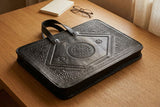

Cover image: original AI-generated Moroccan Corridor® editorial composition using a catalogue pouf as reference. Not Claudio Bravo’s home, collection or artwork.
Chilean painter Claudio Bravo (1936–2011) lived and worked in Tangier from 1972 and later made a home near Taroudant. The leather poufs, babouches and ceramics associated with him are documented in auction records and exhibition catalogues, and several appear in or echo the titles of his paintings. This essay follows those objects, keeping what is documented separate from what we interpret.
On this page
From Tangier to Taroudant: A Life Among Objects
Born in Chile in 1936, Bravo lived and worked in Tangier beginning in 1972, according to the Museum of Modern Art’s artist record. He died in Taroudant in 2011. These dates frame a long relationship with Morocco, not a passing encounter.
His former home near Taroudant now brings together the artist’s residential spaces, studio and collections within a palais-musée. Yet the house is best approached as one part of a larger story. The objects associated with Bravo also survive in paintings, exhibition records and the documentation of his collection.
These sources allow us to move beyond the broad statement that Morocco inspired him. They make it possible to name things: a group of white leather poufs, embroidered babouches, a collection of old Moroccan ceramics. Specific objects give that relationship substance.
They also keep the discussion grounded. A Moroccan setting does not make every object Moroccan, and ownership does not establish that an object appears in a particular painting. Where a connection is documented, however, it opens a compelling passage between the room and the canvas.
The Leather Pouf: More Than a Background Detail
The leather pouf provides an unusually clear example. Christie’s catalogued a group of six Moroccan white leather poufs together with a pair of Bravo’s white leather babouches. Its accompanying essay identifies paintings in which the babouches and round poufs appear, including El Guardián y su Hijo (1979), Padre e Hijo (1989) and Gandoura Rosa (1995).
This is more than a general resemblance between a painted furnishing and a familiar Moroccan form. It is a documented relationship between objects from the artist’s surroundings and subjects in his work.
The catalogue of the 2004 exhibition Claudio Bravo y Marruecos also lists Pouf rojo. Even at the level of its title, the work offers a useful counterpoint to the white poufs: the object could be named as a subject, rather than remaining an anonymous furnishing in an interior.
For a reader familiar with the pouf as a footrest or occasional seat, this changes the question. Instead of asking only what the object does, we can ask how its shape becomes available to painting. The practical object and the pictorial subject coexist; one does not need to cancel the other.
Our guide to Moroccan leather poufs approaches the object through materials, construction and use. Bravo’s work offers another route: the same family of objects encountered through the attention of a painter.
Babouches: An Everyday Object, Repeated
Babouches extend this connection between leatherwork, collecting and painting. A separate Christie’s lot records a large collection of Moroccan leather and embroidered babouches displayed by colour on a pine rack. It also describes framed reproductions associated with paintings of babouche displays. The exhibition catalogue lists a work titled Babuchas.
The distinction between a pair and a collection matters. A pair belongs to the scale of the body and an individual’s use. An assembled group introduces another way of encountering the object: through repetition, differences and relationships between colours.
This does not tell us what Bravo intended each shoe to mean. It does give us a concrete basis for considering how a familiar object can become part of a larger arrangement. The collecting and ordering are documented; any interpretation of their pictorial effect must begin with the individual painting.
For an article about Moroccan craft, the babouches are therefore not an incidental accessory. They broaden the discussion beyond furnishings and remind us that objects worn on the body can belong to the same field of attention as objects placed in a room.
Moroccan Ceramics: Between Collection and Still Life
Ceramics provide perhaps the strongest institutional evidence of Bravo’s engagement with Moroccan craft. In 2004, the Institut du monde arabe presented an exhibition devoted to his collection of old Moroccan ceramics. Its description identifies a rich group of urban earthenware forms and decoration, largely associated with culinary use.
The institution explicitly framed the exhibition around the relationship between an artist and objects produced within a centuries-old craft tradition. This places the collection within a documented cultural context, rather than treating it simply as the decoration of a celebrated home.
The catalogue of Claudio Bravo y Marruecos lists works including Cerámica verde, Cerámica de Fez and Tres cerámicas. These titles establish ceramics as named subjects in his work. They do not, on their own, identify the provenance of every vessel or connect each painted piece to a surviving object.
Another documented example is Berber Still Life (2001), the title used in Christie’s catalogue. Its essay discusses ceramics among the objects that situate the composition in North Africa. Here, a vessel’s household associations become part of a still life without exhausting what the painting can do with it.
The collection and the paintings offer two ways of attending to a material world. One brings objects together physically; the other selects and represents. Keeping those activities distinct makes the relationship between them more interesting, not less.
Cloth and Clothing: Looking at the Fold
Clothing adds a different material register. Works cited in the Christie’s documentation include Gandoura Rosa (1995) and Djellabas verdes y azules (1994). Alongside leather objects and ceramic vessels, these titles bring garments into the discussion.
There is a broader context for this interest in fabric. Forum Gallery’s account of Bravo’s work describes his sustained engagement with the textures and subtle colours of paper and cloth, beginning in the early 1960s. His attention to such materials therefore predates his Moroccan years.
This matters because it prevents a reductive reading. Morocco should not be presented as the single explanation for every fold or surface in his paintings. A longstanding artistic concern could meet a particular garment, object or setting without beginning there.
Nor should the presence of a garment lead us to assign it an unverified fibre, weaving technique or regional origin. The sounder approach is to begin with the identified work and let close observation lead the discussion. Precision is more valuable here than a broad claim about Moroccan textiles as a whole.
Near Taroudant: A House That Holds These Worlds Together
The palais-musée near Taroudant offers a physical setting in which to bring these threads together. The regional tourism source Visit Agadir places it approximately eight kilometres from the city, at the foot of the High Atlas, and describes residential spaces, workshops, artworks and old Moroccan ceramics.
Its interest for this story is not simply that an artist once lived there. It is the proximity of different activities: living with objects, collecting them and making art. These are connected pursuits, but the house need not be read as a direct explanation of every canvas.
It is also important not to assume that every possession recorded in historic auction catalogues remains at the museum. The documented collection and the present visitor experience are not interchangeable inventories.
For a visit, consult the Palais Musée Claudio Bravo website directly for current arrangements. This essay follows the objects and their documented connections rather than attempting to serve as a practical museum guide.
Looking Before Decorating
What can this bring to the way we live with objects today? Not a formula for recreating Bravo’s house, and not a claim that owning a similar pouf or vessel reproduces an artist’s vision.
Something quieter is available: the decision to look before assigning an object a decorative role. A pouf can be considered for its volume as well as its usefulness. A ceramic vessel can be approached through its form before its placement on a shelf. A garment can be noticed as cloth before being reduced to a cultural emblem.
At Moroccan Corridor, this is the most useful connection between an artistic subject and the objects we select. Craft deserves more than an atmospheric label. It deserves specific attention to material, construction, origin and the limits of what we know.
Bravo’s Moroccan years offer a compelling starting point for that attention. The records name objects, collections and paintings. Our task as viewers is not to turn them into a single explanation, but to notice the relationships without erasing the differences.
Before deciding where an object belongs in a room, we can take time to see what is already there.
Frequently Asked Questions
Who was Claudio Bravo, and what was his connection to Morocco?
Claudio Bravo was a Chilean painter born in 1936. He lived and worked in Tangier from 1972, later made a home near Taroudant, and died there in 2011. His Moroccan years are traceable through the objects he lived with, collected and painted.
Which Moroccan objects are linked to his paintings?
Christie’s documents a group of white leather poufs and white leather babouches that its catalogue essay connects to several paintings. His collection of old Moroccan ceramics was shown at the Institut du monde arabe in 2004, and works such as Berber Still Life (2001) feature ceramics.
Where is the Claudio Bravo museum?
The palais-musée is near Taroudant, approximately eight kilometres from the city at the foot of the High Atlas, according to Visit Agadir. Historic auction records should not be treated as an inventory of its current contents. Consult the museum’s website for current visiting arrangements.
The editorial notebook
Sources and References
This essay distinguishes documented ownership and catalogue information from Moroccan Corridor’s editorial interpretation. Artwork titles follow the cited sources; spellings can vary between catalogues.
-
Museum of Modern Art: Claudio Bravo
Artist record and biographical context. -
Christie’s: A Collection of Six Moroccan White Leather Pouffes
Collection record and discussion of paintings. -
Christie’s: A Large Collection of Moroccan Leather and Embroidered Babouches
Collection record. -
Institut du monde arabe: Céramiques marocaines, la collection de Claudio Bravo
2004 exhibition. -
Claudio Bravo: Claudio Bravo y Marruecos
Exhibition catalogue listing. -
Christie’s: Berber Still Life
Painting dated 2001 and accompanying catalogue essay. -
Forum Gallery: Claudio Bravo
Exhibition text on paper and fabric. -
Visit Agadir: Souss-Massa’s Museums
Claudio Bravo Museum and regional context.