
There is something quietly insistent about a zigzag pattern. It does not ask for attention — it earns it. The zigzag has deep roots in Moroccan decorative culture: it appears in the symbolic vocabulary of Amazigh weaving across the Atlas, and in the geometric logic of zellige, the hand-cut ceramic mosaic tradition that has shaped Moroccan interiors since the eleventh century. When that geometry wraps a pouf, it brings more than decoration into a room. It brings a thousand years of logic.
Here is how to let it work.
1. Anchor It in a Neutral Field
A zigzag pouf carries its own visual energy. The most effective interiors give it room to breathe — a jute rug, a linen sofa, raw plaster walls. Neutrals do not compete; they amplify. Place the pouf at the foot of a bed or beside a reading chair and let the geometry do the talking.
What to avoid: pairing with another strongly patterned textile at the same scale. Two competing rhythms cancel each other out.

2. Read the Palette Before You Place It
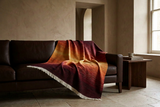
Moroccan zigzag poufs are rarely monochrome. Look closely at yours: the secondary tones woven into the chevron — ochre, rust, ivory, charcoal — are your palette cues. Pull one of those tones into a throw, a cushion, or a ceramic object nearby. This creates visual coherence without matching.
A pouf in natural undyed wool with black zigzag lines pairs naturally with aged brass, dark wood, and matte terracotta. One in bolder polychrome works well against whitewashed surfaces where the color can expand.

3. Use It as a Transitional Piece
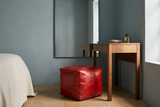
The pouf is one of the few objects that moves between rooms without losing its logic. In a living room, it functions as a footrest or occasional seat. In a bedroom, it grounds the foot of the bed. In an entryway, it offers a moment of pause — somewhere to sit while removing shoes, and something worth looking at while doing so.
The zigzag pattern, with its directional energy, suits transitional spaces particularly well. It implies movement without creating restlessness.

4. Layer It Into a Textile Conversation
If you already have a Moroccan rug in the room, the pouf becomes part of a larger textile dialogue. The key is scale contrast: a fine-weave kilim on the floor reads differently from a chunky hand-stitched pouf beside it, even if both carry geometric motifs. That contrast — flat versus volume, fine versus coarse — is what gives the room depth.
The zigzag motif connects the pouf to a broader Moroccan geometric tradition — one that runs from zellige tilework to Amazigh weaving. Placing it alongside other crafted objects from that tradition deepens the conversation rather than crowding it.
If the rug and pouf share a similar motif family (chevron, lozenge, stripe), keep the colorways distinct. Tonal variation within a motif family is sophisticated. Exact repetition reads as a set — and sets rarely feel collected.

5. Let It Stand Alone
Not every room needs layering. A single zigzag pouf on a bare concrete or hardwood floor, beside a low bench or a stack of books, is a complete statement. The restraint is the point. In a spare interior, the pouf becomes the object — the one thing in the room that carries warmth, texture, and cultural weight simultaneously.
This is where the handmade quality matters most. The slight irregularities in the stitching, the variation in the wool — these are not imperfections. They are the proof of the hand, and in a minimal room, they are everything.

A Note on Provenance
A zigzag pouf made in Morocco by hand is not the same object as one that borrows the aesthetic. The pattern has roots. The wool has a source. The hands that shaped it belong to a specific tradition of craft. When you place it in your home, you are not just styling a room — you are extending a chain of making that stretches back generations.
That is worth knowing. And worth showing.
Explore our collection of handmade Moroccan poufs →
Frequently Asked Questions
What is a zigzag pouf?
A zigzag pouf is a handmade Moroccan leather or wool pouf decorated with a chevron or zigzag pattern — a motif with deep roots in Amazigh weaving and Moroccan geometric decorative traditions including zellige tilework. At Moroccan Corridor, zigzag poufs are hand-stitched by Moroccan artisans using traditional techniques.
Where should I place a zigzag pouf in my home?
A zigzag pouf works in any room: as a footrest beside a reading chair or sofa in a living room, at the foot of a bed in a bedroom, or as a functional decorative object in an entryway. Its directional pattern suits transitional spaces particularly well.
How do I style a zigzag pouf with a Moroccan rug?
Pair a zigzag pouf with a Moroccan rug by playing on scale contrast rather than pattern matching — a flat-weave kilim on the floor reads differently from a chunky hand-stitched pouf beside it. If both carry geometric motifs, keep the colorways distinct. Tonal variation within a motif family is sophisticated; exact repetition reads as a set.
What colors work best with a zigzag pouf?
Look at the secondary tones in the chevron pattern itself — ochre, rust, ivory, charcoal — and pull one of those into a nearby throw, cushion, or ceramic object. Neutrals (linen, raw plaster, jute) amplify the pattern without competing with it.
Is a handmade Moroccan zigzag pouf different from a factory-made one?
Yes — significantly. A handmade Moroccan zigzag pouf is hand-stitched by artisans using traditional techniques, with slight irregularities in the stitching and wool that are marks of authenticity, not defects. Factory-made poufs that borrow the aesthetic do not carry the same material quality, craft provenance, or longevity.
What is the meaning of the zigzag motif in Moroccan craft?
The zigzag appears across Moroccan decorative traditions — in the symbolic vocabulary of Amazigh weaving across the Atlas Mountains, and in the geometric logic of zellige, the hand-cut ceramic mosaic tradition. It implies movement and is associated with water and continuity in Amazigh symbolic systems.