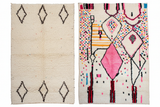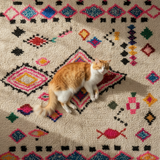

Flat-woven kilims are generally the simplest to maintain and suit high-traffic rooms. Low- to medium-pile rugs offer more texture, while deep-pile Beni Ourain rugs provide greater softness for bedrooms and quieter living areas. The right choice depends on the room, the weave, the rug’s actual construction, and the care you are prepared to give it.
Pile height is usually described in inches. In a Moroccan rug, it is better described in generations.
The depth of the wool is not simply a design choice made for comfort or marketing. It is the trace of a gesture — a knot, tied and cut, repeated thousands of times across a loom — that varies from one region to the next, from one weaving tradition to another. Before you think about traffic zones and vacuum settings, it helps to understand where that pile actually comes from.
For a broader view of traditions, rooms, interior styles, and sizing, see our Moroccan Rugs guide.
Why Moroccan Rugs Don't Fit the Standard Pile Chart
Most pile height guides sort rugs into three neat categories: low, medium, and high. The system works reasonably well for machine-made rugs, where pile depth is set by a machine and held constant across every inch of the surface.
Moroccan handwoven rugs follow a different logic entirely.
The pile in a Moroccan rug is influenced by the knot — its type, its tightness, the thickness and preparation of the wool strand, and the number of passes between rows. The technique behind each weaving tradition — flat-woven, knotted, or looped — helps determine pile depth. Wool preparation and handwork also vary from one region and individual piece to another, which is why a specification sheet cannot describe every surface completely.
This is why understanding pile in Moroccan rugs requires a different framework — one rooted in weaving tradition rather than fibre length. For a full overview of Moroccan rug types and their construction methods, see our Field Guide to Moroccan Rug Techniques & Traditions.
Flat-Woven: No Pile, Total Precision
Before reaching high pile, it helps to start at zero.
Kilims, Zanafi rugs, and Hanbel blankets are flat-woven — meaning they have no raised pile. Rather than knotted fibres rising above the surface, the pattern is formed entirely by the interlacing of warp and weft threads. The result is a rug that lies flat, with a firm, precise feel underfoot and a geometric design that often reads with remarkable sharpness. The full technical detail of how flat-weaving differs from knotted construction is covered in our Field Guide to Moroccan Rug Techniques & Traditions — what matters here is what that absence of pile means for everyday use.
Flat-woven Moroccan rugs are often a practical choice for busy areas because there is no raised pile to compress and less depth for loose debris to enter. Their durability still depends on the quality of the weave, the fibre, the finishing, and daily care. They slide easily under furniture, work well in dining rooms where chairs are pulled in and out repeatedly, and can layer beneath a higher-pile rug in a living room or bedroom.
If durability and ease of maintenance are priorities, the flat-woven tradition is the right place to start.
→ See: Rug Layering 101: How to Pair a Kilim with a Pile Rug
Low to Medium Pile: Azilal, Boucherouite, and the Colour Traditions
Moving up from flat-woven, the Azilal rug occupies a distinct register. Woven in the valleys of the High Atlas south of Marrakech, Azilal rugs often feature a short to medium pile — dense enough to give the surface warmth and texture, but low enough that the geometric and abstract patterns can remain crisp. Individual rugs vary in pile height, density, and wool preparation.
The pile in an Azilal rug is rarely perfectly even. The wool — often a mix of natural and hand-dyed fibre — can produce subtle variations in height that give the surface a slightly irregular, breathing quality. This is not automatically a defect. It is one of the visible consequences of handwork, alongside the overall integrity of the weave.
Boucherouite rugs are woven from recycled textile scraps rather than a single standard wool yarn. Their fibre content, surface, and pile can vary considerably — cotton, synthetic fibres, wool, or combinations of these materials may be present. The resulting surface is often uneven, tactile, and entirely one of a kind, but its durability and care requirements depend on the particular piece.
Azilal and some Boucherouite pieces can work well in living rooms, home offices, and spaces with moderate traffic. They require more attention than a simple flatweave, but generally less pile management than a deep-pile rug.
→ See: Beni Ourain or Azilal? How to Choose the Right Moroccan Rug for Your Living Room
High Pile: The Beni Ourain Standard
The Beni Ourain rug is perhaps the most internationally recognised Moroccan weaving tradition — and the one most closely associated with a deep, generous pile.
Woven by Amazigh women of the Beni Ourain confederation in the Middle Atlas mountains, traditional examples are often made from natural, minimally processed wool in ivory or cream tones, sometimes with natural brown or black geometric motifs. The knotting, wool preparation, and pile depth vary between pieces. Some examples reach approximately one to one and a half inches in depth, but a nominal measurement should never replace inspection of the actual rug.
The deep pile of traditional Beni Ourain rugs has a practical history connected to the cold climate of the Atlas. These textiles served as insulation and bedding as well as floor coverings. Contemporary pieces vary in wool preparation, density, and finish, so the origin of the tradition is useful context but not a guarantee of identical performance.
This origin still helps explain how a deep-pile Beni Ourain rug may be lived with today. Heavy traffic can compress the pile over time, and direct sunlight can affect natural wool and dyes. A bedroom, a reading room, or a quieter corner of a living room may allow its softness and texture to be appreciated with less accelerated wear.
→ See: Beni Ourain Rugs: Origin, Making Process, and How to Use Them Today
→ See: How to Clean a Moroccan Rug: A Step-by-Step Care Guide
Pile and Authenticity: What the Depth of the Wool Tells You
There is one thing a pile height chart cannot tell you: whether the pile in front of you was made by a machine or by a person.
Industrial rugs marketed as "Moroccan style" may feature a high pile that is soft, uniform, and consistent across the surface. A handmade rug can also have a carefully finished surface, so pile variation alone is not proof of authenticity. It is one clue that should be considered alongside the reverse side, knot structure, materials, finishing, provenance, and overall construction.
In a genuine handmade Moroccan rug, small variations may be visible. Running your hand across the surface can reveal subtle changes in density or softness. The knots may not all have the same tension, and the wool strands may not all have the same diameter. These micro-variations can be evidence of the hand, but they should be read together with the other physical characteristics of the piece.
When assessing a Moroccan rug, an overly uniform pile is worth examining rather than automatically rejecting. Authenticity lives in the relationship between the material, the technique, the irregularities, and the documented origin.
→ See: How to Recognize an Authentic Berber Rug
→ See: Real or Fake? The Anti-Scam Guide to Buying an Authentic Berber Rug
Practical Guide: Which Pile for Which Room
The room should guide the pile decision as much as the visual style. Our Moroccan Rugs guide brings together interior style, room placement, and sizing advice; the table below focuses specifically on texture and maintenance.
| Pile type | Moroccan rug tradition | Best placement | Traffic | Care level |
|---|---|---|---|---|
| Flat / no pile | Kilim, Zanafi, Hanbel | Entryway, kitchen, dining room, layering base | High | Low to moderate |
| Low–medium | Azilal and some Boucherouite pieces | Living room, home office, children's room | Moderate | Moderate |
| High | Beni Ourain, some Mrirt pieces | Bedroom, reading nook, lower-traffic living area | Low to moderate | Attentive |
One practical note: rugs in the high-pile category benefit from rotation every few months to distribute wear evenly and prevent localised flattening. A quality rug pad beneath any pile type can improve stability and help protect both the rug and the floor beneath it.
→ See: Moroccan Rugs for Homes With Kids and Pets: What to Choose
Frequently Asked Questions
What is the pile height of a Beni Ourain rug?
Authentic Beni Ourain rugs often have a generous pile, sometimes measuring between one and one and a half inches. Because they are handmade from natural wool with variations in knotting and preparation, the pile tends to be slightly uneven and more variable than a machine-made equivalent at the same nominal height.
Are Moroccan rugs good for high-traffic areas?
It depends on the tradition and the individual piece. Flat-woven Moroccan rugs — kilims, Zanafi, Hanbel — are often practical for high-traffic zones because they have no raised pile to compress. High-pile rugs like Beni Ourain may be better suited to lower-traffic spaces where their texture and warmth can be appreciated with less accelerated wear.
How does pile height affect rug cleaning?
Flat-woven rugs are often the simplest to maintain because surface debris has less depth to enter. Low to medium pile rugs require regular vacuuming and occasional rotation. High-pile rugs like Beni Ourain need more careful attention — vacuum with a low-suction setting, avoid rotating brushes that can pull the fibres, and address spills promptly.
Can you layer a high-pile Moroccan rug with a kilim?
Yes — but with care. Placing a high-pile rug on top of a kilim can create an unstable surface that shifts underfoot. The reverse — a kilim layered over a high-pile rug as a base — may be more stable and visually effective. A rug pad between layers can add grip and protect both pieces.
Explore the full Moroccan Corridor rug collection — handwoven pieces selected from Moroccan weaving traditions and sourced as directly as possible from the communities that made them.
→ Use the Moroccan Rugs guide to compare styles, rooms, traditions, and sizes
→ Shop Moroccan Rugs
→ Moroccan Berber Rugs: A Complete Guide to Every Style and Origin
→ Moroccan Rug Types — A Field Guide to Techniques & Traditions