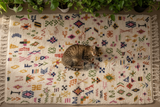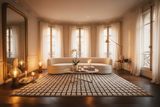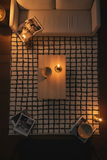

Choose a rug large enough for every chair to remain on it when pulled away from the table. A flat-woven kilim is often the most practical choice, while a low-pile or vintage Moroccan rug can add warmth and pattern without making the chairs difficult to move.
A dining-room rug has to do more than look good beneath the table. It has to support movement, tolerate repeated chair movement, and give the table a clear visual setting without narrowing the room around it.
The dining-room rug should connect the table and the chairs, not simply sit beneath the table. When the chairs remain supported as they move, the rug becomes part of the room's architecture rather than a decorative island.
For broader guidance on Moroccan rug traditions, rooms, and sizing, see our Moroccan Rugs guide. For general room-by-room measurements, read our Moroccan rug sizing guide.
Start with the Chairs, Not Just the Table
The most common dining-room rug mistake is measuring the table and forgetting the chairs. A chair needs to remain on the rug when it is pulled out for someone to sit down. Measure from the table edge with the chairs in their usual pulled-out position, not only when they are pushed underneath.
As a practical starting point, allow roughly 60 cm of rug beyond every side of the table. The exact amount depends on the depth of the chairs, the shape of the table, the room's circulation, and the actual dimensions of the handmade rug.
Before buying, use painter's tape to mark the proposed rug footprint on the floor. Pull out every chair and check the doors, walkways, sideboards, and clearance around the table.
Choosing the Right Size
Small dining tables
A small round or square table can work with a compact rug, provided the chairs remain fully supported when pulled out. Avoid choosing a rug that only frames the table legs while leaving the chairs on bare floor.
Tables for four
A rectangular table for four often needs more length than expected because the chairs at the ends move beyond the table footprint. Mark the chairs' movement before choosing a standard size.
Tables for six
An 8 × 10 ft rug is a common starting point for a table seating six, but the table and chair dimensions should decide the final choice. A rug that is slightly generous usually gives the dining group a stronger visual connection, provided it does not block a door or reduce the walking path.
Large tables and open-plan rooms
A larger table or an open-plan dining area may need a 9 × 12 ft rug or a vintage piece close to those proportions. Leave enough visible floor beyond the rug to separate the dining area from the kitchen or living room without making the room feel divided.
Why Kilims Work So Well in Dining Rooms
A flat-woven kilim has no raised pile, which can make it easier for dining chairs to move across the surface. Its firm structure also keeps the table visually grounded without adding too much height beneath the chairs.
Kilims are not automatically maintenance-free. Care still depends on the fibre, weave, finishing, and daily use of the individual piece. Use a suitable rug pad to improve stability and protect the floor.
A kilim can also bring a sharper geometric language to a dining room built around wood, plaster, stone, or simple upholstered chairs. If the kilim has strong pattern, keep the tableware and surrounding textiles relatively quiet.
Low-Pile and Vintage Moroccan Rugs
A low- or medium-pile Moroccan rug can bring more softness and texture than a kilim while remaining easier to live with than a deep-pile rug beneath dining chairs. Check the pile height at the edges and under the table before deciding.
A vintage rug can work beautifully in a dining room because slight variation and softened colour allow it to sit comfortably with both old and contemporary furniture. Look at the actual dimensions, fringe placement, reverse side, and surface condition rather than relying only on a standard size label.
For more on how pile affects texture, comfort, movement, and maintenance, read our guide to pile height in Moroccan rugs.
Match the Rug to the Table
A Moroccan rug can either echo the table or create a deliberate contrast. A warm Boujad or faded vintage rug can reinforce a walnut or dark wood table. An ivory Beni Ourain can soften a black table or a room with strong architectural lines, although its deeper pile should be checked carefully for chair movement.
A colourful Azilal or Boucherouite can become the focal point beneath a simple table. Keep the chairs and larger surrounding surfaces calm enough for the rug's colour and composition to remain legible.
When the table is already visually strong, a quieter kilim or neutral rug may create a more settled room. The goal is not to match every object, but to establish a relationship between the table, the rug, and the surrounding floor.
Keep the Room Easy to Move Through
Dining rooms need more circulation than a static furniture photograph suggests. Check the route from the kitchen, the nearest door, the space behind the chairs, and the distance to any sideboard or cabinet.
The rug should not catch under chair legs, create a raised edge in a walkway, or stop a door from opening. If the rug has fringe, allow enough clearance beyond the table and chairs for it to remain visible without becoming a tripping point.
Care and Everyday Use
Dining rugs live close to food, liquids, chair movement, and repeated foot traffic. Blot spills immediately with a clean cloth and avoid rubbing a stain deeper into the fibre. Vacuum regularly according to the rug's pile and construction, and rotate it periodically to distribute wear.
A low-profile rug pad can improve grip and reduce movement. Avoid thick padding that makes chairs unstable or changes the level of the table unexpectedly.
Common Dining-Room Rug Mistakes
- Measuring only the tabletop: include every chair when pulled out.
- Choosing a rug that is too narrow: a rug should support the dining group, not only the table legs.
- Ignoring chair movement: test the chairs on the taped footprint before buying.
- Using a deep pile without checking clearance: the chairs must remain stable and easy to move.
- Forgetting doors and walkways: the dining rug must work with the entire room, not only the table.
Frequently Asked Questions
How much bigger should a dining-room rug be than the table?
Allow roughly 60 cm of rug beyond every side of the table as a practical starting point. The exact margin depends on the chairs, table shape, room circulation, and the actual dimensions of the rug.
Should all dining chairs stay on the rug?
Yes. When chairs are pulled out, all four legs should remain on the rug. This keeps the chairs stable and prevents them from catching on the edge of the rug as people sit down.
Is a kilim a good rug for a dining room?
Often, yes. A flat-woven kilim has a lower profile that can make chairs easier to move, while its geometric pattern can add structure beneath a dining table. The individual weave and fibre still determine its care requirements.
Can I use a high-pile Moroccan rug under a dining table?
You can, but it may be less practical. A high pile can make chairs harder to move and may compress beneath repeated use. A kilim or low-pile rug is often easier for a busy dining area.
What size rug is best for a dining table for six?
An 8 × 10 ft rug is a common starting point, but the final size depends on the table, chair depth, room proportions, doors, and circulation. Mark the footprint with painter's tape before buying.
Use the Moroccan Rugs guide to compare traditions, rooms, sizes, and interior styles before choosing the piece that belongs beneath your dining table.