
In brief
Orange can belong in a contemporary interior without turning the room into a period reference. Give it a clear role, pair it with deliberate furniture lines, and leave enough visual space for the object’s shape and material to register. A handmade piece does not need a matching decorative theme: its leather, weave, seams, or embroidery can provide the detail within a quieter composition.
Orange does not arrive with a decade attached. Its surroundings supply the associations: the furniture profile, the neighbouring colours, the patterns, and the way those elements accumulate.
A leather pouf beside a simple chair can feel entirely different from the same pouf surrounded by competing prints and a coordinated suite of orange objects. Neither arrangement is inherently better. They simply tell different stories.
This guide is for the room that wants warmth and handmade character without an intentionally retro look. For the earlier decision between a coloured surface and a coloured object, see Orange Paint, Furniture, or Accessories? How to Choose. For the colour’s associations rather than its composition, read What Does Orange Symbolize in Interior Design?.
Change the Context, Not Necessarily the Orange
If an orange object feels more retro than you intended, examine what is reinforcing that impression. It may be the repeated colour, a strong neighbouring pattern, or a cluster of furniture and accessories that all point towards the same period.
No single combination proves a room is retro. Orange with brown, for example, can be restrained and contemporary when the forms are clear and the composition is considered. Walnut, orange leather, and a pale woven surface need not become a nostalgic scheme.
Nor does choosing a muted shade automatically solve the problem. Rust can sit within a period-inspired room; a brighter orange can work as one precise interruption in a quiet contemporary setting. Shade matters, but it does not work independently of scale, shape, and context.
Before replacing the orange piece, temporarily remove one nearby patterned textile or repeated accent. Then look again from the doorway. You may need less reinforcement around the object, not a different object.
Let Furniture Lines Do Some of the Work
A clear furniture silhouette gives the eye a structure against which to read colour. This does not require every piece to be angular. A rounded chair can be quiet; a rectangular cabinet can be visually busy. Look at the outline and the details together.
With an orange pouf, consider the neighbouring chair as part of the composition. A restrained chair profile allows the pouf’s curved volume and stitched construction to remain visible. Leave a readable interval between the two rather than packing the pouf into the chair’s footprint.
For a woven orange cushion, the sofa supplies the larger outline. One elongated cushion against a relatively uninterrupted seat can read as a deliberate horizontal element. Several different cushion shapes, motifs, and colours create a more layered composition, which may be exactly what you want, but is a different decision.
Contemporary does not mean empty. It means the arrangement need not rely on a coordinated historical vocabulary to make sense. An inherited chair and a handmade textile can coexist when their proportions and practical positions work.
Build Contrast Without a Matching Set
Begin with the colours already occupying the largest surfaces. The floor, sofa, curtains, and walls are part of the palette even if you think of them as neutral. A warm cream and a cool grey will not frame the same orange in quite the same way.
A Pale Ground With One Warm Volume
Chalk, cream, or a pale mineral tone can give an orange object a clear outline. Keep the ground varied enough to feel inhabited: a woven rug, the grain of wood, or a matte ceramic surface can supply interest without adding another strong colour.
The aim is not an all-white room with an isolated novelty. It is a composition in which one warm volume has a reason to be there.
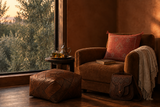
The opening illustration shows this relationship through the round embroidered orange leather pouf: its curved outline and stitched panel geometry introduce detail against the cream sofa, pale rug, and simple wooden table. The quieter surroundings allow the leatherwork to register without turning the room into a matching decorative theme. The product is supplied unfilled and measures approximately 53 cm in diameter by 32 cm high; check the footprint and plan the filling for its intended use. The illustration is a styling reference, not a guide to exact product colour or scale.
Orange With Darker Structure
A dark timber table or a restrained charcoal element can provide a visual counterweight. It need not be repeated in every lamp, frame, and handle. Assess the balance from the whole-room view rather than trying to match each orange object with a dark partner.
Dark surroundings can also produce an intimate, quieter setting. Check that the object’s outline and surface remain readable under the room’s usual lighting, rather than assuming darker always means more sophisticated.
Orange With Another Colour
Green or blue can sit alongside orange, but the relationship depends on the exact shades and their visible areas. An orange cushion against a broad muted green sofa is not the same composition as equal blocks of saturated green and orange.
If you want a restrained result, let one colour carry the larger area and the other remain more local. You do not need to repeat both throughout the room to make the combination intentional.
Give Handmade Materials Room to Speak
The interest of a handmade object is not limited to its colour. A leather surface has grain, joins, and changes in reflected light. A woven surface has yarn, relief, and transitions between its ground and its decoration.
Those details can coexist with modern furniture because they offer a different kind of information. The larger furniture supplies an outline; the smaller object supplies a closer reading.
Allow the actual construction to guide the styling. If a cushion has embroidery, it may not need a patterned throw directly behind it. If a pouf has prominent stitched panels, a quieter neighbouring textile can help those seams remain visible.
Do not turn texture into a formula either. Not every handmade piece belongs beside linen, and not every leather object needs brass. Choose the neighbouring material for what it contributes: contrast, softness, practical comfort, or a clearer view of the object.
Material and construction vary between pieces. Read the individual product details and care instructions; “handmade” is not a substitute for knowing what an object is made from or how you will use it.
Three Ways to Compose a Contemporary Orange Accent
1. A Round Leather Pouf Beside a Quiet Chair
Keep the chair’s full outline visible and place the pouf beside it with usable floor space between the objects. A small table can remain useful without crowding the grouping. The pouf should serve a purpose rather than merely complete a colour triangle.
The Aya round orange leather pouf offers a compact example: its rounded form and stitched side panels introduce colour through a defined volume. Use the product’s actual dimensions when checking the arrangement, and review the selected filling option before ordering.
Let the leather be the main surface detail in this grouping. A chair in a quiet fabric and a rug with a less assertive pattern can give it room without making the corner feel staged.
2. One Lumbar Textile Against a Broad Sofa
A horizontal orange cushion can punctuate the larger sofa without changing the room’s entire palette. Look at the relationship between its width and the seat, not just whether the two colours coordinate.
For an embroidered piece, leave some unpatterned upholstery visible around it. Avoid surrounding it with several unrelated motifs unless a deliberately layered composition is the goal. The textile should remain an object with its own construction, not disappear into a pile of colour samples.
3. A Softer Orange Layer in a Darker Room
Against darker upholstery or timber, a woven orange layer can provide a warm point of contrast. Keep the arrangement simple enough that you can distinguish the textile from the furniture beneath it.
Its folded edge, surface, and visible area matter more than a perfectly centred position. Leave the room’s practical use intact: a throw that must be removed every time someone sits down may be styled for a photograph rather than for daily life.
These are compositional examples, not room-by-room placement rules. Choose the one that responds to your existing furniture rather than reproducing every element.
Edit the Surroundings Before Buying More
Start with the orange piece you already have. Look at it from the doorway and from the place where you normally sit. The close view reveals texture; the wider view reveals whether the object belongs to the composition.
- Remove one unnecessary repetition. Temporarily set aside an orange object that exists only to match another.
- Reduce competing detail. Try a quieter neighbouring textile before deciding the handmade piece is too decorative.
- Restore the outlines. Separate objects whose silhouettes merge, especially around a chair, pouf, or side table.
- Keep what serves the room. A useful, comfortable arrangement matters more than a perfectly controlled photograph.
Then decide whether anything is missing. Sometimes the edit is enough. Adding another orange accent should solve a compositional or practical need, not follow a rule that every colour must appear three times.
Orange does not need to lose its warmth to feel current. It needs a context that lets it belong.
Frequently Asked Questions
Does orange always make a room look retro?
No. The impression comes from the wider composition, including furniture profiles, neighbouring colours, patterns, and repetition. Orange can work as a restrained accent within a contemporary room.
Is burnt orange more contemporary than bright orange?
Not automatically. A muted orange can belong to a period-inspired scheme, while a brighter orange can work in a quiet contemporary setting. Consider the shade together with its visible area, the object’s shape, and the surrounding materials.
Can orange and brown look contemporary together?
Yes. Clear furniture outlines, varied surfaces, and a considered balance of colour can keep the combination from becoming an intentionally nostalgic scheme. The exact shades and their visible areas matter more than the colour names alone.
Can handmade Moroccan pieces work with modern furniture?
Yes. A handmade piece can contribute texture and construction detail alongside simpler furniture forms. Choose it for its proportions, material, and practical role rather than assuming it needs a matching decorative theme.
Do I need to repeat orange in three places?
No. One orange object may be enough when its position and scale make sense. Repeat the colour only when the additional object contributes to the room, rather than adding a matching accent to satisfy a formula.
How can I style an embroidered orange cushion without making the sofa look busy?
Leave some quieter upholstery visible around the cushion and reduce competing patterns nearby. Assess the cushion’s width against the sofa, and let its embroidery provide detail rather than surrounding it with several unrelated motifs.
Warm Colour. Considered Objects.
Explore orange home accessories through their form, material, and everyday purpose. Choose the piece that brings something to your room, then give it room to be seen.
Explore Orange Home Accessories