
A Moroccan leather pouf is more than a low seat or footrest. It is an object shaped by Moroccan craft traditions, regional techniques and changing ways of living. Over time, the pouf has moved from the traditional Moroccan salon into contemporary interiors around the world.
Today, Moroccan leather poufs come in different shapes, finishes, sizes and decorative traditions. Some are embroidered, others are hand-embossed. Some are compact round poufs designed for relaxed floor seating, while larger square and rectangular forms work as structured ottomans or low tables.
For a broader guide to Moroccan leather poufs, including their materials, craftsmanship, uses and care, see our Complete guide to Moroccan leather poufs.
At Moroccan Corridor, we source Moroccan leather poufs directly from artisan workshops in Morocco. This guide explores where the pouf comes from, the main types you may encounter, and how to choose the shape, finish and size that best suits your space.
A Brief History of the Moroccan Pouf
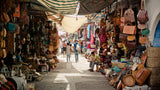
The Moroccan pouf belongs to a broader tradition of low seating and floor-level living found throughout North Africa and the Mediterranean world. Its contemporary form developed within the Moroccan salon, where low cushions, mattresses and small upholstered seats create an informal environment designed for conversation, hospitality and tea.
In Morocco, the pouf became known in different contexts by different names, including stormia. Traditionally covered in leather and filled with locally available materials, it served practical purposes while also contributing to the visual richness of the salon.
The object was never simply a decorative accessory. Its low profile suited a way of living organised around floor-level seating, while its leather construction made it durable enough for repeated everyday use.
The Moroccan salon
The traditional Moroccan salon is built around the idea of shared space. Long banquettes, cushions, carpets and low tables create an environment in which guests can sit, rest, eat and drink tea together.
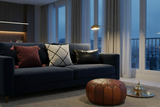
The pouf fits naturally into this setting. It can function as a footrest, an additional seat or a low support, and several poufs can be moved around the room as needed.
This flexibility helps explain why the Moroccan pouf has translated so successfully into contemporary interiors.
From traditional object to contemporary design
The Moroccan pouf eventually moved beyond the traditional salon and became an internationally recognised design object.
Its appeal is partly functional: it occupies little visual space, can be moved easily and serves several purposes. But its appeal is also cultural. Handworked leather, geometric decoration and natural variation give each pouf a visual character that differs from standardized factory upholstery.
The contemporary pouf therefore sits between two worlds: a traditional Moroccan object and a modern piece of adaptable furniture.
Claudio Bravo and the Moroccan pouf
The Moroccan pouf also entered the visual culture of Western art and design through its appearance in interiors associated with artists and collectors.
One particularly notable example is the Chilean-born artist Claudio Bravo, whose Moroccan home and interiors included traditional Moroccan furnishings and objects. His collection and photographic record helped reinforce the connection between Moroccan objects, colour, texture and contemporary artistic interiors.
The pouf is particularly well suited to this visual language: compact, tactile and sculptural, it can function as furniture while also becoming part of the composition of a room.

Prayer, Claudio Bravo — huile sur lin, 150×120cm, 1999

Gandora Rosa, Claudio Bravo — huile sur lin, 170×120cm, 1995

Padre e Hijo, Claudio Bravo — 1989

El Guardín y su Hijo, Claudio Bravo — 1979

Chilaba Verde y Azul, Claudio Bravo — 1994
Types of Moroccan Leather Poufs
Moroccan leather poufs are not a single standardized product. Their appearance varies according to region, workshop, technique, shape and intended use.
The most useful way to distinguish them is by their surface treatment, shape and visual character.
Round Embroidered Poufs
Embroidered round poufs are among the most recognizable Moroccan styles. Their surfaces are decorated with coloured thread applied to leather panels, often creating floral, geometric or repeating motifs.
The embroidery gives the surface a softer, more textile-like appearance. Compared with strongly geometric embossed leather, embroidered designs tend to introduce more colour and visual warmth into an interior.
They work particularly well in:
- bohemian and eclectic interiors;
- warm, layered living rooms;
- spaces with textiles and patterned rugs;
- rooms where the pouf is intended to act as a decorative accent.

Explore Moroccan embroidered leather poufs.
Round Embossed Poufs
Embossed poufs are decorated by pressing or tooling patterns into the leather surface. Geometric forms and repeating motifs create a more graphic appearance than embroidered designs.
The result is often more restrained and architectural, making embossed poufs particularly effective in interiors where texture and geometry are more important than strong colour contrast.
An embossed round pouf works especially well as:
- a footrest;
- an occasional seat;
- a compact accent piece;
- a companion to a Moroccan rug or low coffee table.

For a deeper explanation of how Moroccan leather poufs are constructed and decorated, see our guide to how Moroccan leather poufs are made.
Poufs with Golden Motifs — Stormia
Another recognizable Moroccan style is the decorated stormia, often associated with traditional salon furnishings.
These poufs can feature contrasting golden or metallic-looking motifs against a darker leather surface. The decoration gives them a more ceremonial and traditional appearance than simpler contemporary poufs.
They are particularly effective when the aim is to introduce a distinctly Moroccan element into a room rather than simply adding a generic leather ottoman.

Square Moroccan Leather Poufs
Square poufs have a more structured silhouette than round poufs. Their flat upper surface and straight sides make them particularly versatile in contemporary interiors.
A square pouf can work as:
- an ottoman;
- a footrest;
- an occasional seat;
- a low table when paired with a tray.
Their stronger geometry also makes them easy to combine with contemporary furniture.
XL and Rectangular Poufs
Larger and rectangular poufs create a more substantial presence in a room. Depending on their dimensions, they can function almost like low benches or upholstered ottomans.
They are particularly suitable for:
- large living rooms;
- the foot of a bed;
- large seating arrangements;
- spaces where a single small pouf would feel visually undersized.
When choosing an XL pouf, proportions matter more than simply choosing the largest available size. The pouf should relate naturally to the sofa, rug and surrounding furniture.
Embroidered vs Embossed: Which Should You Choose?
The choice between embroidered and embossed leather is primarily an aesthetic one.
| Embroidered | Embossed |
|---|---|
| Textile-like appearance | Graphic and architectural appearance |
| Often more colourful | Often more restrained |
| Works well with layered textiles | Works well with minimalist interiors |
| Decorative and expressive | Geometric and structured |
If your interior already contains colourful textiles, patterned rugs or cushions, an embroidered pouf can reinforce that richness.
If the room is more restrained, an embossed pouf can introduce Moroccan character through texture and geometry without adding too much colour.
The important point is that neither style is inherently better. They express different sides of Moroccan leather craftsmanship.
Moroccan Poufs in Contemporary Interiors
As seating and footrests
The most obvious use of a Moroccan pouf is as a footrest or occasional seat.
Its low height makes it particularly compatible with sofas, lounge chairs and floor-level seating. Several smaller poufs can also be arranged around a living room and moved when additional seating is needed.
For frequent seating, the firmness of the filling becomes important. For occasional use as a footrest or decorative accent, a softer filling may be more appropriate.
For detailed guidance on filling and maintaining a leather pouf, see our Moroccan leather pouf care guide.
As a low table
A structured square or rectangular pouf can also function as a low table when a stable tray is placed on top.
This is particularly useful in Moroccan-inspired living rooms, where low furniture and floor-level arrangements are part of the overall design language.
The combination of a leather pouf, a tray and a Moroccan rug creates a layered arrangement without requiring a conventional coffee table.
With Moroccan rugs and textiles
Leather and textile textures naturally complement one another.
A leather pouf placed on a handwoven Moroccan rug creates contrast between the smooth, structured surface of the leather and the softer texture of wool or woven fibres.
Embroidered poufs can also be paired with patterned cushions and textiles when the objective is a more expressive interior.
For a more textured natural look, a leather pouf can be combined with a Moroccan Sabra cactus silk cushion or a handwoven Moroccan rug.
How to Choose the Right Moroccan Leather Pouf
The best Moroccan pouf is not necessarily the most elaborate one. The right choice depends on how you intend to use it and how it relates to the rest of your interior.
1. Choose the shape according to the function
Start with the role the pouf will play.
- Round: versatile, informal and easy to move around.
- Square: more structured and particularly useful as an ottoman or low table.
- Rectangular: useful at the end of a bed or alongside a sofa.
- XL: appropriate for larger rooms and more substantial seating arrangements.
If you are primarily looking for a footrest, a compact round pouf may be enough. If you want a piece that can visually anchor a seating area, a square or larger rectangular form may be more appropriate.
2. Choose the finish according to your interior
Think about the visual language already present in your room.
For interiors dominated by natural materials, neutral colours and clean lines, embossed leather can add texture and Moroccan character without overwhelming the space.
For interiors with rugs, cushions, textiles and stronger colour combinations, embroidery can add another layer of pattern and colour.
3. Choose the size according to the surrounding furniture
A pouf should be considered in relation to the furniture around it.
Next to a large sectional sofa, a very small pouf may disappear visually. Conversely, an oversized pouf can overwhelm a compact room.
Before buying, measure the available floor space and consider the height of the sofa or chair beside which the pouf will be used.
4. Think about how you will use it
A decorative pouf does not necessarily need the same dimensions or firmness as a pouf intended for regular seating.
Ask yourself whether the primary function will be:
- footrest;
- occasional seating;
- low table;
- decorative accent;
- or a combination of several uses.
This simple distinction can make the choice considerably easier.
5. Choose character rather than perfect uniformity
Handmade Moroccan leather poufs naturally vary in colour, texture and small details of construction.
These variations are part of the visual character of a handmade object. If you are looking for a completely uniform, factory-like surface, a traditional leather pouf may not be the right object for you.
If you value material variation and visible traces of handwork, those same characteristics become part of the appeal.
For a detailed guide to leather quality, authenticity and value, see Are Moroccan Poufs Worth It? What to Look For.
The Moroccan Corridor Collection
At Moroccan Corridor, we select Moroccan leather poufs with attention to their shape, decorative character and relationship to the broader Moroccan craft tradition.
Our collection includes different expressions of the Moroccan pouf — from simple embossed forms to more decorative embroidered designs and structured square styles.
The objective is not to reproduce one standardized model, but to preserve the variety that makes Moroccan leatherwork interesting while selecting pieces that work naturally in contemporary interiors.
Explore the Moroccan Corridor Moroccan Leather Poufs collection.
Frequently Asked Questions
What is the history of the Moroccan pouf?
The Moroccan pouf developed within the tradition of low seating associated with Moroccan salons and floor-level living. Over time, the traditional leather pouf evolved from a practical household object into an internationally recognized Moroccan design piece.
What are the main types of Moroccan leather poufs?
The main types include round embroidered poufs, round embossed poufs, decorated stormia-style poufs, square poufs and larger rectangular or XL forms. They differ mainly in shape, surface treatment and decorative vocabulary.
What is the difference between an embroidered and an embossed Moroccan pouf?
Embroidered poufs are decorated with thread stitched onto the leather surface, giving them a more textile-like and often colourful appearance. Embossed poufs are decorated by pressing or tooling patterns into the leather, creating a more graphic and architectural surface.
What is a stormia Moroccan pouf?
Stormia is a term associated with a traditional Moroccan leather pouf or low seat used within Moroccan salon furnishings. Stormia-style poufs can feature decorative motifs and are particularly associated with the traditional visual language of Moroccan interiors.
Should I choose a round, square or rectangular Moroccan pouf?
Choose according to how you intend to use it. Round poufs are versatile and informal, square poufs are more structured and work well as ottomans or low tables, while rectangular and XL poufs are useful when you need a larger visual or functional presence.
What size Moroccan pouf should I choose?
The right size depends on the room and surrounding furniture. A compact round pouf works well beside a chair or sofa, while larger square and rectangular poufs are better suited to spacious living rooms or the foot of a bed.
Is a Moroccan pouf the same as an ottoman?
Not exactly. An ottoman is a broad category of low upholstered furniture, while a Moroccan pouf refers to a specific Moroccan form traditionally associated with leather, low seating and Moroccan craft traditions. A Moroccan pouf can therefore function as an ottoman, but not every ottoman is a Moroccan pouf.
"The Moroccan pouf has travelled far from the salon in which it was traditionally used. What makes it interesting today is precisely that balance: a familiar piece of furniture that still carries the materials, forms and craft vocabulary of Morocco. We look for poufs that preserve that character while feeling completely at home in contemporary spaces."