
In brief
Place an orange accent where its use and visibility agree. In a living room, that may mean a cushion on a seat you actually use, a throw within reach, or a pouf beside an armchair without obstructing the route through the room. In a bedroom, consider a textile on the bed or an object in a genuine dressing or reading area. Test the position from the doorway, from your usual seat, and while moving through the space before treating it as permanent.
An orange object can look right in a photograph and still be in the wrong place. A pouf may interrupt the path to the sofa. A cushion may occupy the seat someone uses every evening. A throw may cover the surface you need to keep clear.
Placement is the meeting point between composition and daily life. The question is not simply where orange will be noticed, but where the object can remain useful once the room is being used.
This guide focuses on positions within living rooms and bedrooms. If you are still choosing the type of change, start with Orange Paint, Furniture, or Accessories? How to Choose. For furniture lines and colour balance, see Orange Without the Retro Look.
Read the Room From Three Positions
From the Doorway: What Appears First?
The entrance offers a first view, not necessarily the most important one. Notice whether the orange object is visible as a complete form or appears as an unexplained fragment behind furniture.
A cushion against a sofa back may be clearly visible from one entrance and hidden from another. A pouf at floor level can disappear behind a coffee table. You do not need to move everything to make orange the first thing a visitor sees; decide whether that first impression is part of the object’s intended role.
From the Seat or Bed: What Do You Live With?
Sit where you normally sit. In the bedroom, look from the bed as well as towards it. A composition that works from the doorway may feel crowded at close range.
Check whether the object remains within useful reach and whether it takes up space your body needs. The view from the sofa should not come at the cost of somewhere comfortable to put your feet.
Along the Route: What Must Stay Clear?
Walk the usual paths to doors, windows, storage, and seating. Open the drawers and wardrobe doors that are used regularly. Account for the actual people and mobility needs of the household rather than applying a decorative spacing rule.
When colour and circulation compete, keep the route. An object can be moved; a daily obstruction is not a successful accent.
Where to Place Orange Accents in a Living Room
On the Sofa: Use the Seat’s Real Proportions
An orange cushion can define one part of a broad sofa rather than divide the entire seat into matching sections. Try it towards an end if that leaves the principal sitting position comfortable, or at the centre if the sofa’s arrangement and use support it.
There is no universal best side. Choose according to the seat people use, the view into the room, and the cushion’s actual width. A long lumbar cushion can occupy considerably more space than a small square one.
Avoid building a display that must be dismantled before anyone can sit down. If cushions are routinely placed on the floor, reduce the number or plan a sensible place to set them aside.

Over an Arm or Back: Keep a Throw Within Reach
A throw can bring orange into the room without occupying another area of floor. Fold it over a sofa arm or back where it can be reached and used, checking that it does not interfere with the seat or trail into a walking route.
The fold changes how much colour is visible. A narrow band may be enough; a larger drape makes the textile more prominent. Make that adjustment for the room’s actual view, not for a rule about how throws should hang.
Check the underside and the furniture finish before leaving any textile in sustained contact. Follow its care instructions and keep it away from flames and heat sources.
Beside an Armchair: Give a Pouf Its Own Footprint
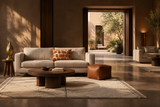
A pouf works best when its position supports its intended use. As a footrest, it needs to relate to the chair and your seated posture. When not in use, a position beside the chair may keep the walking route clearer than leaving it directly in front.
Check both positions, including the movement between them. Do not wedge it under the armchair or assume it can share the same floor area as a side table.
The Aya round orange leather pouf, at approximately 45 cm in diameter and 30 cm high, offers a compact reference for testing this arrangement. Those dimensions describe the object, not the space needed to use it. Allow for your feet, the chair, and access around the grouping, and check the selected filling option.
Near a Coffee Table: Avoid the Main Passage
An orange pouf can connect visually with a seating group, but a clear patch of floor is not automatically an available position. Check whether someone crosses it to reach the sofa or whether the table needs that clearance during use.
Do not treat a leather pouf as a stable surface for drinks solely because it looks table-like. Use the product for its intended purpose and assess its support and filling; keep hot drinks on a suitable stable table.
Where to Place Orange Accents in a Bedroom
On the Bed: Choose the Layer You Will Actually Keep
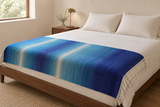
A cushion near the head of the bed introduces colour into the upper part of the composition. A folded throw towards the foot adds a horizontal band lower down. Choose the position according to which surface needs the accent and how you use the bedding.
For a throw, test a narrower fold before spreading it over a larger area. Check whether it stays within the bed’s edges or hangs into the route around it. At night, have a practical place for any decorative layer you remove.
Orange bedding need not be the room’s dominant feature. A small visible area can be enough when the bed already occupies most of the view.
At the Foot of the Bed: Test Access Before Adding a Pouf
The foot of the bed can look like a natural place for a decorative object, but it may also be the route to a wardrobe or the space needed to change the bedding.
Place a temporary object of comparable footprint there and walk the room normally. Check access with wardrobe doors and drawers open. If you must repeatedly step around it or move it to reach storage, choose another position.
A pouf should not be assumed suitable as a dressing seat simply because it fits. Review its construction, intended use, filling, and support before relying on it for seated tasks.
In a Reading Corner: Build Around the Chair
If the bedroom contains a genuine reading chair, an orange textile or pouf can belong to that small area rather than compete with the bed. Keep the chair, reading light, and any useful table accessible.
Let the accent support the existing activity. A cushion can make sense on a chair that accommodates it; a footrest can make sense where it is comfortable and does not block access. If there is no room for either, the corner does not need an orange object to feel complete.
The opening illustration uses the Aya square orange leather pouf to make this relationship visible. Its square outline and pale stitched panels give the reading corner a defined accent, while its position beside the chair leaves the route towards the bed open. Treat the image as an AI-generated styling example, not a measured room plan: check the product’s current dimensions and filling option, then test its footprint in your own space before settling on the position.
Beside Storage: Do Not Borrow Working Space
A gap beside a chest of drawers may be required for opening, cleaning, or moving around the furniture. Avoid treating every unused-looking corner as decorative capacity.
Check the position with the room in use, not just with every door closed and the bed perfectly made. An accent that belongs there should survive those ordinary changes.
In a Smaller Room, Use Existing Surfaces First
When floor space is limited, consider an accent on a surface already serving the room before adding another freestanding object. A cushion or folded throw can change the view without introducing another floor footprint, provided it does not crowd the seat or bed.
If you want a pouf, measure its actual width, depth, and height, or its diameter if round, and test where it would stand both during and between uses. Do not rely on a wide-angle photograph to judge fit.
One well-placed orange element can be enough. There is no need to repeat it on the sofa, bed, floor, and side table for the room to look considered.
For homes where changes must remain movable and painting is not an option, our guide to adding orange in a rental home discusses the wider approach. Here, the priority remains finding a position that works within your actual room.
Test the Position in Daily Use
- Start with one object. Choose a position for a specific use, rather than arranging several accents at once.
- Check the three views. Look from the entrance, from your seat or bed, and along the main route.
- Open what needs to open. Test doors, drawers, curtains, and access to storage with the object in place.
- Use the room normally. Sit down, stand up, make the bed, or reach for the throw. Notice whether the position creates repeated extra work.
- Adjust before adding. Change the position or visible area before deciding another matching object is needed.
Assess colour under your normal daylight and evening lighting, but do not let a flattering patch of light override practical access. Follow the object’s care guidance when choosing a position exposed to sunlight or close to a heat source.
Give the colour a place. Give the object a purpose. Leave the room free to be lived in.
Frequently Asked Questions
Where should I place an orange pouf in a living room?
Place it where it supports its intended use without obstructing access. Beside an armchair may work between uses; a footrest position should relate to your seated posture. Check the pouf’s footprint, filling, and the route around the seating group.
Should an orange cushion go in the centre or at the end of a sofa?
Either can work. Choose according to the cushion’s width, the view into the room, and the seats people actually use. Keep enough comfortable sitting space and avoid an arrangement that must be dismantled every time.
Where should I put an orange throw in a bedroom?
A folded throw towards the foot of the bed can create a horizontal accent. Adjust its fold to control the visible colour, keep it out of walking routes, and plan where it will go if removed at night.
Can I place a pouf at the foot of the bed?
Yes, if it leaves practical access to the bed and storage. Test the footprint with doors and drawers open and while changing the bedding. Check the product’s intended use and support before treating it as a seat.
How can I add orange to a small room without crowding it?
Consider a cushion or folded textile on an existing seat or bed before adding another floor-standing object. Check that the textile does not displace comfortable use. If choosing a pouf, test its actual dimensions during and between uses.
Does an orange accent need to be visible from the doorway?
No. The entrance is one view, not the only one. An object may belong primarily to a reading corner or a seat. Assess it from the doorway, from your usual position, and along the route through the room.
Find the Piece for Its Place
Explore orange home accessories by dimensions, material, and intended use. Begin with the space you have and the purpose you need the object to serve.
Explore Orange Home Accessories