

Hero image: Jean Discart, The Cobbler. Reproduction via Artvee; public-domain status as stated by the source. Used without editorial retouching.
Jean Discart’s paintings associated with Tangier bring makers, tools and objects into sharp focus. A cobbler’s shoes, a pottery painter’s vessels and the surfaces of cloth, wood and metal become subjects in their own right. These works offer a way to look at representations of Moroccan material life, provided we distinguish what the paintings show from what they can establish about the city’s history.
A Painter Between Modena, Vienna and Paris
Sotheby’s catalogues identify Discart as born in Modena in 1856, entering the Vienna Academy in 1873 and making his Paris Salon debut in 1884. Their accounts connect his training with Anselm Feuerbach and, subsequently, Leopold Carl Müller. The 2009 catalogue gives a more complicated sequence of admission and study than a simple list of teachers suggests.
These details place his work within European academic painting and the market for Orientalist subjects. They do not, by themselves, tell us how long he spent in Morocco or where each composition was completed.
That distinction matters because the 2009 Sotheby’s notice explicitly acknowledges gaps in the record of his career. It treats the inscription “Tanger” on paintings as suggesting a visit, rather than documenting a residence of several years. Here, the connection with Tangier is discussed through the catalogued works and their inscriptions, without turning an uncertain itinerary into biography.
How to Read These Images
Three kinds of evidence guide this reading. First are visible features: gestures, arrangements, colours and surfaces within the reproductions. Second are catalogue records, which supply titles, signatures, dimensions, media and interpretations. Third is our own reading of how the compositions direct attention.
These are related but not interchangeable. An inscription naming Tangier is evidence of how a painting identifies its subject; it is not proof that every object depicted was made there. A carefully rendered workshop is still a composition, not an inventory or an unmediated record of working conditions.
The term “Orientalist gaze” is used here to ask how a European painter frames people and objects for a viewer. Admiration for technical skill can coexist with selection, arrangement and distance. We can appreciate the painting without assuming that its world contains everything necessary to understand the people represented.
The Cobbler: Work at the Centre of the Picture
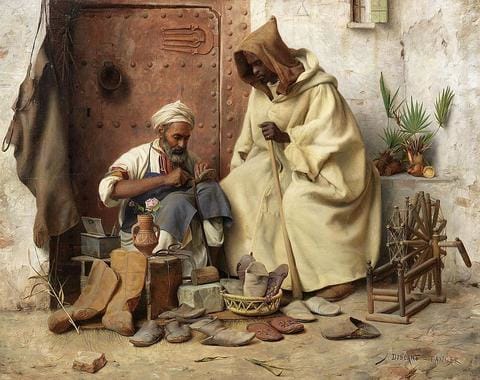
Jean Discart, The Cobbler. The existing article reproduction is retained; Sotheby’s 2018 catalogue identifies the corresponding composition as an oil on panel, signed and inscribed “J. DISCART. TANGER”.
The seated figure’s attention gathers around his hands. Beside him, a standing figure bends towards the work. Shoes spread across the foreground, while a large studded door anchors the scene behind them. The composition moves between the maker, the person watching and the objects through which their exchange becomes legible.
The 2018 Sotheby’s catalogue identifies the panel as measuring 40 by 50 centimetres and describes babouche slippers, boots and a stitching kit. Its interpretation emphasises the cobbler’s concentration and the detailed presentation of his trade.
What interests us is the place given to practical work. The shoes are not simply ornaments filling an otherwise empty foreground. Their variety and arrangement make footwear part of the painting’s visual argument: the maker is understood through what surrounds him.
Yet the picture cannot establish wages, workshop organisation or the provenance of every material. Nor does it justify treating contemporary Moroccan leatherwork as unchanged since the scene was painted. It offers a representation of a maker’s world, not a certificate for objects produced today.
The Pottery Studio: A Painter Depicting Another Painter
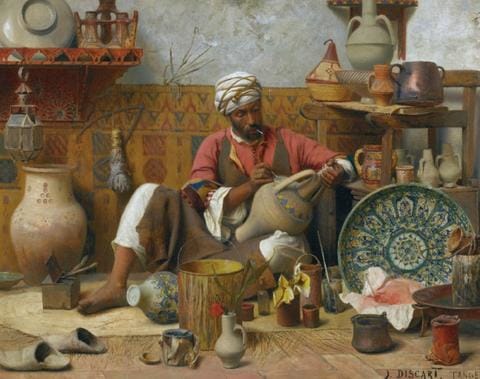
Jean Discart, The Pottery Studio, Tangiers. Sotheby’s 2009 catalogue records an oil on panel, 34.6 by 45.7 centimetres, signed “J. DISCART.” and inscribed “TANGER”.
Here, vessels gather around a seated figure engaged in decoration. Shelves, containers and a large patterned plate make the setting dense with objects. The eye moves between the figure’s absorbed gesture and the decorated surfaces around him.
Sotheby’s makes a compelling observation: Discart has, in effect, painted a painter. The comparison invites us to look at two forms of skilled surface-making, the ceramic decorator’s work inside the scene and the artist’s rendering of it.
The catalogue identifies the prominent patterned platter as Fez pottery and suggests that some other objects relate to Kabylie in Algeria. Those are the catalogue’s identifications, not a provenance assessment made from this small reproduction. They are nevertheless important to the reading: a scene labelled Tangier may bring together objects associated with more than one region.
The inscription should therefore not flatten a wider material geography into a single city of manufacture. Objects can circulate; a composition can assemble them. The place named in a painting and the origin of everything shown within it are different questions.
A Portrait Retained with a Cautious Caption
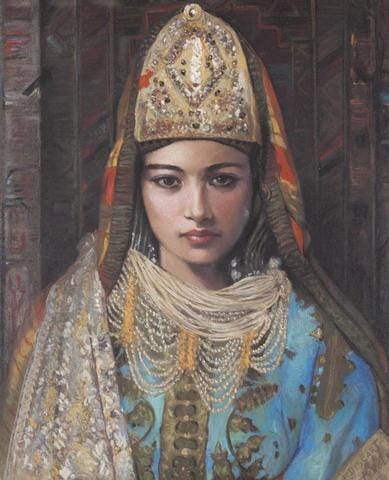
Previously captioned La Mariée de Tanger in this article. The title, attribution and source of this particular reproduction have not been independently confirmed in the catalogue records consulted for this revision.
This portrait introduces a different arrangement of material detail. An elaborate headdress, layered jewellery and decorated clothing surround the face. Where the workshop scenes distribute objects across a setting, this image concentrates them around the sitter.
The earlier caption identifies a bride, but costume alone cannot establish the sitter’s identity, community or the circumstances of the portrait. Until a reliable record for this exact image is located, it is better to preserve the distinction between the inherited label and what can actually be verified.
Detail Is Not the Same as Documentary Certainty
Discart’s attention to surfaces makes these images rewarding to examine. A vessel, a shoe or a folded garment can hold the viewer’s attention as strongly as a face. But precision in rendering does not remove the painter’s choices.
The selection of objects, their arrangement and the relationship between figures all shape the image. Some things become highly visible, while others remain outside the frame: the wider city, the maker’s own account of the work and the conditions in which the object moved from hand to hand.
That is not a reason to dismiss the paintings. It is a reason to ask better questions of them. What is being made visible? Which kinds of work are dignified by attention? Where does appreciation of a surface take the place of knowledge about a person?
Tangier as an Inscription, Not a Complete City Portrait
These works bring Tangier into view through particular subjects and a particular painter’s choices. They should not be asked to stand for all of the city’s history, or for every community that lived there.
Their strongest contribution is more focused. They allow us to examine how craft, labour and objects became part of an artistic image associated with Tangier. The paintings can open a conversation about material life without closing it around a single European perspective.
For Moroccan Corridor, that distinction is essential: to notice the object without losing sight of the limits of the image. Look closely at the hand. Then ask what the painting leaves beyond the frame.
Sources and Image Notes
- Sotheby’s, The Orientalist Sale, 2018, lot 16: Jean Discart, The Cobbler. Work description, signature, medium, dimensions and catalogue commentary.
- Sotheby’s, 19th Century European Art including Important British Paintings, 2009, lot 18: Jean Discart, The Pottery Studio, Tangiers. Work description, biographical discussion and catalogue identifications of depicted objects.
- Artvee, Jean Discart, The Cobbler. Source of the replacement hero reproduction, listed as public domain by Artvee.
The auction catalogues are used as object records and attributed interpretations, not as a complete social history of Tangier. The hero reproduction is sourced from Artvee, which states that its public-domain files may be used for personal and commercial projects. Other inline reproductions are retained from the earlier article; their reproduction sources and permissions remain to be documented. The third image’s inherited title and attribution remain unverified. No current auction-record claim is made.