Not all Moroccan leather is the same. The skin of a goat, a sheep, and a cow behave differently at every stage of production — tanning, dyeing, cutting, stitching — and produce finished objects with distinct characteristics in terms of texture, durability, and appearance. Understanding these differences is useful both for choosing the right object and for understanding why authentic Moroccan leather goods are made the way they are.
Full-Grain Leather: The Moroccan Standard
All traditional Moroccan leather goods are made from full-grain hides — the highest grade of natural leather. Full-grain leather is taken from the outermost layer of the hide, where the fibre structure is tightest and most durable. Unlike industrially processed leather, the surface is not buffed, sanded, or corrected to remove imperfections. Natural marks — scars, grain variations, insect bites — remain visible and are considered part of the material's character rather than defects to be hidden.
The practical consequence is a leather that is more breathable, more durable, and more responsive to use than corrected-grain or bonded alternatives. Full-grain leather develops a patina over time — deepening in colour, acquiring a subtle sheen, and becoming more supple with handling. An object made from full-grain Moroccan leather will look better after ten years of use than it did when new. This is not a marketing claim — it is the physical behaviour of the material.
All leather products at Moroccan Corridor are made from full-grain hides sourced from animals raised for food consumption. No animal is raised or slaughtered for leather alone.
The Three Skins
Moroccan artisans work primarily with three types of hide: goatskin, sheepskin, and cowhide. Each has specific properties that make it suited to particular objects and uses.
Goatskin
Goatskin is the primary material of Moroccan leather craft — and for good reason. Unlike sheep, goats have no grease deposits in the skin, which produces a hide that is naturally more resistant to moisture and wear while remaining supple and fine-grained. Goatskin is lighter than cowhide and tougher than sheepskin, making it the optimal material for objects that need to be both soft to the touch and durable over years of use.
The term maroquin — from which the French word maroquinerie derives — refers specifically to goatskin tanned in the Moroccan tradition. When European traders encountered this leather in the 16th century, it was so superior to anything produced locally that they named it after its country of origin. The name has remained in use for five centuries.
At Moroccan Corridor, goatskin is the primary material for leather poufs, bags, and accessories. It is the material best suited to objects that will be handled daily and expected to last for decades.
Sheepskin
Sheepskin produces a softer, more pliable leather than goatskin — the result of a finer grain structure and a higher natural fat content in the hide. This softness makes it well suited to embroidered decorative objects, where the needle passes through the leather more easily, and to clothing and accessories where suppleness is prioritised over durability.
The trade-off is longevity: sheepskin is more susceptible to tearing and surface wear than goatskin, particularly in objects that will see heavy daily use. For a pouf used as primary seating, sheepskin will deteriorate faster than goatskin under equivalent conditions. For a decorative pouf or an embroidered accessory, the difference is less significant.
Cowhide
Cowhide is the thickest and most rigid of the three. Its density makes it the most durable option for objects that need to maintain their structure under sustained mechanical stress — shoulder straps, shoe soles, belt loops, and the bases of structured bags. The rigidity that makes it ideal for these applications also makes it less suited to objects that require flexibility or a soft hand feel.
Moroccan artisans use cowhide primarily for the structural components of bags and footwear — soles, reinforced panels, and straps — where its resistance to deformation is an advantage rather than a limitation.
Comparison Guide
The choice of skin is not arbitrary — it follows the logic of the object being made and the use it will see.
Goatskin is the best choice for objects that need to balance softness and durability over years of daily use: poufs, bags, wallets, and accessories. It is the most versatile of the three and the material most associated with the Moroccan leather tradition.
Sheepskin is the best choice for decorative objects, embroidered pieces, and clothing where softness and workability are prioritised. It is not recommended for objects that will see heavy daily use as primary seating or load-bearing applications.
Cowhide is the best choice for structural applications: shoe soles, bag bases, reinforced straps, and any component that needs to resist deformation under sustained stress. It is rarely used for the full exterior of a pouf or bag in the Moroccan tradition — its rigidity makes it unsuitable for objects that need to be soft to the touch.
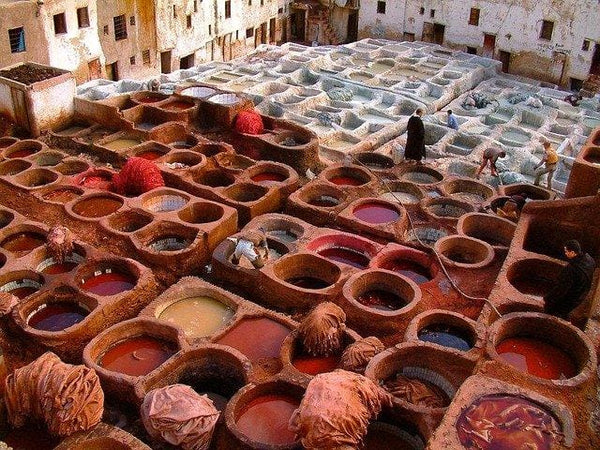
The Tanning Process in Fès and Marrakesh
Moroccan leather is vegetable-tanned — a process that uses natural tannins derived from plant bark rather than the chromium salts used in industrial production. The process takes weeks rather than hours and produces leather that is firmer, more breathable, and longer-lasting than chrome-tanned alternatives. It is also the process that gives Moroccan leather its characteristic smell, its responsiveness to natural dyes, and its capacity to develop a patina over time.
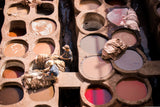
The tanneries of Fès — the Chouara, Sidi Moussa, and Ain Azliten — have operated continuously since the eleventh century. The process performed there today is substantially the same as it was in the medieval period. It is one of the few industrial processes in the world that has remained unchanged for a thousand years, not because of tradition for its own sake, but because the result has not been improved upon.
The process proceeds in stages:
Hides arrive at the tannery salted and dried. They are first soaked for two to three days in a caustic mixture of water, quicklime, cow urine, and salt. This breaks down the outer surface of the hide, loosening the hair fibres, residual fat, and flesh that remain after slaughter. Tanners scrape the hides by hand during this stage to remove what the soaking has loosened.

The hides are then transferred to vats containing water and pigeon excrement — a traditional softening agent whose ammonia content makes the hide malleable and receptive to dye. This stage typically lasts one to two days. The smell is significant. The result is a hide that has been chemically prepared to absorb colour evenly and deeply.
The softened hides are transferred to the tanning vats, where artisans trample them barefoot for hours each day — typically from early morning until early afternoon — to work the tannins evenly into the hide and achieve the desired degree of softness. This stage continues for several days until the hide reaches the correct texture.

When the hides are dry and smooth, they are ready for dyeing. The dyes used are entirely natural: poppy for red, mint for green, indigo for blue, kohl for black, henna for orange, and a mixture of oil and pomegranate for yellow. Each colour requires its own vat and its own preparation. The hides are submerged and worked by hand until the colour has penetrated evenly.

The dyed hides are rinsed and then placed in a rotating wooden drum for one day to relax the fibres and even out the surface. They emerge ready for cutting and crafting.
From Hide to Finished Object
The tanned and dyed hide arrives at the workshop as a flat, finished material. What happens next depends on the object being made — but in both cases, the process is entirely manual.
Leather Bags
Each bag begins with a paper pattern — a template developed by the designer and refined by the artisan over successive iterations. The hide is laid flat and the pattern pieces are traced and cut by hand using traditional knives. The cut pieces are then assembled, stitched using heavy needles and waxed thread, and finished with edge paint or burnishing to seal the cut edges.
Decorative elements — engraving, hand-painting, inlay work in coloured leather, copper or silver hardware — are applied at this stage. The finished bag is oiled to condition the leather and remove any residual smell from the tanning process.

Leather Poufs
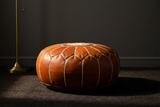
Pouf production begins with the design of the surface pattern — the geometric or floral motif that will appear on the top and sides of the finished piece. The artisan sketches the pattern directly onto the leather, then cuts and dyes the individual pieces that will make up the design. These pieces are assembled and stitched together by hand, a process that requires precision and patience: a single embroidered pouf top can take between one and three days to complete.
The assembled panels are then stitched to the body of the pouf, the zip is inserted into the base, and the finished piece is inspected. The entire production process for a standard round pouf requires a minimum of ten hours and at least two artisans working in sequence.

Frequently Asked Questions
What is the difference between goatskin and sheepskin leather?
Goatskin is tougher, more resistant to moisture and wear, and more durable over time. Sheepskin is softer and more pliable, making it easier to work with for embroidery and clothing, but less suited to objects that will see heavy daily use. For poufs and bags intended for regular use, goatskin is the superior material.
What is full-grain leather?
Full-grain leather is taken from the outermost layer of the hide, where the fibre structure is tightest and most durable. Unlike corrected-grain leather, the surface is not buffed or sanded — natural marks and grain variations remain visible. Full-grain leather is the highest grade of natural leather and the standard used in all traditional Moroccan leather craft.
What is maroquin leather?
Maroquin refers specifically to goatskin tanned using the Moroccan vegetable-tanning tradition. The term entered European languages in the 16th century, when Moroccan goatskin was so prized that traders named it after its country of origin. The French word maroquinerie — meaning the leather goods trade — derives from the same root.
Why is Moroccan leather vegetable-tanned?
Vegetable tanning uses natural tannins derived from plant bark rather than chromium salts. The process takes weeks rather than hours and produces leather that is firmer, more breathable, and longer-lasting. It also produces leather that develops a patina over time — a characteristic that chrome-tanned leather does not share. Vegetable tanning has been practiced in Fès continuously since the eleventh century.
What natural dyes are used in Moroccan leather?
Traditional Moroccan leather dyeing uses entirely plant-based pigments: poppy for red, mint for green, indigo for blue, kohl for black, henna for orange, and a mixture of oil and pomegranate for yellow. Each colour requires its own preparation and vat. The dyes are applied by hand after the tanning process is complete.
How long does it take to make a Moroccan leather pouf?
A standard round embroidered pouf requires a minimum of ten hours of work and at least two artisans working in sequence — one for the surface embroidery and pattern assembly, one for the structural stitching and finishing. More complex patterns can take significantly longer. This is before accounting for the tanning and dyeing process, which takes an additional one to two weeks.
Are Moroccan Corridor leather products ethically sourced?
All leather used in Moroccan Corridor products comes from animals raised for food consumption. No animal is raised or slaughtered for leather alone. The hides are a by-product of the food industry — using them for leather is the most complete and responsible use of the animal.