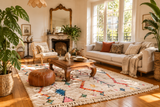

A Moroccan leather pouf can be a relatively inexpensive decorative object — or a significant investment. Whether it is worth the money depends on more than the word "Moroccan". The leather, construction, craftsmanship, provenance, intended use and expected lifespan all contribute to its real value.
At Moroccan Corridor, we work directly with Moroccan workshops and the artisans who make our leather poufs. This guide looks at the question from a buyer's perspective: when is a Moroccan leather pouf genuinely worth buying, and when is it not? For a complete overview of the object itself, see our Complete Guide to Moroccan Leather Poufs.
Are Moroccan Poufs Worth the Money?
There is no universal answer.
A Moroccan leather pouf can be worth significantly more than a mass-produced alternative if the difference in price reflects better materials, skilled craftsmanship, stronger construction and greater longevity.
But a higher price does not automatically mean better value.
The useful question is not simply:
"How much does a Moroccan pouf cost?"
It is:
"What am I actually getting for the price I am paying?"
A well-made pouf can provide years of use as a footrest, occasional seat, low table or decorative piece while developing a character that changes with age.
A poorly made pouf may have the same appearance when new but offer considerably less value over time.
That distinction is what makes assessing value, rather than simply price, important.
What Makes a Moroccan Pouf Worth Buying?
Several factors determine whether a Moroccan leather pouf represents good long-term value.
Durability
A well-constructed leather pouf is designed to withstand regular use.
The leather itself matters, but so does the way the panels are cut, joined and finished. A strong construction allows the pouf to retain its shape while the leather gradually develops its own character.
This is one reason a handmade leather pouf can be fundamentally different from a low-cost decorative imitation.
The question is not whether the pouf looks attractive when it arrives.
It is whether the object will remain useful and attractive after years of use.
For a detailed guide to assessing leather, stitching and construction quality, see our guide to Moroccan leather pouf pricing, quality and authenticity.
Craftsmanship
Craftsmanship is part of the value of an artisan-made pouf.
Cutting, stitching, tooling, embroidery and finishing all require time and skill. Decorative work can add substantial labour without necessarily adding more leather or making the object physically larger.
This means that two poufs of similar size can represent very different amounts of work.
The important distinction is that craftsmanship should contribute to the quality and character of the finished object — not simply provide a label that justifies a higher price.
To understand what actually goes into making one, see How Are Moroccan Leather Poufs Made?
Patina and Ageing
One of the distinctive qualities of natural leather is the way it changes with use.
Instead of remaining visually identical throughout its life, well-maintained leather can soften, deepen in colour and develop a patina.
This changes the economics of the object.
A decorative piece designed only to look new may lose some of its appeal as it ages. A well-made natural leather pouf can become more individual as its surface records years of use.
That does not mean every leather pouf automatically becomes more beautiful with age. Leather quality, finishing, use and care all influence how it develops.
But the potential for ageing gracefully is part of what gives a good leather pouf its long-term appeal.
How Long Does a Moroccan Leather Pouf Last?
There is no single lifespan that applies to every Moroccan pouf.
A well-made leather pouf that is used appropriately and cared for can remain functional for many years, potentially decades. The actual lifespan depends on the leather, construction, frequency of use, filling, environment and maintenance.
This is why claims such as "a Moroccan pouf lasts exactly 20 years" should be treated cautiously.
A better way to think about longevity is:
quality of materials + quality of construction + appropriate use + care = potential lifespan
A pouf that costs more but remains attractive and functional for many years may provide better value than a cheaper piece that needs replacing after a short period.
For practical advice on preserving leather over time, see our Moroccan Leather Pouf Care Guide.
Versatility: What Can You Actually Use a Moroccan Pouf For?
Part of the value of a pouf comes from its flexibility.
A single piece can perform several different functions depending on the room and how it is filled.
As a footrest
This is one of the simplest and most comfortable uses.
Placed beside a sofa or armchair, a pouf provides flexible support without requiring a permanent piece of furniture.
As occasional seating
A properly filled pouf can work as additional low seating.
It is particularly useful when entertaining because it can be moved around the room and stored when it is no longer needed.
The height and firmness should, however, be considered before buying if seating is one of your main intended uses.
As a low table
A firm square or rectangular pouf can also function as a low table when paired with a suitable tray.
This creates another layer of flexibility without requiring a separate coffee table.
As a decorative object
A pouf does not have to perform a purely functional role.
The leather, colour, embroidery or tooling can make it an important visual element within a room.
This is particularly relevant for pieces with strong decorative craftsmanship.
The Practical Trade-Offs
A Moroccan leather pouf is not the right choice for every buyer.
Understanding its limitations is just as important as understanding its advantages.
Handmade Means Variation
Handmade leather is not perfectly uniform.
Colour, grain, stitching and surface texture can vary from one piece to another. Small irregularities may be part of the character of the material and the evidence of handwork.
If you want a completely uniform industrial finish, a handmade leather pouf may not be the right product for you.
If you appreciate natural variation and individual character, the same quality can be an advantage.
Leather Requires Basic Care
Natural leather is durable, but it is not maintenance-free.
It should be protected from prolonged moisture, excessive heat and other conditions that can damage the material.
Basic care is usually enough to preserve its appearance and flexibility.
For the practical details, see our Moroccan Leather Pouf Care Guide.
A Pouf Is Low Furniture
This sounds obvious, but it is an important buying consideration.
A Moroccan pouf works particularly well in low, relaxed interiors and as a flexible occasional piece.
It is not a replacement for a conventional dining chair or high armchair.
If you are looking for fixed-height everyday seating, another type of furniture may be more appropriate.
Filling Affects Comfort
The same leather pouf can feel very different depending on how it is filled.
A lightly filled pouf may work well as a decorative accent or footrest. A firmly filled pouf can provide more structured support for seating.
Because filling affects both comfort and shape, it is worth considering your intended use before buying.
If your pouf arrives unstuffed, see our complete guide to stuffing a Moroccan pouf for filling options and practical instructions.
Is a Moroccan Leather Pouf Better Than a Cheaper Alternative?
Not automatically.
A cheaper synthetic or factory-made pouf may be perfectly suitable for someone who wants an inexpensive decorative object with a uniform appearance.
The question is what you value.
An artisan-made leather pouf may offer:
- a natural material;
- visible craftsmanship;
- individual variation;
- the potential to develop a patina;
- greater longevity;
- identifiable provenance;
- multiple uses within the home.
A mass-produced alternative may offer:
- a lower initial price;
- uniformity;
- predictable dimensions;
- minimal maintenance;
- easier replacement.
Neither choice is automatically right or wrong.
But they represent different propositions.
If the goal is simply to fill an empty corner at the lowest possible cost, an artisan-made leather pouf may not be the logical choice.
If the goal is to own a functional object made from natural materials that can remain part of the home for many years, the calculation is different.
When Is a Moroccan Pouf Not Worth It?
A Moroccan leather pouf may not be worth buying if:
- you are looking exclusively for the lowest possible price;
- you want completely uniform industrial production;
- you need waterproof outdoor furniture;
- you do not want to maintain natural leather;
- you need a conventional high seat;
- you are unlikely to use its flexibility as a footrest, seat or low table;
- the seller cannot provide meaningful information about the product's origin and materials.
The last point is particularly important.
A Moroccan label alone does not establish value.
The more information a seller can provide about the material, construction, provenance and intended use, the easier it is for the buyer to judge whether the price makes sense.
Why Provenance Affects Value
Provenance is not only about authenticity.
It also helps explain what you are paying for.
There is a meaningful difference between:
"Made in Morocco"
and:
"Handmade in a Moroccan workshop"
and:
"Made by a known workshop using specified materials and techniques."
More specific provenance gives the buyer a clearer understanding of the object and its production.
For a specialist retailer, the ability to explain where an object comes from, how it was made and what materials were used is part of the value provided alongside the object itself.
At Moroccan Corridor, our leather poufs are sourced directly from Moroccan workshops and artisans. We consider that relationship part of the provenance of the objects we curate — not simply a marketing detail.
Who Should Buy a Moroccan Leather Pouf?
A Moroccan leather pouf may be particularly well suited to you if you:
- appreciate natural materials;
- value handmade craftsmanship;
- want flexible furniture;
- like objects that develop character with age;
- need occasional rather than permanent seating;
- want a footrest that can also serve another purpose;
- appreciate the individuality of handmade objects;
- care about knowing where and how an object was made.
In these circumstances, the value of the pouf extends beyond its immediate function.
It becomes a combination of material, craftsmanship, utility, provenance and longevity.
Who Might Prefer Something Else?
A different product may make more sense if you:
- need a highly structured permanent seat;
- want completely uniform manufacturing;
- need furniture that can remain outdoors;
- want something requiring virtually no care;
- are buying primarily on the basis of the lowest price;
- prefer a contemporary industrial aesthetic over visible craftsmanship.
Good buying decisions are not about finding the product that is universally "best".
They are about finding the product that best matches your needs.
For guidance on choosing the right type of Moroccan pouf for your interior and intended use, see our guide to types, history and selection.
Is a Moroccan Leather Pouf a Good Investment?
The word investment should be used carefully.
A Moroccan leather pouf is generally a home furnishing, not a financial investment.
Its value comes from use, durability, craftsmanship, aesthetic appeal and the relationship you develop with the object over time.
A useful way to think about it is lifetime value.
A piece that costs more initially but remains useful, attractive and structurally sound for many years can offer better value than a cheaper product that needs to be replaced repeatedly.
But longevity should never be assumed simply because a product is described as "Moroccan", "handmade" or "genuine leather".
The actual quality of the individual piece matters.
What Should You Consider Before Buying?
Before making a decision, ask yourself five questions:
1. How will I use it?
Footrest, seating, low table or decoration?
2. How important is natural leather to me?
If you value patina and material character, genuine leather may justify a higher price.
3. Am I comfortable with handmade variation?
Natural materials and handcraft do not produce perfectly identical pieces.
4. Can the seller explain the provenance?
Where was it made? What materials were used? How was it constructed?
5. Am I buying for the lowest price or for long-term value?
These are not necessarily the same thing.
If you can answer these questions clearly, you are much more likely to know whether a particular Moroccan leather pouf is worth buying.
The Real Value of a Moroccan Leather Pouf
A Moroccan leather pouf is worth buying when the object you receive justifies the price you pay.
That value can come from several things at once:
Material — natural leather with its own grain and ageing characteristics.
Craftsmanship — skilled work that gives the object its construction and character.
Function — a flexible piece that can serve several purposes.
Provenance — a clearer connection to the place, workshop and people behind the object.
Longevity — the potential to remain useful and attractive for many years.
No single one of these makes a pouf automatically valuable.
And no single price can tell you whether one is worth buying.
The better question is always:
What am I getting, how well is it made, and how long do I expect to live with it?
That is the real measure of value.
Frequently Asked Questions
Are Moroccan leather poufs worth the money?
They can be, particularly when the price reflects good materials, sound construction, skilled craftsmanship and clear provenance. A higher price alone does not guarantee better value. The right question is what you are receiving for the price and how long you expect to use the piece.
Why are handmade Moroccan poufs more expensive?
Handmade poufs can cost more because their price includes natural materials, skilled labour, time-consuming construction, decoration, finishing and the cost of maintaining artisan production. The exact price varies according to the leather, design, construction and selling context.
How long does a Moroccan leather pouf last?
There is no universal lifespan. A well-made leather pouf that is used appropriately and properly maintained can remain functional for many years and potentially decades. Leather quality, construction, filling, frequency of use and environmental conditions all affect longevity.
Are Moroccan leather poufs practical for everyday use?
Yes, provided the pouf is appropriate for its intended use. They work particularly well as footrests, occasional seating and flexible accent furniture. They are less suitable when you need conventional high seating or specialised outdoor furniture.
Are Moroccan poufs comfortable to sit on?
A properly filled Moroccan pouf can provide comfortable occasional seating. Firmness depends on the construction and filling. If seating is a primary purpose, the filling and dimensions should be considered carefully before purchase.
Are Moroccan leather poufs a good investment?
They should be considered a long-term furnishing purchase rather than a financial investment. Their value comes from durability, craftsmanship, utility, aesthetics and the experience of owning a handmade object. A higher initial price can provide better lifetime value when the piece is genuinely well made.
When is a Moroccan pouf not worth buying?
It may not be the right purchase if you are looking only for the lowest price, need completely uniform industrial production, require waterproof outdoor furniture, dislike leather maintenance or need a conventional high seat. The best product depends on your intended use and priorities.
What should I consider before buying a Moroccan leather pouf?
Consider how you will use it, the quality and type of leather, the construction, the provenance, the expected lifespan, the filling and the seller's ability to explain what you are buying. For a detailed assessment of quality and authenticity, see our guide to Moroccan leather pouf pricing, quality and authenticity.