There are places in the world where time moves differently. Where a craft practiced today is the same craft practiced a thousand years ago — not as a revival, not as a tribute, but as an unbroken continuation. The tanneries of Morocco are such places.
To hold a piece of Moroccan leather is to hold something that carries this continuity. Not as metaphor. As fact.
Fès: Where It Began
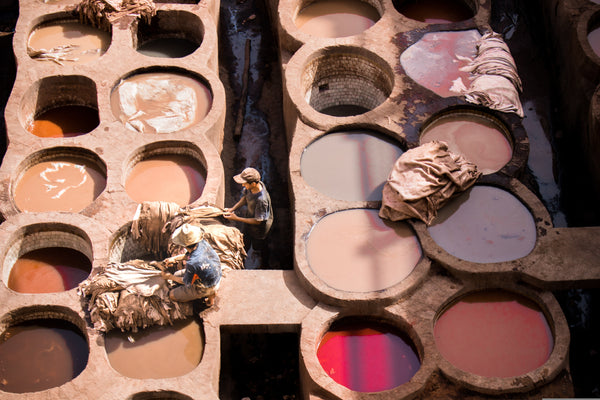
The city of Fès was founded in the 9th century. By the 11th century, its tanneries were already established — among them the Chouara tannery, which still operates today in the heart of the medina, unchanged in its essential method for over a thousand years.
The Chouara is one of the oldest leather tanneries in the world. Seen from the terraces above, it looks like a painter's palette: circular stone vats filled with natural dyes — saffron yellow, poppy red, indigo blue, mint green — and the white of pigeon lime, used to soften the hides before tanning. Workers stand waist-deep in the vats, treading the leather by foot, as they always have.
The process begins with raw hides — cow, sheep, goat, camel — soaked in a mixture of water, quicklime and pigeon dung to remove the hair and fat. The hides are then transferred to vats of tannin solution, derived from the bark of local trees, where they remain for weeks. Finally, they are dyed using natural pigments and dried on the rooftops of the medina, spread flat under the Moroccan sun.
No machines. No shortcuts. The same gestures, the same knowledge, the same patience — for ten centuries.
Marrakesh: The Berber Tradition
Further south, in the imperial city of Marrakesh, a different leather tradition has developed — one rooted in the Berber cultures of the Atlas Mountains and the Saharan trade routes that once made Marrakesh one of the great commercial crossroads of the medieval world.
Marrakesh leather is known for its warmth of colour and its suppleness. The natural dyes used here — derived from henna, saffron, pomegranate rind and mineral pigments — produce the rich ochres, deep reds and warm tans that have become synonymous with Moroccan craft. The tanning process in Marrakesh draws on the same ancestral methods as Fès, adapted to the local climate and the particular character of the hides sourced from the surrounding region.
The cooperatives of Marrakesh work as they always have: the cutting, the tanning, the dyeing and the finishing are carried out by craftsmen who have learned their trade from their fathers, who learned it from theirs. The division of labour is precise and long-established. Nothing is wasted. Every piece of hide is used.
Tetouan: The Andalusian Thread
Five hundred years ago, the fall of Granada changed the map of the Mediterranean world. The Mudéjars — Muslims who had lived under Christian rule in Andalusia — were expelled from Spain along with the Moriscos, and many made their way across the strait to Morocco. A significant number settled in Tetouan, a city in the northern Rif region, where they rebuilt what they had lost.
Among the crafts they brought with them was leatherwork — a tradition refined over centuries in the workshops of Córdoba, Seville and Granada. In Tetouan, this Andalusian heritage took root and flourished. Tanneries were established on the outskirts of the medina, eventually settling permanently in the north, east of Bab Mkaber. The craft passed from generation to generation, absorbing Berber influences while retaining its Andalusian precision.
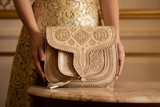
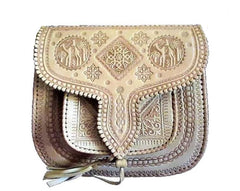
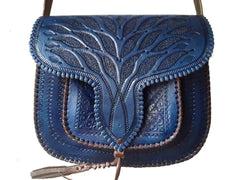
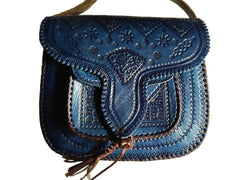
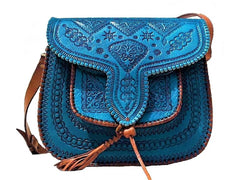
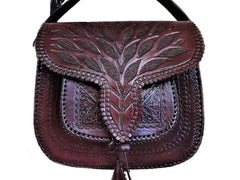
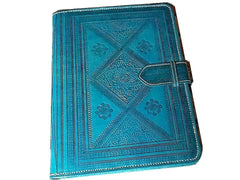
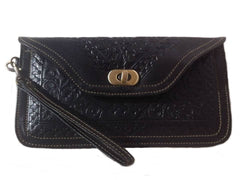
Today, the leather workshops of Tetouan are known for their fine embossing and tooling — geometric patterns pressed into the surface of the hide using hand-carved stamps, a vocabulary of motifs inherited directly from the Nasrid tradition of southern Spain. It is in these workshops that many of the Moroccan Corridor bags are made: the Heritage, the Rebel, the Médaillon.
The leather of Tetouan carries two civilisations in its grain.
What Full-Grain Leather Actually Means
The leather produced in the tanneries of Fès, Tetouan and Marrakesh is full-grain — the highest grade of leather, cut from the outermost layer of the hide, the part that faced the world during the animal's life.
Full-grain leather retains the natural surface of the hide: its grain, its subtle variations in texture, the marks that make each piece unique. It is not sanded, buffed or corrected. It is not coated with a uniform finish to hide imperfections. What you see is what the hide is.
This matters for one reason above all others: full-grain leather develops a patina over time. As it is used — carried, handled, exposed to light and air — it darkens at the points of contact, softens at the folds, deepens in colour and character. It becomes, over years, irreplaceable. An object that is unmistakably yours.
Most leather sold today is not full-grain. It is corrected grain — sanded smooth, embossed with an artificial texture, coated with polyurethane to create a uniform surface. It looks like leather. It does not age like leather.
The difference is not aesthetic. It is a question of what an object is made to do: last for a season, or last for a life.
A Living Craft
What makes Moroccan leather extraordinary is not simply its age. Many crafts are old. What makes it extraordinary is that it is alive — practiced today by craftsmen who have not abandoned the ancestral method in favour of industrial efficiency, because they understand that the method is the product.
The stone vats of Chouara, the embossing tools of Tetouan, the natural dyes of Marrakesh — these are not museum pieces. They are working tools, used every day, producing leather that will outlast the room it sits in.
At Moroccan Corridor, we source from these traditions deliberately. Not for the story — though the story is extraordinary — but for the leather itself. Because nothing produced industrially comes close to what a craftsman in Fès, Tetouan or Marrakesh produces by hand, with knowledge accumulated over ten centuries.
This is the leather in every bag we carry. This is what you carry when you carry one of ours.