
In brief
Le Corbusier’s relationship with Moroccan rugs forms part of the wider reception of Moroccan Berber weaving within European modernist architecture during the 1920s and 1930s. In Almanach d’architecture moderne, he explicitly discusses the place of Berber rugs in modern architecture in terms of scale, colour, geometry and warmth underfoot. The volume also captions a Berber rug in the antechamber of the Pavillon de l’Esprit Nouveau. These primary-source statements complement the secondary accounts discussed here, but do not establish that the individual rugs were specifically Beni Ourain. [3][1][2]
A handmade rug inside a modernist building can look like an unexpected pairing. Yet the relationship between Moroccan weaving and modernist architecture is more than a contrast of surfaces. It is a history of reception: how an existing textile tradition entered another design context, and what that encounter revealed. Le Corbusier’s own published discussion gives this encounter a direct textual basis, alongside later historical interpretations.
Moroccan Rugs in a Modernist Project
In her study La « lettre à Mme Meyer » de Le Corbusier. Une fiction manifeste ?, Guillemette Morel Journel examines an illustrated architectural proposal dated October 1925.
The document presents an imagined visit through a villa designed for a client. Drawings and written descriptions work together to make an unbuilt space feel tangible.
Discussing the boudoir overlooking the salon in the Meyer proposal, Morel Journel interprets the drawn carpets as contributing depth, warmth and a sense of habitation. She then identifies them as “simples tapis berbères” and notes their presence in the Pavillon de l’Esprit Nouveau, realised in 1925. [1]
Her account connects the rugs to two different settings: an illustrated proposal for an unbuilt villa and an exhibition building. The drawings document an architectural presentation, not a completed interior. The reference to the Pavillon provides a separate historical connection.
Le Corbusier’s Own Words: Scale, Geometry and the Berber Rug
The section “Des tapis décoratifs” in Le Corbusier’s Almanach d’architecture moderne adds a primary source to this discussion. On printed page 170, the photograph’s caption identifies a Berber rug in the antechamber of the Pavillon de l’Esprit Nouveau. On page 171, the text explicitly considers the relationship between Berber rugs and modern architecture. [3]
« Répétons : un tapis berbère donne de l’échelle à une architecture. »
Moroccan Corridor translation from the French: “Let us repeat: a Berber rug gives scale to an architecture.”
The discussion then relates the rug’s colour and geometry to the materials and surfaces of walls and furniture, and acknowledges warmth underfoot. Here the textile is not described only as decoration: it has a place in the perception of proportion, in the relationship between surfaces, and in bodily experience. This is our reading of the published passage, not an attempt to reconstruct a private response to an individual carpet. [3]
« Faire comme les Berbères : allier à la géométrie la plus notoire fantaisie. Mais définir la fantaisie. »
Moroccan Corridor translation from the French: “Do as the Berbers do: combine geometry with the most conspicuous imaginative freedom. But define that imaginative freedom.”
We translate fantaisie here as “imaginative freedom,” an interpretive choice rather than a fixed technical equivalent. The final sentence matters: the passage does not simply celebrate geometry without qualification. It brings geometry and expressive variation into relation, then asks that this variation be defined.
These words establish an explicit aesthetic reference to Berber weaving within Le Corbusier’s published architectural discourse. They do not establish that the pictured rug was Beni Ourain, that he personally owned it, or that European recognition originated the tradition’s value. The historical designation “Berber” is retained in the quotations; it should not silently be replaced with a narrower regional attribution.
A Wider Modernist Reception
Le Corbusier was part of a broader reception of Moroccan textiles.
These accounts suggest that the historical significance lies not in a single architect’s discovery of Moroccan rugs, but in the emergence of Moroccan Berber textiles within a wider modernist design culture.
In Antique Moroccan Rugs, Gebhart Blazek writes that appreciation of the carpets’ “spontaneous and bold character” began among modernist architects in the 1920s and 1930s. He names Le Corbusier, Alvar Aalto and Marcel Breuer, describing their integration of Moroccan Berber carpets into interiors and their promotion through presentations and interior shops. [2]
This supports a history involving several architects and channels of exposure. It does not demonstrate that one architect’s enthusiasm caused the choices of all the others.
Nor did European attention mark the beginning of the textiles’ history. Blazek describes rural Moroccan carpets as objects made principally for personal and domestic needs, including use as bedding and blankets, with weaving knowledge passed through generations. [2]
Moroccan weaving belongs to a much broader landscape of regional craft traditions, each shaped by its own geography, materials and visual vocabulary. See our Moroccan craft traditions guide for an overview.
Modernist reception was a new context for these objects, not their origin.
Where Beni Ourain Fits: What the Historical Evidence Does—and Does Not—Show
The sources discussed here use the broader category “Berber carpets.” They do not identify every textile as Beni Ourain. The Almanach likewise uses “tapis berbère,” not a specific Beni Ourain attribution. [3]
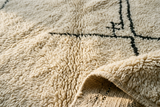
That is an important limit because an ivory ground and dark geometric drawing are not exclusive to one weaving tradition.
Blazek describes white or cream-ground carpets among the Beni Ouarain confederation, as well as Beni Alaham, Marmoucha and Aït Seghrouchène communities in the Middle Atlas. He also discusses the historical presence of related colour traditions elsewhere in the region. [2]
For the regional context, explore our guide to Middle Atlas weaving traditions.
A rug’s appearance may therefore suggest a regional relationship without establishing its precise attribution. To identify an individual historical carpet as Beni Ourain, a dated image needs supporting documentation: an inventory, a catalogue description or another reliable record.
For the history and characteristics of the tradition itself, read our Beni Ourain guide.
The distinction does not weaken the connection with modernism. It makes the account more accurate—and keeps different Moroccan weaving traditions from disappearing beneath a single familiar name.
To explore how Beni Ourain, Azilal, Beni M’Guild, Boujad and other traditions differ within the broader Moroccan rug landscape, see our complete guide to Moroccan rugs.
Geometry Without Uniformity
The visual relationship remains worth exploring, even where an individual carpet’s attribution is unresolved.
At Moroccan Corridor, we read this relationship as an encounter between architectural order and the variability of a handmade surface. The Almanach’s pairing of geometry with fantaisie provides a published point of reference for that discussion, without determining how every carpet should be read. [3]
In a woven textile, a line is not simply drawn. It acquires thickness through yarn, rhythm through knots and a particular presence through the surrounding pile. A geometric composition can remain legible while changing in spacing, direction or emphasis.
Blazek draws attention to changes in composition during the weaving of Middle Atlas carpets, describing them as “conceptual fractures.” His account offers a more precise way to discuss these textiles than treating them as uniformly minimalist. [2]
Our reading is that geometry does not make the carpet equivalent to an architectural plan. The textile introduces a different material expression of line and proportion.
This is a curatorial interpretation. It does not presume to recover an individual weaver’s intention or Le Corbusier’s private response to a particular rug.
Warmth and the Representation of Habitation
Morel Journel’s analysis adds another dimension: the role of the rug in making an architectural space appear inhabited.
In the Meyer proposal, she reads the drawn carpets as contributing warmth to an interior the client might otherwise have found cold. This is the historian’s interpretation of the presentation, rather than a direct statement by Le Corbusier about that proposal. [1]
The Almanach provides a separate direct reference to warmth underfoot in its discussion of rugs. That published remark supports a tactile dimension to the architectural discussion; it should not be treated as a statement of intent for the Meyer drawings. [3]
The observation is useful because it moves the discussion beyond pattern alone. A rug is also a surface associated with touch, use and domestic life.
Within an architectural drawing, such an object can help turn an arrangement of walls, openings and levels into the image of a place someone might occupy. The carpet participates in the presentation of the space, not merely its ornament.
Recognition Is Not Origin
A modernist lens can bring attention to abstraction and compositional freedom. It can also obscure the textile’s own history.
When a Moroccan rug is discussed only through its association with a celebrated architect, its makers, regional context and original uses become secondary. European recognition begins to sound like the source of its value.
We prefer a different distinction: reception is not origin.
The architects’ interest belongs to design history. The weaving belongs to traditions with their own material knowledge, uses and forms of expression. Neither needs to be collapsed into the other.
Describing Amazigh weaving as having “predicted” modernism is therefore less useful than recognising that distinct practices can share visual affinities without sharing an origin or purpose.
What the Historical Sources Establish
Three sources contribute different kinds of evidence. Le Corbusier’s Almanach supplies a primary published discussion and a caption identifying a Berber rug in the Pavillon. Morel Journel examines the role of carpets in a specific architectural presentation and notes their presence in the Pavillon of 1925. Blazek situates Le Corbusier within a broader reception of Moroccan weaving by modernist architects.
On narrow screens, scroll the table horizontally to read all four columns.
| Source | Historical context | What the source supports | Limit of the evidence |
|---|---|---|---|
| Le Corbusier, Almanach d’architecture moderne, “Des tapis décoratifs,” pp. 170–171 [3] | Published discussion of rugs and the Pavillon de l’Esprit Nouveau | Captions a Berber rug in the Pavillon’s antechamber and explicitly discusses scale, colour, geometry, warmth and the place of rugs in modern architecture. | Does not provide a Beni Ourain attribution or establish personal ownership. The date of the consulted edition is not specified in the supplied pages. |
| Guillemette Morel Journel, study of the “Letter to Mme Meyer” [1] | Villa Meyer proposal, October 1925 | Identifies Berber rugs in the drawings and interprets them as contributing depth, warmth and a sense of habitation. | The drawings represent an unbuilt project, not a completed interior. The passage does not identify the rugs as Beni Ourain. |
| Guillemette Morel Journel, same study [1] | Pavillon de l’Esprit Nouveau, 1925 | Notes the presence of Berber rugs in the Pavillon. | The passage does not provide an individual carpet attribution or establish ownership by Le Corbusier. |
| Gebhart Blazek, Antique Moroccan Rugs [2] | Modernist reception, 1920s–1930s | Names Le Corbusier, Alvar Aalto and Marcel Breuer among architects who incorporated Moroccan Berber carpets into interiors. | The passage describes a broader reception, not a building-by-building inventory or a causal chain between architects. |
| Gebhart Blazek, “Middle Atlas” section [2] | Regional weaving traditions | Describes white or cream-ground carpets in several Middle Atlas traditions, including Beni Ouarain. | Colour and geometric appearance alone do not establish the attribution of a historical carpet. |
This table summarises one primary source and two secondary sources, not five independent confirmations. The two Morel Journel rows come from the same study; the two Blazek rows come from the same article. It distinguishes a published architectural statement, evidence of architectural use, scholarly interpretation and regional textile attribution.
Read together, these sources support a history of architectural reception, including Le Corbusier’s own published appreciation of Berber rugs. None of the passages cited establishes the attribution of an individual historical carpet to the Beni Ourain tradition. This distinction allows the connection to be discussed without making the evidence more specific than it is. [3][1][2]
Moroccan Corridor’s Perspective
The relationship between Le Corbusier and Moroccan rugs is worth studying precisely because it is more complex than a discovery story.
The evidence discussed here places Berber rugs within Le Corbusier’s architectural context by 1925, documents his published discussion of their architectural qualities, and situates his interest within a broader modernist reception. It also leaves open the attribution of individual textiles.
For Moroccan Corridor, this distinction matters. We approach Moroccan rugs not only as interior objects, but as expressions of Morocco’s living craft traditions, regional textile knowledge and design history.
Our perspective is therefore one of curation: to connect Moroccan craftsmanship with contemporary interiors while preserving the historical, regional and material context from which these objects come.
A carpet can belong to the story of modernism without modernism becoming its explanation.
For a broader overview of Moroccan weaving traditions and the rugs currently selected by Moroccan Corridor, explore Moroccan rugs.
For practical advice rather than historical context, see How to Style a Beni Ourain Rug in a Scandinavian Interior.
Frequently Asked Questions
What connects Le Corbusier with Moroccan rugs?
In Almanach d’architecture moderne, Le Corbusier explicitly discusses Berber rugs in relation to modern architecture, and a caption identifies a Berber rug in the Pavillon de l’Esprit Nouveau’s antechamber. Morel Journel examines rugs in his architectural context, while Blazek places him within a wider modernist reception of Moroccan Berber carpets. [3][1][2]
Were the rugs specifically Beni Ourain?
The passages cited here do not identify the individual carpets as Beni Ourain. The Almanach uses “tapis berbère,” a broader designation. An ivory ground with dark geometric motifs is insufficient on its own to establish a Beni Ourain attribution. [3][1][2]
What role did Moroccan rugs play in these architectural settings?
The Almanach directly discusses scale, colour, geometry and warmth underfoot. Separately, Morel Journel interprets the drawn rugs in the Meyer proposal as contributing spatial depth, warmth and a sense of habitation. Her reading of that proposal should be distinguished from Le Corbusier’s published remarks about rugs. [3][1]
Was Le Corbusier responsible for making Moroccan rugs popular?
The sources discussed here place Le Corbusier within a broader modernist reception of Moroccan Berber carpets, rather than establishing him as solely responsible for their popularity. Gebhart Blazek also names Alvar Aalto and Marcel Breuer in this wider context. [2]
What is the difference between a Berber rug and a Beni Ourain rug?
“Berber carpet” is a broader designation encompassing several Moroccan weaving traditions. Beni Ouarain is one regional tradition associated with the Middle Atlas. The appearance of a rug alone is not sufficient to establish a precise attribution. [2]
Sources and Editorial Method
Bibliography
[1] Guillemette Morel Journel, La « lettre à Mme Meyer » de Le Corbusier. Une fiction manifeste ?, pp. 35–48, OpenEdition Books. Relevant passage: the discussion of sequence [6], concerning the boudoir, the drawn carpets and the Pavillon de l’Esprit Nouveau.
[2] Gebhart Blazek, Antique Moroccan Rugs, Berber Arts. Relevant passages: the opening discussion of modernist reception and the section “Middle Atlas.”
[3] Le Corbusier, Almanach d’architecture moderne, “Des tapis décoratifs,” pp. 170–171. The reproduced title page bears the imprint Les Éditions G. Crès et Cie, Paris, Collection de “L’Esprit Nouveau.” Consulted in supplied extracts from a digitised copy, including the title pages, the preface dated November 1925 and the spread containing printed pages 170–171. The preface date is not treated as the publication date of the volume or of the consulted edition. The publication date of the consulted edition is not established by these extracts; no date has been inferred from the later Italian introductory material. Page references follow the printed pagination, not the PDF viewer’s page count.
Editorial Method
The short French excerpts retain the source’s wording with typographic normalisation of spacing and apostrophes. English translations are by Moroccan Corridor and are identified as translations; “imaginative freedom” is our rendering of fantaisie. We do not reproduce the full OCR extraction, whose recognition errors should not be mistaken for original spellings.
Moroccan Corridor distinguishes Le Corbusier’s published statements, the observations and interpretations reported by the secondary authors, and its own curatorial reading. The sources cited here support the relationship between Moroccan Berber rugs and modernist architecture; the attribution of individual historical textiles requires additional documentation.
This page is intended as an editorial and historical resource, not as a catalogue attribution of the individual carpets represented in historical architectural imagery.