
In brief: A leather portfolio can be a thoughtful professional gift when its format suits the recipient’s working habits. Start with what the person carries and uses, then consider colour, craft and presentation. For several recipients, confirm the details of the selected model, expected variations, availability and delivery arrangements before committing to an order.
A professional gift has two lives.
The first is brief: a package is opened, a note is read, an acknowledgement is exchanged. The second begins afterwards, when the recipient decides where the object belongs.
On a desk. Inside a work bag. Beside the notebook they take to meetings.
Or nowhere in particular.
Choosing well means thinking about that second life before arranging the first. Not simply what will look considered when presented, but what might remain useful once the occasion has passed.
For Moroccan Corridor’s Heritage portfolios, this is a more meaningful starting point than the idea of an impressive gift. The question is whether the object has a place in the working life of the person receiving it.
An occasion is not a brief
A new partnership, a team welcome and a thank-you to a long-standing client may all call for a gift. They do not necessarily call for the same one.
The occasion explains why you are giving. It does not yet explain what the recipient would value.
Before choosing a portfolio, consider what you know about the person’s day. Do they bring a notebook to meetings? Work with printed proposals or drawings? Keep a small selection of documents close at hand? Move between a studio, an office and conversations elsewhere?
These observations are more useful than a job title alone.
A portfolio may be relevant to someone whose work moves between paper, notes and face-to-face exchanges. It may be less useful to a person who rarely carries physical documents and already has a system they prefer.
A thoughtful choice leaves room for that distinction. It does not ask the recipient to adopt a new working identity simply to accommodate the gift.
Choose the role before the object
“Something for work” is a broad category. A portfolio has a more particular role.
It can keep selected papers and small essentials together, offering a defined place for things that might otherwise sit loose inside a larger bag. It need not replace that bag, and it should not be chosen on the assumption that it will.
This matters when buying for another person. A gift becomes easier to use when its purpose is clear and modest.
For a recipient who travels with a backpack, a flatter portfolio might accompany meetings rather than the commute itself. For someone working across several projects, it might hold the documents for one conversation rather than their entire day.
The distinction is between adding a useful possibility and prescribing a routine.
Our guide to Heritage leather portfolios and briefcases explores the practical differences between formats. For a gift, those differences deserve attention before colour or decoration enters the decision.
Character without a prescribed identity
A professional gift can feel personal without claiming to know everything about its recipient.
Colour is part of that balance.
A restrained shade may be appropriate when you know little about someone’s preferences. A more expressive colour can be a considered choice when it reflects something you have genuinely noticed: the objects on their desk, the colours they wear or the visual world of their studio.
Neither approach is automatically more thoughtful.
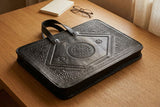
The Heritage Turquoise Portfolio offers an alternative to the expectation that a working object must disappear into black or brown. Its embossed decoration gives the surface detail to return to, while the colour makes the choice feel distinct.
But a company’s signature colour is not, by itself, a reason to choose the same shade for every recipient.
The gift will eventually leave the setting in which it was selected. It should be able to belong to the person who receives it, not only to the identity of the organisation giving it.
Let the object carry its own detail
The Heritage portfolios considered in our collection guide bring handworked leather and decorated surfaces into a contemporary working format.
For gifting, those details can offer a natural point of interest. There is something to notice beyond the category of the object: the relationship between the embossed surface and its borders, the finishing at the edges, the arrangement revealed when it opens.
That does not require an elaborate story attached to the gift.
A short, accurate introduction is more convincing than a sweeping claim about timeless tradition or an unnamed artisan. Describe the selected piece through what is documented and what can be seen. If a particular workshop, maker or process is not established, leave the claim out.
The object does not become less interesting because its story is told with care.
It becomes easier to trust.
One recipient, several recipients
Choosing for one person allows for specific knowledge. Choosing for a team or a group of partners asks a different question: what should remain consistent, and where can there be room for difference?
A single model and colour can create a coherent group. A selection of colours can give recipients a measure of choice. Either approach can work, provided the decision is deliberate rather than an assumption that everyone will want the same thing.
Handcrafted pieces also need to be considered as individual objects. The Heritage product listings note that colour, dimensions and design may vary slightly between pieces.
That variation should be discussed before an order, especially if the portfolios will be presented together. It should not arrive as an explanation after someone notices a difference.
Nor should “handmade” become a blanket answer to every concern. Agree on the selected model and clarify which variations to expect. If close visual consistency is important to the occasion, raise that requirement at the beginning.
A shared standard of suitability matters more than an unsupported promise of identical pieces.
Plan backwards from the occasion
For a dated event, the useful deadline is not simply the day the gift will be handed over.
Time may also be needed to receive the pieces, check them, prepare accompanying notes and organise their presentation or onward delivery.
Before committing to several portfolios, confirm the quantity and model, current availability, any production requirements, the delivery destination and the proposed schedule. Ask what presentation or packaging is actually included rather than assuming a particular format.
If personalisation is essential, establish whether it is available for the selected model before building the project around it.
These are not details to leave until the order feels complete. They are part of deciding whether the gift suits the occasion.
A clear conversation early on protects both the intention and the practical arrangements behind it.
The note can do the explaining
An object does not need to carry the entire message.
Often, a brief note is the right place to explain why it was chosen: a thank-you for a particular collaboration, recognition of work completed together or a welcome grounded in the role someone is about to begin.
Specificity matters more than length.
A note that acknowledges a real contribution can give context to a useful object without turning it into a permanent reminder of the giver.
The portfolio can then go on to hold something else: the recipient’s papers, their notes, their next project.
That freedom is part of a well-chosen gift.
After the occasion
The most useful question may also be the simplest.
Can you picture this person reaching for it on an ordinary working day?
Not displaying it out of courtesy. Not keeping it because it was presented formally. Using it because its format makes sense and its character appeals to them.
There is no way to guarantee that outcome. But choosing with the recipient’s habits in mind gives the decision a stronger foundation than novelty alone.
A Heritage portfolio need not stand for a profession, a milestone or an organisation every time it is opened.
It can become an object of someone’s own.
Choose for the moment of giving. Think further, to the days that follow.
For a closer look at how a portfolio can accompany preparation and presentation, read The Quiet Work Object.