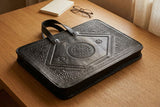

In brief: A leather portfolio gives a selected part of your working day a place of its own. Rather than carrying everything, it holds what you want close at hand and ready to share. This is the perspective behind this look at Moroccan Corridor’s Heritage portfolios: not simply how they organise belongings, but how they accompany the moment of presenting your work.
Before a meeting, there is a quieter act of preparation: deciding what deserves to come with you.
A page of notes. A drawing. A proposal you have read once more before leaving. Not everything involved in making the work needs to accompany its presentation.
A portfolio gives that selection a frame.
The interest is not in appearing more important, or in replacing every other bag you use. It is in the relationship between preparation and presentation. What you choose. What you keep within reach. What you place on the table when the conversation begins.
The Heritage portfolio belongs to that small sequence of gestures.
The work before the meeting
Much of a working day is spent gathering. Files accumulate, messages arrive, notes spread across screens and notebooks. Preparing to meet someone asks for a different movement: reducing that material to what is relevant now.
What needs to be shown? What is only there as a reference? What can stay behind?
These decisions happen before a portfolio is opened. The object does not make them for you. But choosing what to place inside it can become part of that preparation.
A printed proposal might need a few handwritten questions beside it. A drawing may speak more clearly without the rest of the sketchbook. A single sheet can be enough to give a conversation its starting point.
The point is not to carry less as a rule. It is to know why something has come with you.
From carrying to presenting
A bag accompanies the journey. A portfolio can have a more focused role once you arrive.
The two need not compete. You may travel with a backpack or a larger bag and bring out only the portfolio for the meeting itself. One carries the wider day; the other holds the part you are about to share.
This distinction is more useful than an argument about which object looks more professional. Different journeys require different things. A long commute, a walk across town and a meeting in the next room do not call for identical arrangements.
What matters here is the transition.
You arrive. You put away what you no longer need. You place the portfolio beside you, or on the table where space allows. The contents of the journey give way to the subject of the conversation.
Nothing about that needs to be ceremonial. It can be a simple way of being ready.
The moment of opening
There is a brief interval between placing an object on a table and taking something from it.
With a portfolio, opening is part of using. You see the arrangement, reach for a document and decide what to bring forward first.
The Heritage Turquoise Portfolio offers one concrete expression of this: a flatter format with defined interior pockets and a pen holder. Here, those details matter less as a list of features than as places for the things you have selected.
A page kept apart from loose notes. A pen available when a question changes the direction of the discussion. A document returned to its place rather than folded into whatever space remains.
These are modest gestures. Their value lies in their usefulness, not in an audience noticing them.
The portfolio should not become the presentation. It should make room for it.

Paper beside the screen
A portfolio does not need to stand against digital work.
A presentation may begin on a laptop and continue over a printed plan. Notes made on paper may later become an email, a revised drawing or a shared document. The same project can move between formats without belonging exclusively to any of them.
Paper offers particular possibilities. A page can be turned towards another person, placed beside a second version or marked while a question is being discussed. Sometimes that is useful. Sometimes the screen is the clearer choice.
The question is not which medium is more authentic. It is which one serves the exchange.
A portfolio can give paper a deliberate place within that mixed working life. Not as a rejection of technology, but as a way to keep a few physical documents together and ready when they are needed.
An object of your own
Professional objects do not have to erase personal preference.
A working wardrobe, a notebook and a portfolio can belong to the same person without becoming a matching set. Nor does every choice need to communicate ambition, seniority or a particular creative identity.
Sometimes you choose an object because you like its proportions. Because a colour continues to interest you. Because you enjoy the material each time you pick it up.
Within Heritage, leather, geometric decoration and worked edges give an everyday format a distinct character. That character can remain present without demanding an explanation every time the object is used.
This is a quieter way to think about a work accessory: not as evidence of who you are, but as something you are comfortable making part of your day.
Quiet does not necessarily mean neutral in colour. It can mean that the object has a clear role and does not need to do more.
What stays on the table
Once the meeting begins, the portfolio may sit open beside a notebook. It may be closed again after the first document has been taken out. For much of the conversation, you may not think about it at all.
That is not a failure of design or character.
A useful object does not need continuous attention. It can be distinctive when you look at it and unobtrusive when the work asks you to look elsewhere.
This is where the idea of the quiet work object becomes most convincing. Not in a promise to transform a meeting, but in a few specific tasks performed without fuss: keeping selected things together, making them accessible and accompanying their use.
The work remains yours.
So does the decision about what to bring forward.
Not everything you carry needs to be presented. What you present deserves a place of its own.
For a closer look at the formats, materials and interior arrangements, read Heritage Leather Portfolios & Briefcases: A Moroccan Expression of Work.