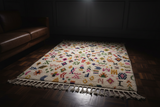

Some rugs ask to be studied. An Azilal rug demands it.
We have spent the past several months working directly with weavers in the High Atlas province of Azilal — travelling to villages in the Aït Bou Gmez valley, sitting with the women who make these pieces, and selecting, one by one, the rugs that would form this new collection. The result is a group of works that we believe represents the tradition at its most compelling: vivid, asymmetric, entirely individual.
This is not a curated selection of similar pieces. It is a collection of singular objects.
Why Azilal, Why Now
The Azilal rug has had a quiet decade of growing recognition among designers and collectors — and for good reason. In a market where most rugs are produced to a template, an Azilal is the opposite: composed directly on the loom, without a fixed pattern, by a weaver making real-time decisions about colour, motif, and composition. The result is a piece that cannot be reproduced, only found.
We have long believed that the Azilal tradition is underrepresented in the premium rug market relative to its quality. Beni Ourain rugs — with their monochrome palette and geometric restraint — have dominated the conversation for years. Azilal rugs offer something different: warmth, colour, and a compositional energy that transforms a room.
This collection is our argument for that position.
What We Selected, and Why
Every piece in this collection was chosen for a specific reason. We were not looking for the most decorative or the most colourful — we were looking for the most resolved: rugs where the weaver’s compositional decisions feel intentional, where the relationship between the natural wool ground and the coloured motifs is genuinely considered.
- Wool quality. The best Azilal rugs are made from hand-spun mountain wool — denser, lanolin-rich, and more resilient than commercially processed alternatives. Every piece in this collection meets that standard.
- Dye integrity. We prioritised rugs using natural dyes — saffron, indigo, henna, pomegranate rind — or high-quality fixed synthetics that will not bleed or fade. Each piece has been assessed for colourfastness.
- Compositional individuality. We passed on many technically accomplished rugs because they felt derivative — too close to a recognisable template. The pieces we selected have a quality of genuine invention.
How to Place an Azilal Rug
In a minimal space, an Azilal rug becomes the room’s primary visual event. Let it. Keep surrounding furniture in natural materials — linen, oak, raw plaster — and allow the rug’s colour to do the work.
In a layered interior, the abstract quality of Azilal motifs means they coexist well with other patterns. They do not compete with botanical prints or geometric textiles in the way that more structured rug designs might.
Under furniture, consider that much of the rug will be obscured. Choose a piece where the visible border and exposed field are as strong as the centre — Azilal rugs, with their all-over compositions, tend to hold up well under this condition.
On the wall, the best Azilal pieces — particularly smaller formats — work as textile art. The compositions are strong enough to carry a wall without additional framing.
For a full guide to the tradition — its origins, characteristics, and symbolic vocabulary — see our reference page: Azilal Rugs — Colour and Abstraction from the High Atlas.
On Sourcing and Provenance
Every rug in this collection comes with documented provenance: the region of origin, the tribal group, and where possible the weaver’s name and community. We believe this information matters — not as a marketing claim, but as a record of where the object came from and who made it.
The Azilal province is not a production centre in the industrial sense. There are no workshops, no middlemen aggregating output for export. The rugs are made in homes, by women who have learned the practice from their mothers and grandmothers, and they reach the market through a network of local souks and trusted intermediaries. Our sourcing works within that network, not around it.
We pay above-market prices at the point of purchase. We do not negotiate down.
The Collection
The new Azilal collection is available now. Each piece is listed individually, with detailed photography, dimensions, and provenance notes.
If you have questions about a specific piece — its wool, its dyes, its provenance — write to us. We know these rugs individually and can answer in detail.
FAQ
Is this collection available to ship internationally? Yes. All pieces in the Azilal collection ship worldwide. Delivery times and duties vary by destination — full details are available at checkout.
Are these rugs truly one of a kind? Yes. Every Azilal rug in this collection is a unique piece — composed directly on the loom without a fixed pattern. Once sold, it cannot be reproduced. We list each piece individually for this reason.
What wool is used in these rugs? The rugs in this collection are made from hand-spun mountain wool sourced from High Atlas flocks. The wool is lanolin-rich, naturally resilient, and processed without industrial bleaching or chemical treatment.
Do the rugs use natural or synthetic dyes? We prioritised natural dyes — saffron, indigo, henna, pomegranate rind — in our selection. Where synthetic dyes are present, we verified colourfastness before inclusion. Each product listing specifies the dye type.
How do I care for my Azilal rug? Vacuum regularly without a beater bar. Spot-clean with cold water and mild soap. Rotate periodically for even wear. For deep cleaning, hand-wash or use a specialist rug cleaner. Avoid prolonged direct sunlight if the rug uses natural dyes.
Can I find out more about the weaver or the rug’s origin? Yes. Each piece comes with documented provenance — region, tribal group, and where possible the weaver’s name. Write to us with your order reference and we will share everything we know.
What makes an Azilal rug different from a Beni Ourain? Beni Ourain rugs work in a restrained natural palette — ivory ground, dark geometric motifs. Azilal rugs introduce colour and compositional freedom: vivid dyes, asymmetric arrangements, and a more improvisational quality. For a full comparison, see our guide: Azilal Rugs — Colour and Abstraction from the High Atlas.
For the full reference guide to Azilal rugs — their history, characteristics, and place within the Moroccan textile tradition — visit Azilal Rugs — Colour and Abstraction from the High Atlas.