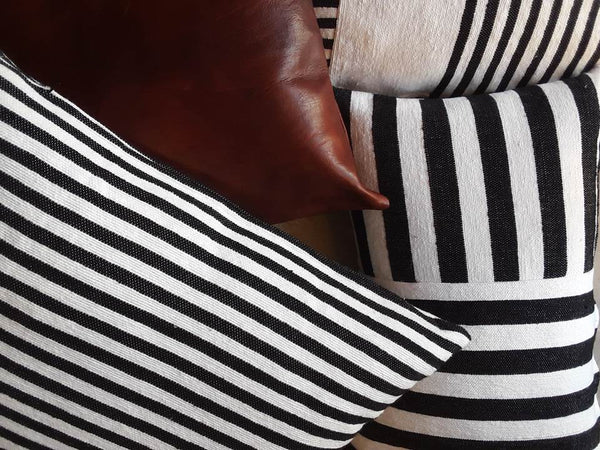
A throw pillow is a small object with a disproportionate effect on a room. It introduces colour, texture, and pattern at eye level — the zone of a space that registers most immediately when you enter it. A well-chosen pillow can resolve a room that feels unfinished; a poorly chosen one can undermine furniture that cost ten times as much. The Moroccan Corridor pillow collection is built around this understanding: each piece is designed to work as a considered object in a considered interior, not as a decorative afterthought.
Every pillow in the collection is handwoven in Morocco by artisans working on traditional wooden looms, using techniques that have been refined over generations. The designs are contemporary in sensibility — clean lines, restrained palettes, geometric structures — but the making is entirely traditional. No industrial production. No shortcuts.
Handwoven in Morocco
Morocco has one of the richest textile traditions in the world — a convergence of Amazigh weaving, Andalusian pattern-making, and sub-Saharan colour vocabulary that has produced a distinctive craft language unlike anything found elsewhere. The Moroccan Corridor pillow collection draws on this tradition without reproducing it literally: the techniques are ancestral, the aesthetic is contemporary.
Each pillow is woven from start to finish by a single artisan or a small team working in sequence. The loom is set up with the warp threads — the structural foundation of the textile — stretched and tensioned by hand. The weaver then passes the weft thread horizontally through the warp, row by row, building the pattern from the bottom up. There is no template on the loom, no mechanical guide. The pattern exists in the weaver's hands and memory.
The result is an object that is genuinely unique. Small variations in tension, colour, and pattern accumulate naturally over the course of weaving and give each piece a specific character that machine production cannot replicate.
Each unique pillow style is made by hand in Morocco, carefully fabricated on age-tested wooden looms with techniques that have been passed down for generations.


This collection was designed to showcase the beauty of handwoven Moroccan textiles — bold design, clean lines, and a palette that works across a wide range of interior styles. Each pillow brings together innovative design and ancient craftsmanship.
Each piece has a story to tell — made by hand, one row at a time, by artisans who have spent years mastering their craft.

The Techniques Behind the Collection
The collection brings together four distinct weaving and finishing techniques, each producing a different surface quality and visual character. Understanding the differences helps in choosing the right piece for a specific interior context.
Striped Weaving
The striped pillow is the foundational form of the collection — the most direct expression of the woven structure. The stripe pattern is created by alternating coloured warp threads before weaving begins: the arrangement of threads on the loom determines the width, spacing, and colour sequence of the stripes. Once the warp is set, the pattern is fixed. The weaver's skill is expressed in the evenness of the tension and the density of the weave rather than in pattern variation.
The collection includes striped pillows in a range of formats — square, lumbar, and oversized — and a palette centred on black, white, and grey, with occasional warm accents. The restraint of the palette is deliberate: these are pieces designed to work with existing interiors rather than compete with them.
Bouclé
Bouclé is a looped yarn technique that produces a textured, tactile surface — the characteristic nubby appearance that has made bouclé one of the most sought-after textile finishes in contemporary interiors. The loops are created during the spinning process, by feeding two threads at different tensions so that one forms loops around the other. The resulting yarn is then woven in the standard way, but the looped surface gives the finished textile a depth and warmth that flat-woven alternatives cannot match.
The Moroccan Corridor bouclé pillows are available in white, cream, and black — colourways chosen for their versatility and their compatibility with the neutral, material-focused interiors where bouclé performs best.
Pompom Pillows
The pompom is one of the most recognisable elements of Moroccan textile craft — a finishing detail that appears on everything from wedding blankets to market bags. In the context of a throw pillow, it functions as a textural accent: the woven body of the pillow provides the structure, and the pompoms at the corners or edges introduce a playful, three-dimensional quality that softens the geometry of the weave.
The pompoms are made by hand — wound, tied, and trimmed individually — and attached to the finished pillow cover. No two pompoms are identical in size or density, which gives the finished piece a handmade quality that is immediately apparent.
Leather Pillows
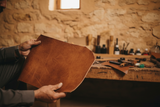
The leather pillow is the most distinctive piece in the collection — a direct extension of the Moroccan leather craft tradition into the textile domain. Full-grain goatskin, tanned and dyed using the same methods used for poufs and bags, is cut and assembled into pillow covers with the same precision applied to any leather object. The result is a pillow that is simultaneously soft and structured — the leather yields to pressure but returns to its shape, and develops a patina over time that woven textiles cannot replicate.
The leather pillow collection is available in black and natural tones, in square formats with geometric panel constructions.
How to Style Moroccan Throw Pillows
The most common mistake with throw pillows is using too many of the same type. A sofa covered in identical cushions reads as a showroom display rather than a lived-in space. The more effective approach is to combine different textures and scales within a restrained palette — a bouclé square with a striped lumbar, for example, or a leather panel pillow alongside a pompom accent.
The black, white, and grey palette of the Moroccan Corridor collection is designed for exactly this kind of combination. The pieces work together because they share a colour language, but they differ enough in texture and format to create visual interest without visual noise. A set of three — one bouclé, one striped lumbar, one pompom — covers most sofa configurations and most interior palettes.
For rooms with warmer tones — terracotta, ochre, natural linen — the cream and brown variants provide a more harmonious integration. For rooms with cooler, more graphic palettes — concrete, dark wood, matte black — the high-contrast black and white pieces perform best.
The Collection
Every piece in the collection is handwoven in Morocco and available for international shipping. Pillow covers are sold without inserts as standard — this keeps shipping costs reasonable and allows you to use inserts of your preferred firmness.


Frequently Asked Questions
What are Moroccan throw pillows made of?
The Moroccan Corridor pillow collection uses several materials depending on the technique: hand-spun wool or cotton for striped and bouclé woven covers, wool yarn for pompom finishes, and full-grain goatskin for leather pillow covers. All materials are sourced and processed in Morocco.
Do the pillow covers come with inserts?
No — pillow covers are sold without inserts as standard. This keeps international shipping costs reasonable and allows you to use inserts of your preferred firmness and fill material. Standard insert sizes (45×45cm for square covers, 30×50cm or 35×55cm for lumbar covers) are widely available.
How do I care for a handwoven Moroccan pillow cover?
Woven covers should be hand-washed in cold water with a gentle detergent, or dry-cleaned. Do not machine wash or tumble dry — the heat and agitation can distort the weave and shrink the cover. Lay flat to dry. For leather covers, wipe with a clean dry cloth and condition with a natural leather conditioner every six to twelve months.
What is bouclé?
Bouclé is a looped yarn technique that produces a textured, nubby surface. The loops are created during the spinning process by feeding two threads at different tensions, so that one forms loops around the other. The resulting yarn is woven in the standard way, but the looped surface gives the finished textile a depth and warmth that flat-woven alternatives cannot match. Bouclé has become one of the most sought-after textile finishes in contemporary interiors.
Can Moroccan throw pillows be used outdoors?
The woven and leather covers in this collection are designed for indoor use. Prolonged exposure to moisture, direct sunlight, and temperature variation will damage both the wool and the leather. For covered outdoor spaces with limited sun and moisture exposure, the woven covers can be used with care — but they should be brought inside in wet weather.
How do I combine different pillow styles?
The most effective approach is to combine different textures within a restrained palette. A bouclé square with a striped lumbar, or a leather panel pillow alongside a pompom accent, creates visual interest without visual noise. The black, white, and grey palette of the collection is designed for exactly this kind of combination — the pieces share a colour language but differ enough in texture and format to work together without competing.