
Moroccan blankets inspire a particular kind of curiosity — about the hands that made them, the regions they come from, and the ways they can transform a space. Here are the questions we hear most often, answered with the depth they deserve.
Discovering Moroccan Blankets: First Encounters and Buying Direct
What's the earliest memory most people have of seeing or using a Moroccan blanket?
For many, the first encounter is sensory before it is visual — the weight of a wool throw on a cold night, or the flash of sequins on a market stall in Marrakech. For others, it is a photograph: a Handira draped over a whitewashed wall, or a pompom blanket folded at the foot of a riad bed. The memory tends to be specific and vivid, because Moroccan blankets have a presence that generic textiles do not.
Have people bought Moroccan blankets directly from artisans or souks in Marrakech, Fez, or elsewhere?
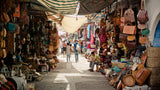
Many do, and the experience is formative. Buying directly from a weaver in the souks of Fez or from a cooperative in the Atlas Mountains connects you to the object in a way that no online transaction can fully replicate. You see the loom, you feel the fiber before it becomes a finished piece, and you understand — viscerally — why the price reflects the labor. That said, buying from reputable curated sellers who work directly with artisans offers the same provenance with greater consistency and accessibility.
Have people watched artisans weave blankets by hand on a loom? What stands out?
Those who have watched a Moroccan weaver at work consistently report the same thing: the speed is surprising, and the rhythm is hypnotic. The shuttle moves faster than you expect. The pattern emerges row by row, almost imperceptibly, from what looks like organized chaos. What stands out most is the absence of a pattern chart or written guide — the design lives in the weaver's memory, passed down through observation and practice rather than documentation.
Craft & Authenticity
Which Moroccan blanket styles are most recognized — Handira, Sabra, Beni Ourain-inspired, pompom, wedding blankets, or others?
The Handira is the most recognized internationally, largely because its sequined surface photographs exceptionally well and has been widely featured in interior design media. Pompom blankets are the most commonly purchased by travelers. Beni Ourain-inspired throws have found a strong following in minimalist and Scandinavian-influenced interiors. Sabra silk blankets are gaining recognition as the contemporary face of Moroccan textile design — vegan, lustrous, and distinctly modern in their color palette.
What materials are most often used in Moroccan blankets?
Wool dominates the Atlas and Berber traditions — warm, durable, and naturally water-resistant. Cotton is common in northern and coastal regions, and in lighter summer throws. Sabra — extracted from the agave cactus — is increasingly used for its silk-like sheen and lightweight quality. Many artisan pieces combine fibers: wool with cotton for breathability, or Sabra with wool for texture contrast. Metallic sequins, traditionally hammered aluminum, are the defining material of the Handira.
How are traditional wedding blankets woven and decorated?
The Handira — the Moroccan wedding blanket — is traditionally woven by Berber women of the Middle Atlas on horizontal ground looms. The base is undyed natural wool, typically ivory or cream, woven in a flat or slightly textured weave. Once the weaving is complete, metallic sequins are hand-sewn across the surface in patterns that vary by region and by the weaver's personal aesthetic. The sequins are believed to reflect the evil eye and bring protection to the bride. A single Handira can take several weeks to complete and is considered a deeply personal gift.
Which regions in Morocco are associated with the highest-quality blankets and weaving traditions?
The Middle Atlas — particularly the areas around Azilal, Beni Mellal, and Khenifra — is the heartland of Handira and Berber weaving. The High Atlas produces robust wool blankets suited to the cold mountain climate. The Rif Mountains, and Chefchaouen in particular, are known for their lighter, striped cotton and wool throws. Fez and Marrakech are centers of urban craft production, where traditional techniques meet contemporary design. Each region has a distinct aesthetic vocabulary shaped by its geography, climate, and cultural history.
What separates an authentic handmade Moroccan blanket from a mass-produced version?
Four things: irregularity, weight, fringe, and story. A handwoven blanket has slight variations in tension and pattern — the mark of a human hand rather than a machine. Its weight and hand-feel are distinctive: natural wool has a lanolin quality that synthetic fibers cannot replicate. The fringe on an authentic piece is an extension of the warp threads, not sewn on separately. And finally, a genuine piece has a story — a region, a weaver, a tradition. If a seller cannot tell you where a blanket was made and by whom, that absence is itself informative.
Style & Interior
What colors and patterns appear most often in Moroccan blankets?
The palette varies dramatically by style and region. Handira blankets are typically ivory or cream with silver metallic sequins. Beni Ourain-inspired throws favor undyed natural wool — cream, ivory, and warm white — with geometric patterns in dark brown or charcoal. Pompom blankets and Chefchaouen throws embrace bold color: vivid blues, reds, greens, and yellows in horizontal stripes. Sabra silk blankets tend toward jewel tones — deep teal, burnt orange, indigo, and saffron. Geometric patterns — diamonds, chevrons, and tribal motifs — are the dominant visual language across most traditions.
How do people style Moroccan blankets at home?
The most common uses are layering at the foot of a bed, draping over a sofa or armchair, and hanging on a wall — particularly for Handira blankets, whose sequined surface catches light beautifully. Lighter throws work well as picnic blankets or outdoor layers. The most effective styling tends to be simple: a single Moroccan blanket in a neutral room creates more impact than multiple competing textiles. Pairing with Sabra silk cushions in complementary tones creates a cohesive, considered aesthetic without effort.
Which interior styles pair best with Moroccan blankets?
Moroccan blankets are more versatile than their exotic reputation suggests. They are most naturally at home in bohemian interiors, where their texture and pattern feel organic among plants, rattan, and layered rugs. But they work equally well in minimalist spaces — a single Handira or Beni Ourain throw provides warmth and visual interest without clutter. Modern luxury interiors benefit from the tactile richness of a Sabra throw. Rustic and Scandinavian spaces are elevated by the natural wool tones of an Atlas blanket. The key is restraint: one strong Moroccan textile, well placed, is more powerful than many.
Have people styled Moroccan blankets in non-traditional ways that worked surprisingly well?
Yes — and some of the most compelling uses are the least expected. A Handira used as a tablecloth for a dinner party. A pompom blanket repurposed as a wall installation in a child's room. A Chefchaouen stripe throw used as a curtain panel in a studio apartment. A Sabra silk throw draped over a mid-century modern chair. Moroccan blankets have enough visual character to hold their own in almost any context — the constraint is imagination, not the textile itself.
Buying Guide & Mindset
What's the biggest misconception people outside Morocco have about Moroccan blankets?
That they are purely decorative, or purely ethnic. The most persistent misconception is that a Moroccan blanket belongs only in a certain kind of interior — maximalist, bohemian, or overtly "global." In reality, the best Moroccan blankets are simply exceptional textiles: well-made, beautiful, and durable. They belong wherever good craft belongs. The second misconception is that authenticity is easy to verify — it is not, and it requires either direct knowledge of the source or trust in a seller who has done that work on your behalf.
If someone were buying their first Moroccan blanket, what advice would you give them?
Start with use, not aesthetics. Decide first how you intend to use the blanket — warmth, decoration, travel, or daily living — and let that guide the style and material. For warmth and daily use, choose wool. For decoration and visual impact, choose a Handira. For travel and versatility, choose a Chefchaouen stripe or pompom throw. For a contemporary, design-forward piece, explore Sabra silk. Then buy from a seller who can tell you the story of the piece. That story is part of what you are bringing into your home — and it is what will make the blanket meaningful rather than merely decorative.
Which matters more: the craftsmanship and story behind a Moroccan blanket, or how it fits aesthetically into a space?
This is a false choice — and the best Moroccan blankets make it irrelevant. When a piece is genuinely well-made, the craftsmanship is visible in the aesthetic: in the irregularity of the weave, the depth of the color, the weight of the fiber. The story and the beauty are not separate things. They are the same thing, expressed differently. That said, if forced to choose: the craftsmanship and story will outlast any interior trend. Aesthetics change. The knowledge that a piece was made by hand, with skill and intention, does not.
Read our complete guide to Moroccan blankets →