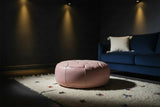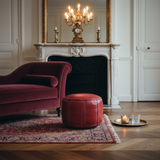
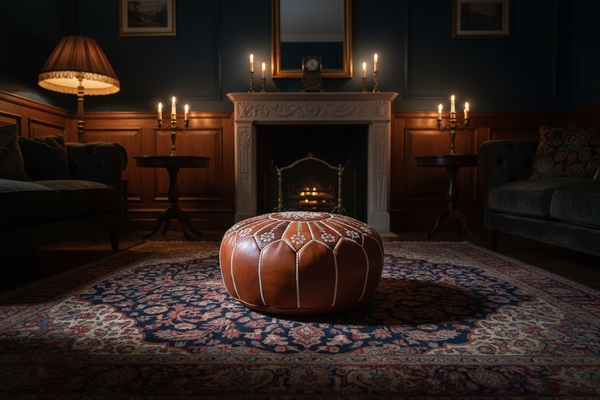
The Moroccan leather pouf has become a global design icon, gracing the pages of interior design magazines and adorning homes from Marrakech to Manhattan. But behind every beautifully crafted pouf lies a rich story of tradition, craftsmanship, and cultural heritage that few buyers truly understand. This comprehensive guide takes you beyond the surface to explore the authentic world of Moroccan leather poufs—from the ancient tanneries where the journey begins to the bustling souks where artisans sell their wares.
Ancient Moroccan Leatherwork: Traditions Spanning Millennia
Moroccan leather craftsmanship, known as maroquinerie, dates back over a thousand years. The art of leather working was perfected during the reign of the Almoravid dynasty in the 11th century, when Moroccan leather goods became prized commodities along ancient trade routes. The techniques used today remain remarkably similar to those employed by medieval artisans, passed down through generations of master craftspeople.
The leather pouf, or pouf marocain, emerged as a functional piece of furniture in traditional Moroccan homes. Originally used as low seating in salons where families gathered on floor cushions and carpets, the pouf served multiple purposes: footrest, extra seating for guests, and even as a small table when topped with a tray. Its round, compact form made it easy to move and store, perfectly suited to the fluid, multi-functional spaces of Moroccan architecture.
What makes Moroccan leather poufs truly special is the continuation of traditional hand-stitching methods. Each pouf is assembled using techniques that require years of training to master, ensuring that every piece is not just furniture, but a work of functional art.
Inside Morocco's Historic Tanneries: The Origin Story
To understand the true value of a Moroccan leather pouf, one must first visit the tanneries—the ancient workshops where raw hides are transformed into supple, colorful leather. The most famous tanneries are found in Fes, particularly the Chouara Tannery, which has been operating since the 11th century.
The tanning process is entirely natural and has remained virtually unchanged for centuries. Hides—typically from goats, sheep, or cows—are first soaked in a mixture of cow urine, quicklime, water, and salt to loosen excess fat, flesh, and hair. Workers then transfer the hides to earthen vessels filled with natural dyes: poppy for red, indigo for blue, henna for orange, saffron for yellow, and mint for green.
This traditional vegetable tanning process takes weeks to complete, but it produces leather that is soft, durable, and develops a beautiful patina over time. The leather used for high-quality poufs comes from these traditional tanneries, where quality control is maintained through centuries of expertise rather than modern chemical processes.
The environmental and labor conditions in tanneries are challenging, which is one reason why authentic, traditionally-tanned Moroccan leather commands a premium price. Supporting artisans who use these methods helps preserve both cultural heritage and traditional livelihoods.
The Craftsman's Workshop: Transforming Leather into Art
Once the leather is tanned and dyed, it makes its way to the workshops of skilled leather artisans, often located in the medinas (old cities) of Marrakech, Fes, and other Moroccan cities. Here, the transformation from leather to pouf begins.
Creating a single leather pouf is a labor-intensive process that typically takes 6-8 hours of skilled work:
Pattern Cutting: The artisan cuts leather pieces according to traditional patterns. A standard round pouf requires 8-12 panels, each cut precisely to ensure proper symmetry.
Embroidery and Decoration: For decorated poufs, intricate embroidery is added at this stage. Traditional designs include geometric patterns, Arabic calligraphy, or the distinctive Moroccan star motif. This embroidery is done entirely by hand using contrasting leather thread.
Hand-Stitching: The panels are stitched together using a saddle-stitch technique that creates strong, durable seams. This is done with waxed thread and specialized leather needles, requiring significant hand strength and precision.
Assembly: The panels are assembled inside-out, then turned right-side-out through a small opening at the top. This opening is later used for filling and is finished with a leather zipper or hand-stitched closure.
Finishing: The completed pouf is inspected, any loose threads are trimmed, and the leather is conditioned to enhance its suppleness and sheen.
Master artisans can identify their own work years later by the distinctive characteristics of their stitching and pattern placement—a testament to the individual craftsmanship that goes into each piece.
Marketplace Pricing Revealed: The True Cost in Morocco
Understanding the local pricing structure for Moroccan leather poufs provides valuable context for international buyers and helps set realistic expectations when shopping in the souks or online.
Understanding Price Variables in the Moroccan Market
Several factors influence the price of a leather pouf in Morocco:
Leather Quality: Goat leather is typically the most expensive due to its softness and durability, followed by sheep leather, with cow leather being the most economical option. The tanning method also matters—traditionally tanned leather costs more than chemically processed alternatives.
Craftsmanship Level: Poufs with intricate hand-embroidery, complex geometric patterns, or special decorative elements command higher prices. A simple, undecorated pouf requires less labor than one with elaborate stitching.
Size and Shape: Standard round poufs (approximately 50cm diameter) are most common and affordable. Larger poufs, square poufs, or rectangular ottomans require more leather and labor, increasing the price.
Location of Purchase: Prices vary significantly between cities. Fes, being closer to major tanneries, often has lower prices than Marrakech, which caters more to tourists. Smaller towns may offer even better deals.
Local Pricing: The Insider Perspective
As of 2026, here's what Moroccan locals typically pay for leather poufs (prices in Moroccan Dirhams and approximate USD equivalents):
Basic Unstuffed Pouf: 300-500 MAD ($30-$50 USD) - Simple design, good quality leather, minimal or no embroidery
Mid-Range Decorated Pouf: 600-900 MAD ($60-$90 USD) - Hand-embroidered designs, premium leather, traditional patterns
High-End Artisan Pouf: 1,000-1,500 MAD ($100-$150 USD) - Exceptional craftsmanship, intricate embroidery, finest leather quality
Stuffed Poufs: Add 200-400 MAD ($20-$40 USD) - Filled with cotton, fabric scraps, or foam
These are the prices Moroccans pay when shopping in their local souks, often after negotiation. Tourist prices typically start 2-3 times higher, which is why negotiation skills are essential.
The Cultural Context of Pricing Differences
The significant price difference between what locals pay and initial tourist prices isn't simply about exploitation—it reflects complex cultural and economic realities:
Dual Economy: Morocco operates on a dual pricing system where tourists are expected to pay more. This isn't considered dishonest but rather a form of wealth redistribution, as tourists are assumed to have greater purchasing power.
Negotiation as Culture: Bargaining is a social ritual in Moroccan commerce, not a sign of distrust. The initial high price is an invitation to engage in this cultural practice, and both parties expect to meet somewhere in the middle.
Supporting Artisans: Even at "tourist prices," buyers are often paying fair wages for skilled handcraft. The markup helps support not just the seller but entire families and communities of artisans.
Export Considerations: When comparing souk prices to international retail prices, remember that export involves additional costs: international shipping, import duties, quality control, business overhead, and retail markup. A pouf purchased in Marrakech for $80 might reasonably retail for $150-$200 internationally.
Mastering the Medina: Your Guide to Smart Shopping
Shopping for a leather pouf in a Moroccan souk can be an exhilarating experience—a sensory journey through narrow alleyways filled with colorful goods, aromatic spices, and the calls of merchants. Here's how to navigate this experience successfully.
Identifying Quality: What to Look For
Before you begin negotiating, you need to assess quality. Here are the key indicators of a well-made leather pouf:
Leather Quality:
- Smell the leather—it should have a natural, slightly earthy scent, not chemical or plasticky
- Feel the texture—genuine leather is supple with natural variations; synthetic materials feel uniform and plasticky
- Check for consistent color—hand-dyed leather may have slight variations, which is normal and desirable
- Look for natural grain patterns and small imperfections that indicate real leather
Stitching Quality:
- Examine the seams—stitches should be even, tight, and consistent
- Check for double-stitching on stress points
- Look for hand-stitching indicators: slight irregularities that show human craftsmanship rather than machine precision
- Ensure embroidery is secure with no loose threads
Construction:
- The pouf should feel substantial and well-structured even when empty
- Panels should align symmetrically
- The base should be flat and stable
- Zippers (if present) should be leather or high-quality metal, not cheap plastic
Design Authenticity:
- Traditional Moroccan designs include geometric patterns, stars, and arabesque motifs
- Hand-embroidered designs will have slight variations—perfect uniformity suggests machine work
- Ask about the origin—genuine Moroccan poufs are made in Morocco, not imported and decorated
The Art of Negotiation: Respect and Strategy
Negotiating in the souk is an art form that requires patience, respect, and strategy. Here's how to approach it:
Do Your Research: Visit multiple shops before buying to understand the price range. Don't buy from the first shop you visit.
Start with Respect: Greet the shopkeeper properly ("Salam alaikum"), show genuine interest in the craftsmanship, and ask questions about the artisan who made the piece.
The Opening Offer: When the seller states a price, don't show shock or offense. A good counter-offer is typically 40-50% of the asking price for tourist-oriented shops, or 60-70% in more local markets.
Negotiate Gradually: Move up slowly in small increments. The seller will come down, you'll go up, and you'll meet somewhere in the middle. This dance might take 10-20 minutes—don't rush it.
Use Leverage Respectfully:
- "I saw a similar one for less at another shop" (only if true)
- "I'm buying multiple items" (if you are)
- "This is my budget" (be honest about what you can pay)
- "I'm a student/teacher/artist" (occupations are respected in Moroccan culture)
Know When to Walk Away: If you can't reach an agreement, politely thank the seller and leave. Often, they'll call you back with a better offer. If not, you'll find another pouf elsewhere.
Seal the Deal with Grace: Once you agree on a price, don't try to renegotiate. Share mint tea if offered, exchange pleasantries, and part as friends. You've just participated in a centuries-old tradition.
Ethical Shopping Considerations
As you shop for your Moroccan leather pouf, consider these ethical dimensions:
Fair Compensation: While negotiating is expected, remember that artisans deserve fair payment for skilled work. Driving prices too low undermines traditional crafts and the livelihoods they support.
Authentic vs. Imitation: Buying genuine Moroccan-made poufs supports local artisans and preserves traditional skills. Cheap imitations made elsewhere and imported to Morocco don't benefit the communities that created this craft.
Sustainable Materials: Ask about the leather source and tanning methods. Traditional vegetable tanning is more environmentally friendly than chemical processes, though more expensive.
Working Conditions: When possible, buy directly from artisan cooperatives or workshops where you can see working conditions. Many cooperatives ensure fair wages and good working environments.
Cultural Respect: Understand that you're purchasing a piece of cultural heritage. Treat the transaction with the respect it deserves, and appreciate the human skill and tradition embodied in each pouf.
Bringing Your Pouf Home: Travel, Maintenance, and Design Ideas
You've found the perfect pouf and successfully negotiated a fair price. Now comes the practical matter of getting it home and keeping it beautiful for years to come.
Getting Your Treasure Home
Traveling with Your Pouf:
Most poufs are sold unstuffed, making them easy to transport. An empty leather pouf can be folded flat and packed in a suitcase, though be mindful of airline weight limits. If you're buying multiple poufs or other leather goods, consider:
- Shipping Services: Many souk shops offer international shipping, though costs can be high. Get a detailed receipt and tracking information.
- Local Shipping Companies: In major cities like Marrakech and Fes, independent shipping companies can send your purchases home for less than shop-arranged shipping.
- Carry-On Consideration: A folded pouf can fit in a carry-on bag, protecting it from luggage handling and ensuring it arrives safely.
Customs and Duties:
Leather goods may be subject to import duties in your home country. Keep your receipt, declare your purchase honestly, and research your country's duty-free allowances before traveling. Most countries allow a certain value of goods duty-free for personal use.
Filling and Caring for Your Pouf
Filling Options:
Your pouf will arrive unstuffed, giving you control over firmness and fill material:
- Fabric Scraps: The traditional Moroccan method uses old clothing, fabric remnants, and textile scraps. This is economical, eco-friendly, and creates a firm, supportive pouf. You'll need approximately 3-4 large garbage bags of fabric.
- Polyfill: Polyester fiberfill (available at craft stores) creates a softer, more cushioned pouf. You'll need 5-7 pounds for a standard pouf.
- Foam Pieces: Shredded foam provides good support and maintains shape well. Look for high-density foam scraps from upholstery suppliers.
- Bean Bag Filling: Polystyrene beads create a moldable, comfortable pouf but may compress over time and require refilling.
- Combination Fill: Many people use a base layer of fabric scraps for weight and structure, topped with polyfill for comfort.
Filling Process:
- Open the zipper or closure completely
- Begin stuffing from the bottom, pushing fill material into corners and edges first
- Pack firmly but not so tight that seams strain
- Fill to about 2-3 inches from the top
- Close the zipper or hand-stitch the opening securely
- Massage and shape the pouf to distribute filling evenly
Leather Care:
Proper care will keep your Moroccan leather pouf beautiful for decades:
- Regular Cleaning: Wipe with a soft, slightly damp cloth weekly to remove dust. Avoid soaking the leather.
- Conditioning: Apply leather conditioner every 3-6 months to prevent drying and cracking. Use products designed for natural, vegetable-tanned leather.
- Stain Treatment: Address spills immediately by blotting (never rubbing). For stubborn stains, use a leather-specific cleaner.
- Sun Protection: Avoid placing your pouf in direct sunlight, which can fade colors and dry out leather.
- Humidity Control: Leather thrives in moderate humidity. In very dry climates, use a humidifier; in humid areas, ensure good air circulation.
- Patina Appreciation: Natural leather develops a beautiful patina over time. These changes in color and texture are normal and desirable, adding character to your pouf.
Styling Your Moroccan Pouf
A Moroccan leather pouf is incredibly versatile and can enhance various interior design styles:
Traditional Moroccan Style: Pair with low seating, colorful textiles, lanterns, and patterned rugs. Use multiple poufs in complementary colors to create an authentic Moroccan salon atmosphere.
Bohemian Eclectic: Mix your pouf with vintage furniture, plants, macramé, and global textiles. The pouf's handcrafted quality fits perfectly with boho's artisanal aesthetic.
Modern Minimalist: A single pouf in a neutral color (black, white, natural tan) provides textural interest and organic form in minimalist spaces. Use as a sculptural accent piece.
Scandinavian Hygge: Combine with natural wood, sheepskins, and neutral tones. A leather pouf adds warmth and tactile appeal to Nordic-inspired interiors.
Eclectic Global: Layer with textiles and artifacts from various cultures. The pouf's artisanal quality complements other handcrafted global pieces.
Functional Placement Ideas:
- Living room footrest in front of sofas or armchairs
- Extra seating for guests (can accommodate one adult comfortably)
- Bedroom accent at the foot of the bed or in a reading nook
- Children's room seating (durable and safe with no hard edges)
- Home office footrest under desks
- Entryway seating for putting on shoes
- Outdoor covered patio seating (bring inside during rain)
The Deeper Value: More Than Just Furniture
The true value of a Moroccan leather pouf extends far beyond its price tag. When you bring one of these beautiful pieces into your home, you're not just purchasing furniture—you're becoming a custodian of centuries-old craft traditions, supporting artisan communities, and connecting your living space to the rich cultural heritage of Morocco.
Understanding the journey from tannery to workshop to souk helps us appreciate the skill, labor, and tradition embodied in each hand-stitched seam. Knowing what locals pay provides context for fair pricing, while learning to identify quality ensures you invest in authentic craftsmanship that will last for generations.
Whether you purchase your pouf in the bustling souks of Marrakech, from a artisan cooperative in Fes, or from a reputable international retailer who works directly with Moroccan craftspeople, you're participating in an economic and cultural exchange that sustains traditional skills in an increasingly industrialized world.
The Moroccan leather pouf is more than a trendy home accessory—it's a functional work of art, a conversation starter, and a daily reminder of the beauty that emerges when ancient techniques meet contemporary design sensibilities. As you rest your feet on your pouf or offer it as extra seating to a guest, remember the hands that stitched it, the traditions that shaped it, and the culture that created it.
In choosing authentic, artisan-made Moroccan leather goods, you're voting with your wallet for a world where craftsmanship matters, where traditional skills are valued, and where beautiful, functional objects are made by human hands with care, skill, and pride.
Frequently Asked Questions About Moroccan Leather Poufs
Q: How can I tell if a leather pouf is genuinely Moroccan-made?
A: Look for hand-stitching irregularities (a sign of authentic handcraft), natural leather variations, traditional Moroccan design motifs, and ask the seller directly about origin. Genuine Moroccan poufs have a distinctive construction style and use vegetable-tanned leather. If possible, buy from reputable sources or directly from artisan cooperatives.
Q: What's the difference between goat, sheep, and cow leather poufs?
A: Goat leather is the softest, most supple, and most expensive option, with excellent durability. Sheep leather is slightly less durable but still soft and comfortable. Cow leather is the most economical, thicker and more rigid, but extremely durable. All three are authentic options used in traditional Moroccan leatherwork.
Q: Should I buy a stuffed or unstuffed pouf?
A: Unstuffed is generally recommended, especially if traveling. It's easier to transport, allows you to control firmness, and lets you choose eco-friendly filling options. Stuffed poufs are convenient if buying locally or having the item shipped, but you pay for filling materials and increased shipping weight.
Q: How much should I expect to pay for an authentic Moroccan leather pouf?
A: In Morocco, expect to negotiate down to $60-$120 USD for a quality unstuffed pouf, depending on size and decoration. International retail prices typically range from $120-$250 USD, reflecting import costs, duties, and retail markup. Prices significantly below this range may indicate lower quality or non-authentic products.
Q: Are Moroccan leather poufs comfortable to sit on?
A: Yes, when properly filled! Firmness depends on your filling choice and amount. They work best as footrests or occasional seating rather than primary seating for extended periods. The low height (typically 12-14 inches) makes them ideal for floor-level seating arrangements.
Q: How do I clean and maintain my leather pouf?
A: Dust regularly with a soft cloth, condition every 3-6 months with leather conditioner, address spills immediately by blotting, and keep out of direct sunlight. Natural leather will develop a beautiful patina over time—this is normal and desirable, not a defect.
Q: Can I use my leather pouf outdoors?
A: Only in covered outdoor spaces protected from rain and direct sun. Leather is not waterproof and will be damaged by moisture. If using on a covered patio, bring inside during wet weather and apply leather protector spray for added resistance.
Q: What's the best filling material for a Moroccan pouf?
A: The traditional method uses fabric scraps and old clothing—it's economical, eco-friendly, and creates good support. For softer comfort, use polyfill or a combination of fabric scraps on the bottom with polyfill on top. Avoid materials that compress quickly, as refilling can be tedious.
Q: How long will a Moroccan leather pouf last?
A: With proper care, a well-made Moroccan leather pouf can last 15-20 years or more. The leather actually improves with age, developing a rich patina. Hand-stitched seams are extremely durable. Regular conditioning and protection from excessive sun and moisture are key to longevity.
Q: Are there ethical concerns with buying Moroccan leather products?
A: The main ethical considerations are ensuring fair artisan compensation and choosing traditionally-tanned leather over chemically processed alternatives. Buy from reputable sources, artisan cooperatives, or directly from workshops where you can see working conditions. Avoid extremely cheap poufs that may indicate exploitation or poor quality.
Q: Can I wash my leather pouf if it gets dirty?
A: Never submerge or machine wash a leather pouf. For surface dirt, use a slightly damp cloth. For deeper cleaning, use leather-specific cleaners following product instructions. For serious stains or damage, consult a professional leather cleaner rather than attempting aggressive home cleaning.
Q: What size pouf should I buy?
A: Standard round poufs are approximately 20 inches (50cm) in diameter and 12-14 inches (30-35cm) high—this is the most versatile size. Larger poufs (24+ inches) work well as statement pieces or primary ottomans. Smaller poufs (16 inches) are good for children's rooms or tight spaces. Consider your space and intended use when selecting size.