
Seven days in Morocco is enough to understand why travellers return again and again. It is not enough to see everything — Morocco rewards slow travel and repeat visits — but it is enough to experience the three things that define the country at its most essential: the medieval labyrinth of Fes, the immensity of the Sahara, and the sensory intensity of Marrakech.
This itinerary is built around the classic Fes → desert → Marrakech circuit — the most coherent and rewarding route for a first visit, and one that connects Morocco's imperial heritage, its Amazigh craft traditions, and its natural landscape in a single journey. To understand the deeper cultural forces that shaped what you will encounter, our guide to the Moroccan Cultural Mosaic is a good place to start before you travel.
Before You Go — A Few Honest Notes
October is one of the best months to visit. The brutal summer heat has broken, the light is golden and warm, the crowds are thinner than in spring, and the desert nights are cool enough to sleep comfortably under canvas. Avoid July and August unless you are specifically prepared for 40°C+ temperatures.
Tangier does not fit this itinerary. Tangier is a full day's travel from Marrakech and sits at the opposite end of the country from the desert. It deserves its own trip — ideally a long weekend from southern Spain. If you try to include it in a 7-day circuit with the desert, you will spend more time on buses than in medinas.
Hire a private driver for the desert leg. The road from Fes to Merzouga (and onward to Marrakech via the Dades Gorge) is one of the most spectacular drives in North Africa. A private driver costs approximately $60–80 per day and transforms a logistical challenge into one of the highlights of the trip. Your riad host in Fes can recommend reliable drivers.
Book your desert camp in advance. The best camps in Merzouga — the ones with proper Berber tents, good food, and genuine silence — fill up in October. Book at least 3–4 weeks ahead.
Day 1–2 — Fes
Arrive in Fes and check into a riad in the medina. This is not optional — staying inside the medina walls rather than in a hotel outside them is the difference between experiencing Fes and merely visiting it. A good riad host will orient you on arrival, tell you which streets to avoid at which times, and connect you with reliable guides and drivers.
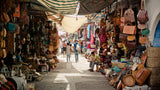
Day 1: Get lost (deliberately). The Fes el-Bali medina — the largest car-free urban area in the world — is genuinely disorienting. Spend the first afternoon walking without a destination. The medina will reveal itself gradually: a carpenter's workshop behind an unmarked door, a madrasa courtyard open to the sky, a tannery glimpsed from a rooftop terrace. This is how Fes works.
Day 2: The essential Fes. Take a guided morning walk — one morning with a good guide is worth it just to understand the geography and history of the medina. After that, explore independently. The non-negotiables: the Bou Inania Madrasa (the finest example of Marinid architecture in Morocco, and a masterpiece of Islamic geometric art), the Chouara tanneries (view from the leather shop terraces above, go in the morning when the colours are most vivid), and the Attarine souk (the spice and craft market at the heart of the medina).
What to eat in Fes: Pastilla — a flaky pastry filled with pigeon, almonds, and cinnamon, dusted with icing sugar. It sounds improbable and tastes extraordinary. Harira soup (tomato, lentil, chickpea) at any medina cafe. Mechoui — slow-roasted lamb — from the mechoui stalls near Rcif square. Fresh-squeezed orange juice everywhere, all day.
What to buy in Fes: Fes is the centre of Moroccan leather production and ceramic craft. Hand-embossed leather goods — poufs, bags, slippers — from the workshops around the tanneries. Zellige tiles and ceramics from the potters' quarter. Brass lanterns from the metalworkers' souk. Buy from workshops, not from touts who approach you on the street.
Day 3 — Fes to Merzouga
An early start with your driver. The road from Fes to Merzouga takes approximately 7–8 hours, but the journey itself is the point. The route crosses the Middle Atlas mountains — cedar forests, Berber villages, the market town of Midelt — before descending through the Ziz valley into the pre-Saharan landscape. The transition from green mountain to ochre desert happens gradually and then suddenly, and it is one of the most dramatic landscape shifts in Morocco.
Arrive in Merzouga in the late afternoon. Check into your camp or guesthouse, rest briefly, then head to the dunes for sunset. The Erg Chebbi dunes — up to 150 metres high, stretching for 22 kilometres — are among the largest in Morocco. The light on the dunes at golden hour is unlike anything else.
Day 4 — The Desert
The desert day has a rhythm: early morning on the dunes before the heat builds, a long slow afternoon in the shade of the camp, and an evening camel trek to a remote camp for the night under the stars.
Sunrise on the dunes. Set an alarm for 5:30am. Climb the nearest dune in the dark and watch the light arrive. The silence of the Sahara at dawn — absolute, total, disorienting for anyone accustomed to urban noise — is one of the experiences that makes this journey worth making.
The overnight camp. A proper Saharan camp — Berber tents, lanterns, a fire, a musician playing guembri — is not a tourist gimmick. It is a genuine encounter with a way of life that has existed in this landscape for millennia. Eat tagine cooked over charcoal. Sleep under more stars than you have ever seen.
What to buy in Merzouga: Handwoven Tuareg leather goods, silver jewellery from the desert nomadic tradition, and woven camel-wool blankets. Buy directly from the artisans at the camp or from the small workshops in Merzouga village.
Day 5 — Merzouga to Marrakech via the Dades Gorge
The drive from Merzouga to Marrakech via the Dades Gorge is a full day — approximately 8–9 hours with stops — and one of the most spectacular road journeys in North Africa. The route passes through the Draa Valley (palm groves, kasbahs, the ancient caravan town of Ouarzazate), the Roses Valley (the source of Morocco's famous rose water), and the Dades Gorge (dramatic red rock formations carved by the Dades river).
Stop at Ait Benhaddou — the UNESCO-listed ksar (fortified village) used as a filming location for dozens of films and series — for an hour in the late afternoon. Arrive in Marrakech in the evening.
Day 6–7 — Marrakech
Marrakech is louder, more touristic, and more overwhelming than Fes — and also more immediately beautiful. The rose-pink walls of the medina, the palm trees of the Menara gardens, the chaos and spectacle of Jemaa el-Fna square: it is a city that performs itself for visitors, and the performance is genuinely extraordinary.
Day 6: The medina. Bahia Palace (the finest surviving example of late 19th-century Moroccan palatial architecture), the Saadian Tombs, the Ben Youssef Madrasa, and the souks — each craft concentrated in its own quarter: leather, metalwork, textiles, spices, ceramics. The souks of Marrakech are more tourist-oriented than those of Fes, but the craft is real and the quality is high if you know what to look for.
Day 7: Slow Marrakech. A morning hammam (the Hammam de la Rose or Les Bains de Marrakech are both excellent and foreigner-friendly). The Majorelle Garden — the cobalt-blue botanical garden created by Yves Saint Laurent, now housing the Berber Museum. An afternoon in the Mellah (the old Jewish quarter) and the spice market. Jemaa el-Fna at night — arrive around 7pm when the food stalls are at their most vibrant, the storytellers are performing, and the square is at its most alive.
What to eat in Marrakech: The food stalls of Jemaa el-Fna (snail soup, merguez, kefta, fresh orange juice). Lunch at a rooftop restaurant overlooking the square. Argan oil on everything. Mint tea, always, everywhere.
What to buy in Marrakech: Berber rugs from the carpet souks (take your time, drink the tea, negotiate calmly). Handira wedding blankets and cushions. Sabra silk cushions. Argan oil from a women's cooperative. Brass and copper lanterns from the metalworkers' souk.
Practical Notes
Getting around. Fly into Fes (FEZ), hire a private driver for the Fes → Merzouga → Marrakech leg, fly home from Marrakech (RAK). This avoids backtracking and keeps the journey linear. Budget approximately $250–350 for a private driver for the two driving days.
Where to stay. Always stay in a riad inside the medina walls in both Fes and Marrakech. The experience of waking up in a traditional Moroccan courtyard house — the fountain, the orange trees, the carved plaster — is inseparable from understanding what Morocco is. Budget $80–150 per night for a good riad with breakfast.
Solo female travel. Morocco is safe for solo female travellers and the vast majority of interactions are positive. A few things that genuinely help: dress modestly (loose trousers, shoulders covered — not because it is required but because it reduces unwanted attention significantly), walk with purpose in the medina, learn a few words of Darija (Moroccan Arabic) — even a simple shukran (thank you) and la shukran (no thank you) go a long way. The medina of Fes requires more navigation confidence than Marrakech; one guided morning walk on arrival is worth it.
Money. Morocco uses the Moroccan dirham (MAD). ATMs are widely available in both cities. Most riads, restaurants, and larger shops accept cards, but carry cash for the souks and medina stalls. Tipping is expected and appreciated — 10–15% at restaurants, 20–50 MAD for guides and drivers per day.
Frequently Asked Questions
Is 7 days enough for Morocco?
Seven days is enough for a deeply satisfying first visit covering Fes, the Sahara, and Marrakech. It is not enough to see everything — Morocco also has Chefchaouen, the Atlantic coast, the Souss valley, and the Rif mountains, among many other destinations. Think of 7 days as an introduction that will make you want to return.
What is the best time of year to visit Morocco?
October and November are ideal — the summer heat has broken, the light is golden, and the crowds are thinner. March and April are also excellent. Avoid July and August in the interior cities (Fes, Marrakech, the desert) unless you are specifically prepared for extreme heat. December to February can be cold in the mountains and the desert at night but is otherwise pleasant.
Is Morocco safe for solo female travellers?
Yes. Morocco is one of the most visited countries in Africa and the infrastructure for tourism is well developed. Solo female travellers do attract more attention than men or couples, particularly in the medinas, but the vast majority of interactions are harmless. Dressing modestly, walking confidently, and staying in well-reviewed riads significantly reduces any friction.
Do I need a visa for Morocco?
Citizens of the EU, UK, USA, Canada, and Australia do not require a visa for stays of up to 90 days. Check the current requirements for your specific nationality before travelling.
What should I buy in Morocco?
Morocco produces some of the finest handcraft in the world. The most distinctive and durable purchases: hand-knotted Berber rugs (Beni Ourain, kilim, Azilal), hand-embossed leather goods from Fez (poufs, bags, slippers), Handira wedding blankets and cushions, sabra silk cushions, brass and copper lanterns, and argan oil from a women's cooperative. Buy from workshops and cooperatives rather than from touts, and take your time — the best pieces reveal themselves slowly.
How much does a 7-day Morocco trip cost?
Morocco is excellent value. A comfortable mid-range budget — good riads, private driver for the desert leg, restaurant meals, entrance fees, and shopping — runs approximately $150–200 per day excluding flights. The desert camp is typically $80–150 per person including the camel trek and dinner.
At Moroccan Corridor, we source our pieces directly from the artisan workshops you will encounter on this journey — the leather craftsmen of Fez, the weavers of the Middle Atlas, the sabra silk artisans of the Souss. If you want to bring a piece of Morocco home before you travel, or to remember it after, our collection is a good place to start.