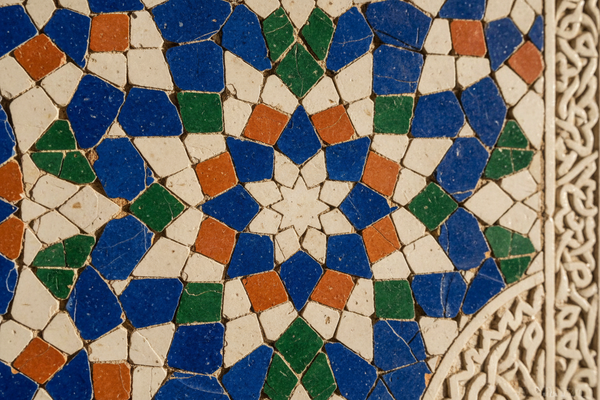
Every piece of Moroccan craft carries within it a visual language that is over a thousand years old. The eight-pointed star pressed into a leather pouf from Fez. The interlocking geometric tiles of a zellige panel. The arabesque carved into the plaster of a riad wall. These are not decorative choices made by individual artisans — they are the direct expression of one of the most sophisticated and coherent artistic traditions in human history: Islamic art.
Understanding Islamic art is to understand the source code of Moroccan craft. This guide explores what Islamic art is, where it came from, what principles govern it, and how its visual language continues to shape the objects made in Morocco today.
What is Islamic Art?
Islamic art is not the art of a single religion, time, place, or medium. It is a vast and diverse tradition spanning approximately 1,400 years, extending from the Atlantic coast of Morocco to the Indonesian archipelago, and encompassing architecture, calligraphy, ceramics, metalwork, textiles, glass, and manuscript illumination.
What unifies this tradition is not a single style but a set of shared principles — aesthetic, philosophical, and theological — that emerged from the encounter between the new Islamic civilisation and the artistic traditions it absorbed and transformed: Roman, Byzantine, Sasanian Persian, Central Asian, and Chinese influences all contributed to the formation of Islamic art in its early centuries.
Islamic art is therefore not a monolith. It encompasses the austere geometry of the Great Mosque of Cordoba and the jewelled complexity of the Alhambra. The bold calligraphy of a ninth-century Quran and the intricate floral inlay of a Mughal tomb. The hand-knotted wool of a Moroccan Berber rug and the hand-embossed leather of a Fez craftsman. What connects them is a shared visual grammar — one built on geometry, pattern, calligraphy, and the arabesque.
The Prohibition on Figuration — and What It Produced
The most distinctive characteristic of Islamic religious art is its non-figurative nature. Many Muslims believe that the depiction of the human form — and to a lesser extent animals — in a sacred context constitutes idolatry, a sin explicitly condemned in Islamic theology. This prohibition, while not absolute and not uniformly applied across all periods and regions, had a profound and generative effect on Islamic art.
Denied the human figure as a primary subject, Islamic artists turned instead to three other visual languages: geometry, the arabesque, and calligraphy. The result was not a diminished art but an extraordinarily rich one — an art of pure abstraction, mathematical precision, and infinite pattern that anticipated by centuries the concerns of modern abstract art.
The prohibition on figuration also produced a remarkable democratisation of sacred art. Where Christian art concentrated meaning in the human figure of Christ or the saints, Islamic art distributed meaning across the entire surface — every tile, every carved panel, every woven thread participating equally in the expression of the divine.
Geometric Art and the Arabesque
Geometric pattern is the most immediately recognisable element of Islamic art. Based on the repetition and interlocking of basic geometric forms — the circle, the square, the triangle, the polygon — Islamic geometric art generates patterns of extraordinary complexity from simple mathematical principles.
The eight-pointed star, formed by the intersection of two squares, is perhaps the most ubiquitous motif in Islamic geometric art. It appears in zellige tilework, in carved plaster, in woven textiles, in metalwork, and in woodcarving across the entire Islamic world. Its eight points carry cosmological significance, representing the eight angels who support the throne of God in Islamic theology.
The arabesque — from the Italian arabesco, meaning in the Arab manner — is a related but distinct tradition. Where geometric art is based on the repetition of angular forms, the arabesque is based on the continuous, flowing repetition of stylised plant forms: leaves, vines, tendrils, and flowers abstracted to the point of pure ornament. The arabesque is theoretically infinite — it can be extended in any direction without interruption — and this quality of infinity is itself theologically significant, evoking the boundless and indivisible nature of God.
Both geometric art and the arabesque share a fundamental principle: the subordination of the individual element to the overall pattern. No single tile, no single carved motif, no single woven thread is meant to be read in isolation. Meaning emerges from the whole, not the part — a visual expression of the Islamic concept of tawhid, the unity and indivisibility of God.
Calligraphy as Sacred Art
If geometric art is the visual language of Islamic architecture and craft, calligraphy is its sacred voice. In a tradition where the word of God — the Quran — is considered the direct speech of the divine, the art of writing that word becomes itself an act of worship.
Arabic calligraphy developed into one of the most sophisticated and varied graphic traditions in the world. The oldest form is Kufic script — angular, monumental, and architectural in character — which appears in the earliest Quranic manuscripts and in the inscriptions of the Dome of the Rock in Jerusalem (691 CE). Later scripts — Naskh, Thuluth, Maghrebi — developed more fluid and curvilinear forms suited to different contexts and media.
Calligraphic inscriptions appear not only in manuscripts but across every medium of Islamic art: carved into the stone lintels of mosques, inlaid in metalwork, woven into textiles, painted onto ceramics, and pressed into leather bindings. In Morocco, the distinctive Maghrebi script — with its rounded forms and descending loops — is the calligraphic tradition most closely associated with local craft production.
Islamic Art in Morocco
Morocco is one of the great centres of Islamic art and architecture. Its imperial cities — Fez, Marrakech, Meknes, Rabat — contain some of the finest surviving examples of medieval Islamic urban design, and its craft traditions are among the most technically accomplished and culturally continuous in the Islamic world.
Zellige. The art of zellige — hand-cut geometric tilework — is Morocco's most celebrated contribution to Islamic decorative art. Each tile is individually hand-cut from a fired and glazed ceramic slab, then assembled face-down into complex geometric compositions. The geometric patterns used in zellige are drawn directly from the vocabulary of Islamic geometric art — eight-pointed stars, interlocking polygons, and the infinite repeat.
Carved plaster and cedar. The interior walls of Moroccan riads, mosques, and madrasas are typically divided into three horizontal zones: zellige at the base, carved plaster in the middle, and carved cedar at the top. The carved plaster zone is where the arabesque reaches its fullest expression — dense, intricate, and three-dimensional, covering entire walls in continuous floral and geometric ornament.
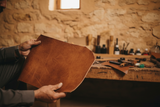
Leather. The tanneries of Fez are among the oldest continuously operating craft workshops in the world. Moroccan leather — tanned using traditional vegetable methods — is embossed with geometric and floral patterns drawn directly from the Islamic decorative vocabulary. The hand-embossed leather poufs, bags, and accessories produced in Fez carry this tradition into contemporary interiors.
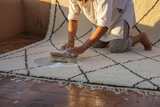
Textiles. Moroccan woven textiles — from the flat-woven kilim to the hand-knotted Berber rug to the sabra silk cushion — translate the geometric language of Islamic art into fibre. The diamond, the zigzag, the stepped triangle, and the lozenge that appear in Amazigh weaving are cognate with the geometric vocabulary of Islamic art, a testament to the depth of the cultural synthesis that produced Moroccan craft.
How Islamic Art Lives in Moroccan Craft Today
The visual principles of Islamic art — geometry, pattern, the arabesque, calligraphy — are not historical curiosities. They are living traditions, practised daily in the workshops of Fez, Marrakech, Tetouan, and Sale by craftsmen and craftswomen who have inherited them through apprenticeship and family transmission.
When a zellige master cuts a tile to fit a geometric composition, he is applying mathematical knowledge transmitted without interruption for over a thousand years. When a leather craftsman presses a geometric stamp into a vegetable-tanned hide, he is using tools and patterns whose forms have not changed in centuries. When a weaver on a traditional loom interlaces coloured threads into a geometric pattern, she is participating in a visual tradition that connects her work to the great monuments of Islamic civilisation.
This is what makes Moroccan craft extraordinary — not merely its beauty, but its depth. Every object is a node in a living tradition, connected backwards through time to the first flowering of Islamic art and forwards into the contemporary homes of people who recognise, even without knowing why, that these objects carry something that mass production cannot replicate.
Frequently Asked Questions
What are the main characteristics of Islamic art?
Islamic art is characterised by geometric pattern, the arabesque, and calligraphy. It is generally non-figurative in sacred contexts. Its defining aesthetic principle is the subordination of individual elements to an overall pattern — an expression of the unity and indivisibility of God.
Why does Islamic art avoid depicting human figures?
Many Muslims believe that the depiction of the human form in a sacred context constitutes idolatry. This theological concern led Islamic artists to develop alternative visual languages based on geometry, pattern, and calligraphy. Figurative art does appear in Islamic secular contexts, particularly in manuscript illustration and court art.
What is the arabesque in Islamic art?
The arabesque is a decorative pattern based on the continuous, flowing repetition of stylised plant forms — leaves, vines, tendrils, and flowers — abstracted to the point of pure ornament. It is theoretically infinite and this quality evokes the boundless nature of God. The arabesque appears across all media of Islamic art, from carved plaster to woven textiles.
What is zellige and how does it relate to Islamic art?
Zellige is the Moroccan art of hand-cut geometric tilework. Each tile is individually cut from a fired and glazed ceramic slab and assembled into complex geometric compositions. The patterns — eight-pointed stars, interlocking polygons, infinite repeats — are drawn directly from the vocabulary of Islamic geometric art.
How old is Islamic art?
Islamic art spans approximately 1,400 years, from the emergence of Islam in the seventh century CE to the present day. Some of the oldest surviving monuments — including the Dome of the Rock in Jerusalem (691 CE) — already display the geometric and calligraphic vocabulary that would define the tradition for centuries.
How does Islamic art influence Moroccan craft today?
The visual principles of Islamic art are living traditions in Moroccan craft workshops. Zellige masters, leather craftsmen, plaster carvers, and weavers all work within a visual vocabulary inherited directly from the Islamic artistic tradition. The geometric patterns on a hand-embossed leather pouf from Fez or a sabra silk cushion connect directly to the same mathematical and theological principles that governed the decoration of the great mosques of medieval Morocco.
At Moroccan Corridor, every piece we offer — from hand-embossed leather poufs to hand-knotted Berber rugs to sabra silk cushions — carries within it the visual language of this extraordinary tradition. We source directly from the artisan workshops where Islamic art is not a historical reference but a living practice.