Mint tea is Morocco's most practiced daily ritual — served at breakfast, after meals, during business meetings, at weddings and funerals, and to every guest who crosses a threshold. It is drunk twenty or thirty times a day in some households. It is the primary expression of Moroccan hospitality, the medium through which relationships are established and maintained, and one of the most refined examples of a culture that has elevated a simple beverage into a ceremonial art form. This article covers its history, its ritual, its recipe, and the objects used to serve it.
A Brief History of Mint Tea in Morocco
Tea is not native to Morocco. The country has no history of tea cultivation, and the beverage did not enter Moroccan culture until the mid-nineteenth century — relatively late by the standards of the tea-drinking world.
The circumstances of its arrival are specific and well-documented. In 1854, during the Crimean War, a British naval blockade of the Baltic ports cut off the primary market for British tea merchants who had been supplying northern European buyers. Looking for alternative markets, British traders turned to the Atlantic ports of North Africa — particularly Tangier and Mogador (present-day Essaouira). They arrived with holds full of Chinese Gunpowder green tea, a compressed, pellet-form tea produced specifically for export and prized for its freshness and thirst-quenching properties.
Moroccans were already familiar with mint infusions — the Mentha spicata variety known as nana, grown throughout the country and used for centuries as a medicinal and culinary herb. The combination of Chinese Gunpowder tea with fresh nana mint was, in retrospect, an obvious one: the bitterness of the tea balanced by the freshness of the mint, the whole sweetened with sugar loaf. The result was a beverage unlike anything produced by either ingredient alone.
From the Atlantic ports, mint tea spread rapidly through Morocco and across the Maghreb, carried by nomadic populations and trading networks into West Africa and the Saharan south. Within a generation, it had become the defining beverage of Moroccan domestic culture — a position it has held without interruption for more than 170 years.
The Ritual of Moroccan Mint Tea
Preparing mint tea in Morocco is not a domestic chore. It is a ceremonial practice — a sequence of actions performed with deliberateness and care, in a specific order, using specific objects, according to conventions that have been transmitted across generations. The quality of the tea is important; the quality of the attention given to its preparation is equally important.
Who Prepares the Tea
Traditionally, the preparation of mint tea is the responsibility of the head of the household — or, in his absence, his eldest son. This is not a rule that is universally observed in contemporary Morocco, but it reflects the cultural weight attached to the act of tea preparation: it is not delegated to whoever happens to be available, but performed by the person whose role it is to represent the household to its guests.
Two teapots are typically prepared simultaneously. The tea master places a generous pinch of Gunpowder green tea in each, then rinses the leaves quickly with a small amount of boiling water — the first wash, which removes the bitterness of the dry tea and is immediately discarded. A handful of fresh nana mint leaves and a large piece of sugar loaf are then added to each teapot, which is filled with boiling water and left to infuse for several minutes.
The tea master then stirs the mixture, tastes it, and adjusts — adding more mint if the tea is too strong, more sugar if it is too bitter, more water if the infusion is too concentrated. When the balance is right, he serves.
The Three Infusions
Tea is served three times from the same leaves, without changing them between infusions. The character of the tea changes with each serving as the leaves continue to release their compounds into the water: the first infusion is the strongest and most bitter; the second is sweeter and more balanced; the third is the lightest and most delicate.
An Arabic proverb describes these three infusions with characteristic precision:
- The first is bitter as life
- The second is sweet as love
- The third is soothing as death
Once the three infusions have been served and consumed, it is understood that the visit is drawing to a close. The tea service marks both the beginning and the end of the encounter.
Tea as Hospitality
Mint tea is the most refined expression of hospitality in Moroccan culture. To be offered tea in a Moroccan home is to be welcomed — genuinely, not performatively. To refuse it is a significant social gesture, not to be undertaken lightly. The act of preparing and serving tea for a guest is an investment of time and attention that communicates respect.
A Tuareg proverb captures the essential conditions of the tea ritual: "It takes three things to make tea: time, embers, and friends." The order is significant. Time comes first — not as a constraint, but as a gift. The preparation of Moroccan mint tea cannot be rushed without destroying what makes it what it is.
The serving gesture is itself part of the ritual. The tea is poured from a height — traditionally as high as the arm can comfortably reach — into small glasses held at waist level. This aerates the tea, releasing its aromas and producing the characteristic foam on the surface of the glass known as the turban. The presence of a good turban is considered evidence of a well-prepared infusion. The absence of one is noticed.


The Traditional Recipe
The recipe for Moroccan mint tea is simple in its ingredients and demanding in its execution. The quality of the result depends on the quality of the tea, the freshness of the mint, and the attention of the person preparing it.
You will need:
- 2 tablespoons Chinese Gunpowder green tea
- A generous handful of fresh organic nana mint leaves
- Sugar loaf or sugar to taste
- Boiling water

Method: Place the Gunpowder tea in the bottom of the teapot. Pour a small amount of boiling water over the leaves — just enough to cover them — swirl briefly, and discard this first water. This removes the initial bitterness of the dry tea and opens the leaves.
Wash the mint leaves, crush them lightly between your palms to release their oils, and add them to the teapot along with the sugar. Fill the teapot with boiling water and leave to infuse for three to four minutes.
Pour a small amount of the infusion into a glass, then return it to the teapot — this mixes the sugar evenly through the infusion. Taste, adjust if necessary, and serve by pouring from height into small glasses. The tea should be drunk very hot.
In the Saharan south, the preparation is slightly different: small enamelled metal teapots are placed directly on the embers of a fire, and the tea, water, and sugar are combined from the start rather than in sequence. The three-infusion structure remains the same.
Health and Aromatic Variations
Moroccan mint tea is drunk hot even in summer — a practice that reflects the understanding, common across hot-climate cultures, that hot beverages promote perspiration and ultimately cool the body more effectively than cold drinks. The green tea base is rich in antioxidants and has documented benefits for digestion, physical endurance, and immune function.
The mint itself — Mentha spicata nana, the variety specific to Morocco — has properties distinct from the more common peppermint: it is sweeter, less aggressive, and more aromatic, with a freshness that complements rather than overwhelms the tea.
Moroccan tea culture also encompasses a range of aromatic additions that vary by region, season, and personal preference. Thyme is added for its antimicrobial properties and its warm, slightly resinous flavour. Geranium leaves add a relaxing, floral quality. Lemon verbena gives a feeling of freshness. Rose petals, orange blossom water, and lemon zest are used to add fruity and floral dimensions to the infusion. These additions are not departures from the tradition — they are expressions of it, reflecting the richness of Morocco's aromatic plant culture.
The Moroccan Tea Service
Serving tea in Morocco is an aesthetic act as much as a practical one. The objects used — the teapot, the glasses, the tray, the perfumer — are not interchangeable with their functional equivalents from other traditions. They are specific objects, made by specific craftsmen, with specific visual and material qualities that are part of what the tea service communicates.
The Teapot
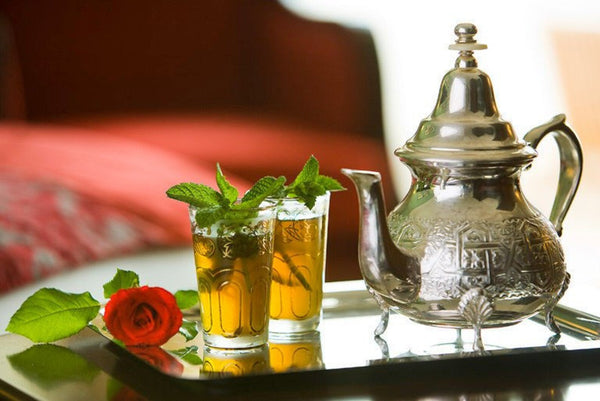
The traditional Moroccan teapot is made from silver-plated or stainless metal — not ceramic, which cannot withstand direct contact with a heat source. The teapot is placed directly on the stove or on the embers of a fire during preparation, which requires a material that conducts and withstands heat without cracking or warping.
Craft teapots are heavy and solid, engraved by hand with geometric and floral patterns that reflect the decorative vocabulary of Moroccan metalwork. They are more expensive than their mass-produced equivalents and significantly more durable — a well-made Moroccan teapot, properly cared for, will last a lifetime.


The Glasses
Moroccan tea glasses are small — deliberately so. The small volume is not a limitation but a design decision: tea is meant to be sipped slowly, in small quantities, savoured rather than consumed. Each glass holds enough for three or four sips, which means the act of drinking is extended and repeated, creating the rhythm of the ritual.
The glasses are made from clear glass, decorated with coloured enamel patterns — geometric designs, floral motifs, or gold banding — that catch the light and make the amber colour of the tea visible. The visual quality of the tea in the glass is part of the experience.
The Tray
The tea tray is the stage on which the service is presented. In Morocco, trays are made from silver or copper, either flat or on a raised foot, and decorated with hand-chiselled geometric patterns. The tray is large enough to hold the teapot, the glasses, and the sugar bowl simultaneously — it is carried to the guest rather than assembled at the table, which means it must be both functional and beautiful.

The Perfumer
Rose water is sometimes used in the preparation of Moroccan mint tea, and it is served to guests in a qmqm — a traditional Moroccan perfumer, a small vessel made from stainless metal, hammered and engraved by hand by craftsmen in the Fès region. Guests sprinkle a few drops of rose water on their hands before or after drinking tea — a gesture of welcome and purification that extends the hospitality of the tea service beyond the beverage itself.

Frequently Asked Questions
What type of tea is used in Moroccan mint tea?
Moroccan mint tea uses Chinese Gunpowder green tea — a compressed, pellet-form tea produced specifically for export, named for its resemblance to gunpowder pellets. Gunpowder tea is prized for its freshness, its thirst-quenching properties, and its ability to withstand the high brewing temperatures used in the Moroccan method. No other variety of tea is traditionally used.
What type of mint is used in Moroccan mint tea?
The mint used in Moroccan tea is Mentha spicata nana — a variety specific to Morocco, sweeter and less aggressive than common peppermint, with a fresh, aromatic quality that complements rather than overwhelms the green tea. It is grown throughout Morocco and sold fresh in every souk. Dried mint is not used in the traditional preparation.
Why is Moroccan mint tea poured from a height?
Pouring from height aerates the tea — the fall through the air introduces oxygen into the liquid, releasing its aromas and producing the characteristic foam on the surface of the glass known as the turban. The turban is considered evidence of a well-prepared infusion. The pouring gesture is also a visual performance — part of the ceremony of the tea service rather than a purely functional act.
Why is tea served three times in Morocco?
The three-infusion structure reflects both practical and cultural logic. Practically, Gunpowder tea leaves continue to release flavour through multiple infusions, with each successive brew producing a lighter, sweeter result. Culturally, the three infusions are associated with a proverb — the first bitter as life, the second sweet as love, the third soothing as death — that gives the structure a philosophical dimension. The three infusions also mark the duration of a visit: when the third glass is finished, the encounter is understood to be complete.
What is a Moroccan teapot made of?
Traditional Moroccan teapots are made from silver-plated or stainless metal — not ceramic. The metal construction allows the teapot to be placed directly on a heat source during preparation, which ceramic cannot withstand. Craft teapots are engraved by hand with geometric and floral patterns and are significantly more durable than mass-produced alternatives.
What is the Moroccan perfumer used for in the tea service?
The qmqm — the Moroccan perfumer — is a small metal vessel used to serve rose water to guests as part of the tea ceremony. Guests sprinkle a few drops on their hands before or after drinking tea. The gesture is one of welcome and purification, extending the hospitality of the tea service beyond the beverage itself. The perfumer is made from stainless metal, hammered and engraved by hand by craftsmen in the Fès region.