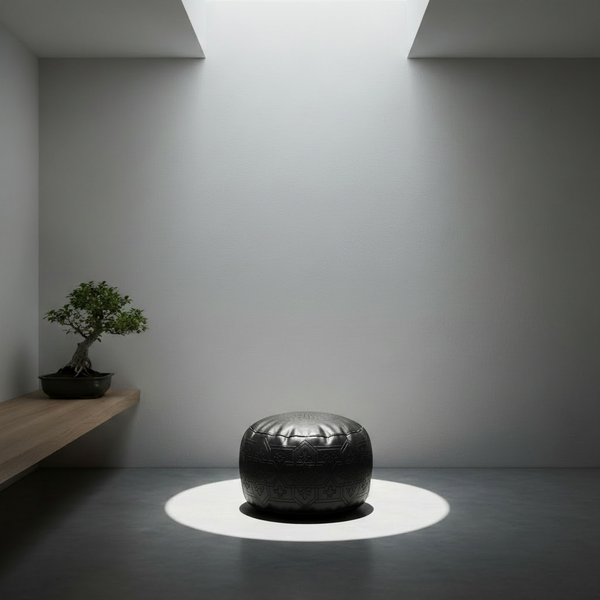
Most Moroccan leather poufs are smooth or embroidered. The embossed pouf is different — its surface is worked with metal stamps pressed by hand into dampened leather, leaving a permanent three-dimensional pattern that catches light, creates shadow, and gives the object a visual depth that flat leather cannot produce. It is a less common technique in contemporary pouf production, and it is one of the defining characteristics of the Moroccan Corridor tabouret collection.
What Is an Embossed Leather Pouf?
Embossing is a leather-working technique in which a metal stamp — carrying a geometric, floral, or arabesque motif — is pressed firmly into the surface of dampened full-grain leather to leave a permanent three-dimensional impression. The stamp compresses the leather fibres rather than cutting them, creating a recessed pattern that is part of the leather itself rather than applied to its surface.
The result is a surface with relief — raised and recessed areas that interact with light differently depending on the angle of view and the quality of the light source. In direct sunlight, the embossed pattern creates sharp shadows that make the geometry legible from across a room. In warm artificial light, the same pattern produces a softer, more diffuse effect — the relief reads as texture rather than pattern, giving the pouf a material richness that a smooth or printed surface cannot replicate.
This is what distinguishes an embossed pouf from its alternatives: it is not a surface decoration. It is a surface transformation — the leather has been physically altered, and the pattern is as permanent and integral as the leather itself.
The Stamping Technique
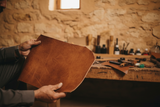
The embossing process used on the Moroccan Corridor tabouret poufs is entirely manual. Each stamp is a solid metal tool — typically brass or steel — carrying a specific motif: a geometric repeat, an arabesque segment, a floral element, or a combination. The artisan dampens the leather surface with water to make it temporarily pliable, then positions the stamp by hand and strikes it with a mallet to drive the impression into the leather.
The process is repeated across the entire surface of the pouf, stamp by stamp, building up the complete pattern through the accumulation of individual impressions. The artisan must maintain consistent pressure and alignment across the full surface — too light and the impression is shallow; too heavy and the leather fibres are damaged. The spacing between impressions, the angle of each stamp, and the sequence in which different motifs are applied are all decisions made by hand, in real time, without mechanical guides.
The motifs used on the Moroccan Corridor embossed poufs draw from the same design vocabulary as the broader Moroccan decorative tradition — geometric patterns derived from Islamic tilework and stucco carving, arabesque repeats, and floral elements from the tawriq tradition. The specific combination of motifs varies between colourways and models, which means no two embossed poufs in the collection carry exactly the same surface pattern.
Once the embossing is complete, the leather is allowed to dry in its impressed state. As it dries, the fibres set permanently in their new configuration — the pattern becomes fixed and will not flatten or fade with use. This permanence is one of the key advantages of embossing over surface printing or applied decoration: the pattern cannot be worn away, because it is not on the surface — it is the surface.
Why Embossed Poufs Are Rare
The embossed pouf is less common in contemporary production than its smooth or embroidered equivalents for straightforward economic reasons: it takes significantly longer to produce. Embroidering a pouf cover requires skill, but the embroidery thread can be applied relatively quickly once the pattern is established. Stamping an embossed pattern across the full surface of a leather pouf — stamp by stamp, by hand, with consistent pressure and alignment — is a slower process that cannot be mechanised without losing the quality of the impression.
Most contemporary pouf production has moved toward techniques that can be executed more quickly and at lower cost. The embossed pouf has survived in the workshops of Fès and Marrakesh because there is a market for it — but it represents a smaller share of total production than the smooth and embroidered variants, and it requires artisans with a specific skill set that is becoming less common as younger craftsmen are drawn to faster, more economically efficient techniques.
This relative scarcity is part of what makes the embossed tabouret a best-seller in the Moroccan Corridor collection: buyers who encounter it recognise immediately that it is a different category of object from the standard Moroccan pouf. The surface tells the story of its making in a way that a smooth or embroidered surface does not.
How the Embossed Surface Changes the Styling Rules
The three-dimensional surface of an embossed pouf behaves differently from a flat leather surface in an interior context, and this difference has practical implications for how it should be styled.
Light Is the Primary Variable
The embossed pattern is most legible in directional light — natural light from a window, a floor lamp positioned to one side, or a table lamp at a lower angle. In flat, overhead light, the relief flattens and the pattern loses much of its visual impact. When positioning an embossed pouf, consider the light sources in the room and orient the pouf so that at least one of them hits the surface at an angle rather than directly from above.
Texture Contrast Works Better Than Pattern Contrast
Because the embossed surface already carries significant visual information — the pattern, the relief, the play of light and shadow — it does not need to be surrounded by additional pattern. The most effective combinations pair the embossed pouf with plain, textured surfaces: a bouclé sofa, a linen armchair, a jute rug, a raw wood floor. The contrast between the precise geometry of the embossed leather and the organic irregularity of natural textiles creates a visual dialogue that pattern-on-pattern combinations cannot achieve.
Avoid placing an embossed pouf directly against a heavily patterned rug or a boldly printed textile — the two surfaces will compete rather than complement, and both will lose.
Colour Reads Differently on an Embossed Surface
The relief of the embossed pattern creates areas of shadow within the leather surface — recessed areas that appear darker than the raised areas even when the leather is a single uniform colour. This means that an embossed pouf in a given colour will read as slightly more complex and varied in tone than a smooth pouf in the same colour. A turquoise embossed pouf, for example, will show both the full turquoise of the raised areas and the deeper, shadowed turquoise of the recessed areas — effectively giving the surface a two-tone quality that adds depth.
This characteristic makes embossed poufs particularly effective in rooms where the colour palette is restrained: the tonal variation within the leather surface provides visual interest without requiring additional colour in the surrounding space.
Position for Visibility
Unlike a smooth pouf, which looks essentially the same from any angle, an embossed pouf rewards close examination. Position it where the surface is visible — not tucked into a corner or pushed under a table where the embossed pattern cannot be seen. Angle it slightly toward the main seating area so that the pattern is legible from the primary viewpoint in the room.
The Collection: Five Colourways
The Moroccan Corridor embossed tabouret is available in five colourways, each carrying a distinct character within the same technical framework. The embossed pattern varies between models — the motifs are drawn from the same Moroccan design vocabulary, but the specific combination and arrangement differ, which means each colourway is a distinct object rather than a colour variant of a single design.
Turquoise
The turquoise embossed tabouret is the most visually striking piece in the collection — the saturated blue-green of the leather, combined with the tonal variation created by the embossed relief, produces a surface of considerable complexity. It functions as a focal point in neutral rooms and holds its own in colourful ones. The embossed pattern on the turquoise model draws primarily from geometric and arabesque motifs.

Orange
The orange embossed tabouret references the terracotta and saffron tones of southern Moroccan architecture and the dyed leather of the Marrakesh tanneries. The embossed surface catches warm light particularly well — in the evening, under incandescent or warm LED lighting, the relief creates a depth of shadow that makes the pattern appear almost carved. It integrates naturally with earth-toned interiors and adds warmth to spaces that read as cool.

Black
The black embossed tabouret is the most versatile piece in the collection. The neutral colour means it works across a wider range of interior contexts than any of the other colourways, and the embossed pattern — which on a black surface reads primarily as texture rather than colour — gives it a material richness that a smooth black leather pouf does not have. It is the piece that requires the least deliberation about context.

Square Lila
The square Lila embossed pouf is the most formally distinctive piece in the collection — the square silhouette is a departure from the standard round tabouret, and it reads as more structured and contemporary. The lilac tone is soft without being passive, and the embossed pattern on this model incorporates floral tawriq elements alongside the geometric base, giving it a slightly more ornate character than the other colourways.

Red
Red is the dominant colour of the Moroccan leather tradition — the deep madder red of the Fès tanneries, the crimson of the royal guard's uniform, the warm red of the Atlas mountain rugs. The red embossed tabouret is the most culturally specific piece in the collection, and the most committed in terms of colour. On a red surface, the embossed relief creates particularly strong shadow contrast — the recessed areas appear almost burgundy against the full red of the raised pattern. It is a statement piece, and it works best in rooms that are prepared to receive one.

View the Embossed Pouf Collection
Frequently Asked Questions
What is an embossed leather pouf?
An embossed leather pouf is a Moroccan leather ottoman whose surface has been decorated using a stamping technique — metal stamps carrying geometric, arabesque, or floral motifs are pressed by hand into dampened full-grain leather to leave permanent three-dimensional impressions. The pattern is part of the leather itself rather than applied to its surface, and it cannot be worn away with use.
How is embossing different from embroidery on a Moroccan pouf?
Embroidery applies thread to the surface of the leather — the decoration is added on top of the material. Embossing physically alters the leather surface — the pattern is pressed into the material, creating relief that is integral to the leather rather than applied to it. Embossed poufs have a three-dimensional surface that interacts with light to create shadow and depth; embroidered poufs have a flat leather surface with a textile decoration on top.
Why are embossed poufs less common than smooth or embroidered poufs?
Embossing is more time-consuming than the alternatives. Each stamp impression is made individually by hand, across the full surface of the pouf, requiring consistent pressure and alignment throughout. The process cannot be mechanised without losing the quality of the impression. Most contemporary pouf production has moved toward faster techniques; the embossed pouf has survived in the workshops of Fès and Marrakesh because there is a specific market for its quality, but it represents a smaller share of total production.
How should I position an embossed pouf in a room?
Position it where the surface is visible and where it receives directional light — from a window, a floor lamp, or a table lamp positioned to one side. The embossed pattern is most legible in directional light; in flat overhead light, the relief flattens and the pattern loses much of its visual impact. Angle the pouf slightly toward the main seating area so that the pattern is visible from the primary viewpoint in the room.
Do the embossed patterns vary between colourways?
Yes — the motifs are drawn from the same Moroccan design vocabulary (geometric patterns, arabesque, floral tawriq elements), but the specific combination and arrangement of motifs varies between models. Each colourway is a distinct object rather than a colour variant of a single design.
How do I care for an embossed leather pouf?
Dust weekly with a soft dry cloth, paying attention to the recessed areas of the embossed pattern where dust can accumulate. Apply a quality leather conditioner every three to four months — work it gently into the surface with a soft cloth, ensuring it reaches the recessed areas of the pattern. Avoid prolonged exposure to direct sunlight and keep away from heat sources. Do not use water or household cleaning products on the leather surface.