Moroccan leather craftsmanship is one of the oldest and most sophisticated artisanal traditions in the world. Practiced continuously since the Almohad dynasty in the 12th century, it has shaped the material culture of Morocco — and given the French language the word maroquinerie. Today, the craft employs 23,000 people in Fès alone, and its products reach markets across four continents. Yet the sector is under pressure, and the artisans who carry it forward are calling for urgent support.
A Craft Rooted in History
Leather has been worked in Morocco for over a thousand years. The Almohad and Marinid dynasties made Fès the undisputed capital of the craft — a city where, by the 14th century, historian Ali Ibn Abi Zar counted 86 tanneries operating within the medina. The proverb of the time said it plainly: Dar Dbagh, Dar Dhab — "the tannery is a house of gold."
That reputation spread across the Mediterranean. By the 16th century, Moroccan goatskin — tanned with sumac and gallnut, supple and richly coloured — was being imported into European markets under the name Maroquin. It was used for luxury bookbindings, ministerial portfolios, and fine accessories. The French word maroquinerie, meaning leather goods, derives directly from Morocco. So does the expression un maroquin de ministre — a minister's portfolio — a term still used in French political life to describe a cabinet position.
The Products of Moroccan Leather Craft
Bags — From the Zaaboula to the LSSAN
Moroccan handmade leather bags span a wide spectrum — from ancient tribal forms to contemporary designs rooted in traditional motifs.
The Zaaboula is a shoulder bag worn by men in rural Morocco, traditionally carried on the left side with a dagger on the right. Made from leather and decorated with tribal embroidery in cactus silk, it was used to carry money, prayer beads, a razor, and the Quran. Its shape and name vary by region; in the Sahara, it is also called the Tuareg bag, in reference to the nomadic Berber tribes of the desert.

The Choukara is a slim messenger bag with a flap decorated with traditional Moorish embroideries. Historically used by merchants traveling under their coats to protect valuables, it is handmade from thick tan leather with a long strap designed for shoulder or cross-body wear.

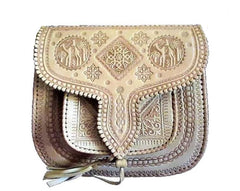
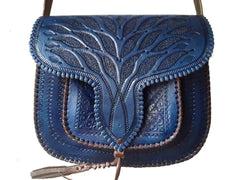
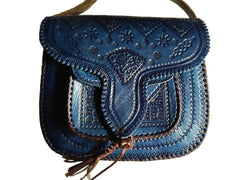
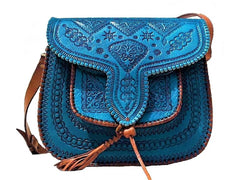
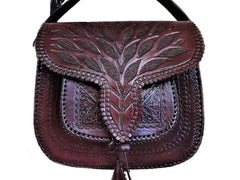
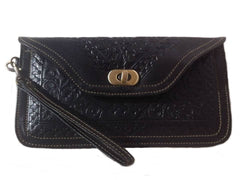
The LSSAN bag takes its name from the Arabic word for "tongue" — a reference to the distinctive shape of its front panel. Designed by Moroccan Corridor, it draws on Islamic geometric patterns, the Amazigh alphabet, and the natural landscape of Morocco. Each bag is hand-tooled by artisans in Fès and Tétouan. Explore the LSSAN collection →

The Sref Alih tote — "hang him" in Moroccan dialect, a reference to its drawstring closure — is a bucket bag hand-embossed across its entire surface with arabesque, floral, and Berber geometric patterns. Made from soft goat or sheep leather. Explore the Heritage collection →

The Waterman bag is a cross-body messenger bag in thick dark brown leather, decorated with rivet studs, coins, and a medallion on the front flap — traditionally used by water carriers to hold coins.

Balgha and Cherbil — The Shoes of Fès
The Balgha (or Babouche) is the emblematic leather slipper of Morocco, inseparable from the craft heritage of Fès. Unisex in origin, the men's version has historically come in yellow, grey, and white; the women's version has evolved into a wide range of colours and embellished forms. The artisans of Fès have continuously refined the Balgha, generation after generation, making it one of the most recognisable symbols of Moroccan craft.

The Cherbil is a traditional women's shoe embroidered with gold or silk threads, one of the oldest forms of footwear in North Africa. Its name is linked to the Andalusian period, when it was worn alongside the caftan as a marker of feminine elegance and social standing. In Moroccan tradition, a woman of good reputation was referred to as Moulat Ech-cherbil — "the owner of the cherbil."

The Stormia — Moroccan Pouf and Ottoman
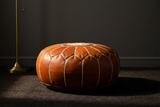
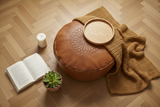
Known in Moroccan dialect as the Stormia, the leather pouf has roots in the Ottoman Empire and the broader Arab world, where it served as royal seating and footrest. Introduced into Moroccan homes as low seating — used alone or with floor cushions — it has since become one of the most internationally recognised Moroccan craft objects.
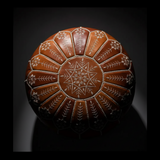
Authentic Moroccan poufs are made from full-grain goatskin, hand-stitched and embroidered with geometric and floral patterns. No two are identical. Explore our pouf and ottoman gallery →

Wallets and Coin Purses
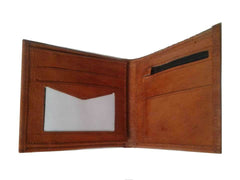
Moroccan leather wallets are made from vegetable-tanned leather dyed with natural pigments in Fès and Marrakesh, then hand-embossed with geometric and arabesque patterns. The traditional leather coin purse — square in shape, with gold patterns and a pull-open closure — remains one of the most distinctive small leather goods produced in Morocco. Explore leather wallets →
Portfolios and Book Bindings
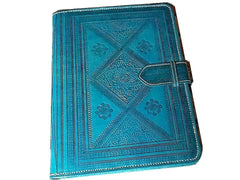
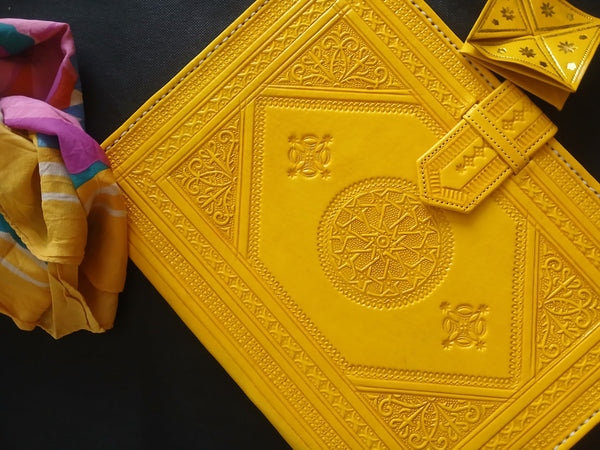
The Moroccan leather portfolio has a direct lineage to the Maroquin — the sumac-tanned goatskin that was imported into Europe from the 16th century for luxury bookbindings and ministerial cases. Today, Moroccan Corridor produces portfolios in two forms: hand-embossed leather, and leather with gold-printed decoration. Both are made by hand in Morocco using traditional tooling techniques. Explore the Heritage portfolio collection →
The Moroccan Horse Saddle
The sarrajin — the Moroccan saddle maker — practices one of the most demanding forms of leather craft. A saddle begins with a carved wooden frame of cedar or walnut, onto which full-grain leather is stretched, cut, and stitched by hand. The leather is dyed with natural pigments — saffron for gold, pomegranate for red, indigo for blue — and decorated with motifs drawn from Berber, Andalusian, and Islamic art. Royal commissions were historically encrusted with silver and draped in silk. Unlike European saddles built for speed, Moroccan saddles were designed for endurance across the Atlas Mountains and the Sahara.

Moroccan Riders by Jalal Gharbi
The Material — Goatskin, Maroquin, and Vegetable Tanning
Goat leather dominates the Moroccan traditional leather market. Its interwoven fibre structure produces a tight, clean texture that is naturally soft, flexible, and water-resistant — due to the lanolin content of the skin. It is the most prized hide for fine leather goods, and the most technically demanding to work.
Traditional Moroccan tanning uses vegetable tannins — compounds extracted from sumac, oak bark, or gallnut — rather than the chromium salts used in industrial production. The process is slower, taking weeks rather than hours, but produces leather of exceptional durability and character: firm, breathable, and capable of developing a deep patina over decades of use.
The leather industry also plays an important environmental role: it recycles hides that would otherwise be waste from Morocco's meat industry, which produced 550,000 tons of red meat in 2023 alone.
The Production Process
Step 1 — Preparation
Raw hides arrive salted and stiff. They are soaked for two to three days in a caustic bath of quicklime, cow urine, water, and salt. This loosens the hair and begins to break down the outer layers of the skin. Tanners scrape off the remaining hair, fat, and flesh by hand.
Step 2 — Softening
The hides are then transferred to vats containing water and pigeon droppings — rich in ammonia — which acts as a natural softening agent. This makes the skin malleable and prepares it to absorb dye. Artisans trample the hides barefoot from 6am to 2:30pm daily, kneading them to achieve the desired softness.

Step 3 — Tanning
The softened hides move into the tanning vats, where they are immersed in a solution of water and vegetable tannin. This transforms the raw skin into stable, rot-resistant leather. The process takes several weeks. It has been performed this way, without machinery or synthetic chemicals, since medieval times.
Step 4 — Dyeing
When the hides are dry and smooth, they are dyed using exclusively natural pigments: poppy for red, mint for green, indigo for blue, kohl for black, henna for orange, and a mixture of oil and pomegranate for yellow. The dyed hides are then rinsed and relaxed using a traditional wooden rotating machine.
Step 5 — Crafting
Each piece of leather is cut and sewn using traditional hand tools, then oiled to condition the material. Decoration is applied by hand — engraving, embroidery, painting, and inlaying of coloured leather, kilim textile, precious stones, copper, or silver — depending on the object and the artisan's tradition.
Moroccan Embroidery on Leather
Embroidery is one of the most distinctive finishing techniques in Moroccan leather craft. Applied to bags, balgha, poufs, belts, book covers, and jackets, it typically features geometric patterns, floral motifs, and arabesques, stitched in vibrant silk threads or metallic gold and silver thread. Each piece is worked entirely by hand.

Moroccan Embroidery on Leather
The Market — Exports, Cities, and the Crisis of the Craft
Moroccan leather goods reach markets across the world, with the United States receiving the largest share of exports (37%), followed by France (11%), Spain, and other European countries. Casablanca and Marrakesh together account for approximately 91% of all leather goods exports — Casablanca primarily supplying the US and Belgian markets, Marrakesh supplying France, the US, and European markets including Switzerland, Denmark, and Sweden.

Yet the data tells a difficult story. Leather goods exports have declined steadily over the past five years:
| 2019 | 2020 | 2021 | 2022 | 2023 | 2024 | |
|---|---|---|---|---|---|---|
| Exports (thousands DH) | 43,446 | 36,730 | 43,099 | 36,764 | 33,175 | 32,325 |
| Evolution vs. previous year | +18% | -15% | +17% | -15% | +10% | -3% |
| Share of total craft exports | 5% | 6% | 5% | 4% | 3% | 3% |
In 2024, leather goods represented just 3% of total Moroccan craft exports — a sector that itself reached a record 1,106 million dirhams. The craft is under structural pressure from informal competition, insufficient export infrastructure, and the difficulty of transmitting skills across generations. Artisans are calling on the government to act.
How Morocco Is Responding
The Moroccan government has identified export promotion, craft labeling, and trade sustainability as the three priority levers for the sector. Current initiatives include the National Registry of Crafts — with over 389,000 registered artisans — and a Compulsory Health Insurance scheme covering more than 641,000 beneficiaries. Programs to improve production quality, market intelligence, and export orientation are also underway.
At Moroccan Corridor, we work directly with artisans in Fès, Tétouan, and Marrakesh — sourcing full-grain leather tanned using traditional methods and crafted into poufs, bags, and accessories by hand. No intermediaries. Full traceability from tannery to finished piece.
Explore our leather pouf collection → | Explore LSSAN bags → | Explore the Heritage collection →
Frequently Asked Questions
What is Moroccan leather craftsmanship?
Moroccan leather craftsmanship is a centuries-old tradition of tanning, dyeing, and hand-crafting leather goods using ancestral techniques. Rooted in the medinas of Fès, Marrakesh, and Tétouan, it encompasses bags, poufs, footwear, wallets, portfolios, saddles, and embroidered accessories — all made by hand without industrial machinery.
Why is Moroccan leather called Maroquin?
The term Maroquin — and the French word maroquinerie — derives directly from Morocco, whose leather was so prized in Europe from the 16th century onward that the country's name became synonymous with the craft. Moroccan goatskin, tanned with sumac and gallnut, was used for luxury bookbindings, ministerial portfolios, and fine accessories across Europe.
What makes Moroccan leather different from industrial leather?
Moroccan leather is vegetable-tanned using natural tannins derived from plant bark, rather than the chromium salts used in industrial production. The process takes weeks rather than hours, producing leather that is firmer, more breathable, and longer-lasting. It develops a rich patina over time rather than degrading. The entire process — from tannery to finished object — is performed by hand.
What is a Moroccan pouf made of?
An authentic Moroccan pouf is made from full-grain goatskin, vegetable-tanned in Fès or Marrakesh and hand-stitched by artisans. The exterior is decorated with hand-embroidered geometric or floral patterns in silk or metallic thread. The interior is filled with fabric padding. No two poufs are identical.
What is the LSSAN bag?
The LSSAN bag is a hand-tooled leather bag designed by Moroccan Corridor, inspired by Islamic geometric patterns, the Amazigh alphabet, and Moroccan nature. Its name comes from the Arabic word for "tongue," a reference to the distinctive shape of its front panel. Each bag is made by artisans in Fès and Tétouan using traditional leather-working techniques.
Is Moroccan leather craftsmanship at risk of disappearing?
Yes. Export data shows a consistent decline over the past five years, with leather goods now representing just 3% of total Moroccan craft exports. The sector faces structural challenges including informal competition, difficulty transmitting skills across generations, and limited export infrastructure. Artisans and industry bodies are calling for government intervention to preserve the craft.
Where can I buy authentic Moroccan leather goods?
Moroccan Corridor sources directly from artisans in Fès, Tétouan, and Marrakesh — with full traceability from tannery to finished piece. Our collections include leather poufs, LSSAN bags, Heritage portfolios, wallets, and accessories. Explore all collections →