The Moroccan leather pouf is one of the most recognisable objects in Moroccan domestic culture — and one of the most misunderstood. Sold in every souk from Fès to Marrakesh, copied by mass manufacturers across three continents, and featured in interiors from São Paulo to Stockholm, it has become a global object. What is less well known is its history, the distinctions between its regional variants, and what separates an authentic hand-crafted piece from an industrial imitation. This guide covers all three.
A Brief History of the Moroccan Pouf
Ottoman Origins
The pouf as a form of low upholstered seating has its origins in the Ottoman Empire, where it was used as a footrest and supplementary seat in domestic interiors. The word "ottoman" entered European languages in the late eighteenth century, when trade between the Ottoman Empire and Western Europe brought this style of furniture to France and Britain. The French term pouf — referring to a low, stuffed seat without a back — followed shortly after.
The object itself, however, predates its European name by several centuries. Low cushioned seating arranged around the perimeter of a room is a feature of domestic interiors across the Arab world, North Africa, and Central Asia that long precedes the Ottoman Empire's political reach.
The Moroccan Tradition
In Morocco, the pouf became a distinct craft object with its own regional traditions, materials, and techniques. The country's long history of leather production — centred on the tanneries of Fès, which have operated continuously since the eleventh century — provided the primary material. Moroccan goatskin, vegetable-tanned using traditional methods, became the standard material for poufs produced in the northern and central cities.
The object known in Moroccan dialect as stormia was used as low seating in the salon marocain, as a footrest alongside traditional banquette seating, and as a surface for serving trays in communal spaces. Its embroidered top surface — worked in silk or cactus silk thread in geometric and floral patterns — reflected the decorative vocabulary of Moroccan architecture and textile arts.
Today, the craft is still practiced in Fès, Marrakesh, and several other cities, each with its own distinct techniques and aesthetic traditions.
Claudio Bravo and the White Pouf
The Chilean hyperrealist painter Claudio Bravo (1936–2011) spent the majority of his career in Morocco, settling first in Tangier in 1972 before moving to Taroudant, where he lived and worked until his death. Bravo was drawn to what he described as "the composition of things" in Morocco — the light, the colours, the objects of daily life arranged with an unconscious precision that he found nowhere else.
The white embroidered Moroccan pouf appears in several of his major works, including Prayer (1999, oil on linen, 150×120cm) and Gandora Rosa (1995, oil on linen, 170×120cm). In these paintings, the pouf functions not as a decorative prop but as a primary subject — its embroidered surface rendered with the same meticulous attention Bravo gave to fabric, skin, and light. His treatment of the object is one of the most precise visual records of the traditional Moroccan pouf in fine art.

Prayer, Claudio Bravo — huile sur lin, 150×120cm, 1999

Gandora Rosa, Claudio Bravo — huile sur lin, 170×120cm, 1995

Padre e Hijo, Claudio Bravo — 1989

El Guardín y su Hijo, Claudio Bravo — 1979

Chilaba Verde y Azul, Claudio Bravo — 1994
Types of Moroccan Leather Poufs
Authentic Moroccan leather poufs are not a single product — they are a family of related objects, each produced in a specific city using specific techniques. The distinctions matter both aesthetically and in terms of quality and durability.
Round Embroidered Poufs — Marrakesh
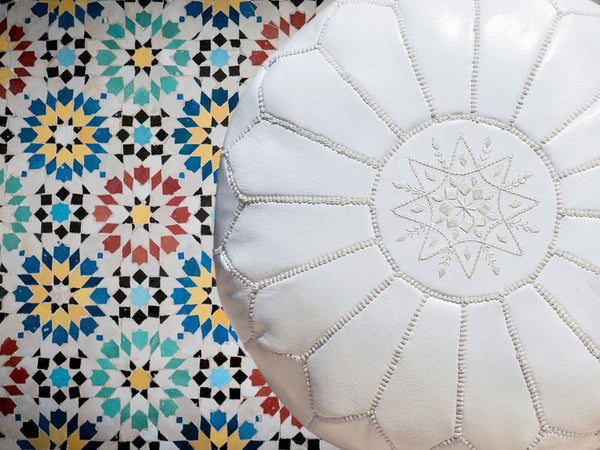
The round embroidered pouf is the most widely recognised variant. Made in Marrakesh, it features a circular top surface worked in silk or cactus silk embroidery in geometric and floral patterns, a full-grain goatskin body, and a zip closure on the underside. The embroidery is done by hand — a process that requires between one and three days per piece depending on the complexity of the pattern.
The tan (brown caramel) version is the most versatile colourway, compatible with a wide range of interior palettes. The collection also includes white, deep red, blue, yellow, and black, as well as two-tone combinations. Standard dimensions are approximately 50cm in diameter and 35cm in height.

Round Embossed Poufs — Fès
The round embossed pouf is produced in Fès using a different technique: rather than applied embroidery, the decorative surface is created by pressing geometric patterns directly into the leather while it is still damp from the tanning process. The result is a lower-relief, more architectural surface — the geometric motifs drawn from Moroccan tilework and stucco carving rather than textile traditions.
Embossed poufs tend to have a more restrained, formal aesthetic than their embroidered counterparts. They work particularly well in minimal and contemporary interiors where the embroidered variant might read as too decorative.

Poufs with Golden Motifs — Stormia
The stormia is a distinct variant produced in Fès, characterised by its gold-painted geometric motifs applied to a dyed leather surface. The technique uses a fine brush and gold pigment to trace arabesque and medallion patterns — a decorative vocabulary derived from the illuminated manuscripts and architectural ornament of the Marinid period. The result is visually striking: rich, colourful, and distinctly Moroccan in character.

Square and XL Poufs
Square poufs offer a wider, flat top surface that makes them particularly well suited to use as a side table — a tray placed on top creates a stable, functional surface. The squared form also works well at the foot of a bed or as a pair flanking a sofa. XL and rectangular variants provide a larger seating surface, closer in scale to a low bench, and are available in both embroidered and plain leather finishes.

Moroccan Poufs in the Home
The pouf's versatility is one of its defining practical qualities. Unlike most upholstered furniture, it has no fixed orientation, no back, and no prescribed position — it can be moved, stacked, repurposed, and repositioned without effort. This flexibility, combined with the visual richness of its embroidered surface, makes it one of the most useful objects in a considered interior.
As Seating and Footrest
A firmly stuffed pouf provides comfortable support as a footrest alongside a sofa or armchair. As occasional seating, two or three poufs grouped together create flexible, low-profile seating that can be rearranged for different configurations. For children's rooms, the pouf is particularly well suited — low, soft, lightweight, and available in a range of colours that work with most palettes.
As a Side Table
A square or round pouf with a flat top surface, combined with a rigid tray, functions as a practical side table or coffee table alternative. The combination works particularly well in rooms where a conventional table would feel too heavy or too permanent — the pouf can be moved aside when the space is needed for other purposes.
Pairing with Cactus Silk Rugs
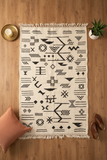
Moroccan poufs pair naturally with cactus silk Sabra rugs — both objects share the same material culture, the same regional craft traditions, and a similar visual vocabulary of geometric pattern and natural colour. The combination of a cactus silk rug in pale ivory or natural tones with one or two embroidered poufs is one of the most coherent and visually resolved floor compositions available in Moroccan craft.

How to Choose the Right Pouf for Your Space
Shape
Round poufs are the most versatile and the most traditional. They work in most room configurations and are available in the widest range of colours and finishes. A round pouf of standard dimensions (50cm diameter, 35cm height) is the right choice for most applications — as a footrest, occasional seat, or decorative accent.
Square poufs offer a wider, more stable top surface and a more architectural silhouette. They are the better choice for use as a side table, at the foot of a bed, or in a room with a more structured, geometric interior aesthetic.
XL and rectangular poufs function closer to a low bench and are suited to larger rooms where a single standard pouf would look undersized. They also work well as a pair, placed symmetrically in front of a sofa.
Upholstery
All Moroccan Corridor poufs are made from full-grain goatskin — the highest grade of leather, taken from the outermost layer of the hide where the fibre structure is tightest and most durable. Full-grain leather develops a patina with use, deepening in colour and acquiring a subtle sheen over time. This is one of its most valued characteristics — a well-used pouf will look better after five years than it did when new.
The distinction between embroidered and embossed surface finish is primarily aesthetic. Embroidered poufs have a warmer, more textile quality — the raised silk thread catches light differently depending on the angle of view. Embossed poufs have a more graphic, architectural quality — the pressed geometric pattern reads clearly from a distance and integrates well with minimal interiors.
Size and Stuffing
Poufs are sold unstuffed as standard — this is a practical necessity for international shipping, not a compromise on quality. The stuffing material you choose will determine the firmness and weight of the finished piece. For use as seating or a footrest that needs to support body weight, use dense materials: cotton batting, old denim, folded towels, or wool fibres. For a lighter, more decorative pouf, polyester ball fibre or foam chips are sufficient. Full stuffing guidance is available in our Moroccan Leather Poufs Care Guide.
The Moroccan Corridor Collection
Every pouf in the Moroccan Corridor collection is sourced directly from artisan workshops in Fès and Marrakesh. Each piece is made from full-grain goatskin, hand-stitched or hand-embossed, and finished by hand. We do not work with factories or intermediaries.

Frequently Asked Questions
What is a Moroccan pouf made of?
Authentic Moroccan poufs are made from full-grain goatskin — the highest grade of natural leather. The leather is vegetable-tanned using traditional methods, then cut, hand-stitched, and finished with silk or cactus silk embroidery (embroidered variants) or hand-pressed geometric patterns (embossed variants). The zip closure on the underside allows the pouf to be stuffed locally after purchase.
What is the difference between a pouf and an ottoman?
The terms are used interchangeably in contemporary home decor language, but they have distinct origins. "Ottoman" refers to the style of low upholstered seating introduced to Europe from the Ottoman Empire in the late eighteenth century. "Pouf" is the French term for a low, stuffed seat without a back. In the context of Moroccan craft, both terms refer to the same object — the hand-stitched leather seat known in Moroccan dialect as stormia.
What is the difference between embroidered and embossed poufs?
Embroidered poufs feature a decorative surface created by hand-stitching silk or cactus silk thread onto the leather top — a technique associated with Marrakesh workshops. Embossed poufs feature a decorative surface created by pressing geometric patterns directly into the leather — a technique associated with Fès workshops. Embroidered poufs have a warmer, more textile quality; embossed poufs have a more graphic, architectural quality.
Are Moroccan poufs suitable for use as seating?
Yes — provided they are firmly stuffed with a dense material such as cotton batting, old denim, or wool fibres. A pouf stuffed with lightweight materials such as polystyrene beads will not provide adequate support for seated use. If seating is your primary use, pack the pouf as firmly as possible and overfill slightly to account for compaction over the first few weeks of use.
Do Moroccan poufs come stuffed?
No — authentic Moroccan poufs are sold unstuffed as standard. This is a practical necessity for international shipping: a fully stuffed pouf of medium size weighs between 8 and 15 kilograms and would make shipping prohibitively expensive. Stuffing locally also allows you to control the firmness to suit your specific use. Full guidance on stuffing materials and technique is available in our Care Guide.
How do I care for a Moroccan leather pouf?
Wipe with a clean dry cloth for routine cleaning. Condition with a natural leather conditioner every six to twelve months. Never use water, soap, or household cleaning sprays directly on the leather. Avoid prolonged exposure to direct sunlight and heat sources. Full care instructions are available in our Moroccan Leather Poufs Care Guide.
Where are Moroccan Corridor poufs made?
All poufs in the Moroccan Corridor collection are made in our Marrakesh Workshops;