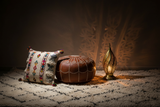

A Moroccan leather pouf often arrives flat and unstuffed. This is intentional: removing the filling makes the pouf easier to transport and allows you to determine its firmness once it reaches your home.
But the way you fill it matters.
An underfilled pouf can look deflated and lose its shape. Poorly distributed filling can create lumps or weak areas. Overpacking can put unnecessary pressure on the zipper and seams.
A properly filled pouf should be firm, evenly packed and structurally supported without stretching the leather excessively.
This guide explains how to choose your filling, how much you need and how to fill your pouf step by step.
Why Are Moroccan Poufs Sold Unstuffed?
Many Moroccan leather poufs are shipped without filling because an empty leather pouf is significantly easier to transport.
The empty form can be folded or compressed for shipping, while the customer can source filling locally after delivery.
There is also a practical advantage:
You can choose the firmness according to how you intend to use the pouf.
A pouf used mainly as a footrest may require a different feel from one intended for occasional seating.
What Should You Fill a Moroccan Pouf With?
Several materials can work.
The best choice depends on the firmness you want, the availability of the material and how often the pouf will be used.
1. Old Clothes and Fabric Scraps
Clean, dry clothing and textile scraps are practical filling materials because they can be compressed densely.
Jeans, towels, blankets and knitwear are particularly useful because they provide substantial volume and can be packed firmly.
Advantages:
- readily available;
- reusable;
- relatively dense;
- easy to add or remove;
- suitable for firm filling.
Disadvantage:
- collecting enough material can take time.
2. Polyester Fiberfill
Polyester fiberfill is lightweight and easy to source.
It produces a softer result than tightly compressed clothing and may be suitable when a lighter, softer pouf is preferred.
Because lightweight filling can compress with use, the pouf may need to be topped up later.
3. Foam Offcuts
Clean upholstery foam can be used as part of a filling system.
Foam provides structure, but using large pieces alone can produce an uneven surface.
Combining smaller foam pieces with fabric or fiberfill can help create a more uniform result.
4. Other Materials
Other dry filling materials can be used depending on the desired result.
The important considerations are:
- the material must be clean;
- it must be completely dry;
- it should not damage the leather;
- it should allow the pouf to retain its shape.
What Should You Avoid?
Avoid materials that create excessive weight, retain moisture, degrade quickly or put unnecessary pressure on the leather.
Do not use:
- wet or damp materials;
- loose sand;
- materials that can leak or stain the leather;
- decomposing organic material;
- large rigid objects that can stress the leather;
- anything with sharp edges.
Newspaper and plastic bags are also poor long-term choices because they can compress unevenly and do not provide reliable structural support.
Step-by-Step: How to Fill a Moroccan Pouf
Step 1 — Open the Zip
Locate the zipper on the underside of the pouf and open it fully.
Make sure the leather around the opening is not under unnecessary tension.
Step 2 — Start at the Bottom
Place the densest filling material at the base.
Work around the edges rather than creating a large pile in the centre.
This helps establish the shape of the pouf from the beginning.
Step 3 — Fill the Corners and Edges
This is one of the most important stages.
Push filling firmly into the sides and corners.
Poorly filled edges can leave the pouf looking collapsed even when the centre appears full.
Step 4 — Build the Filling in Layers
Add filling gradually.
Compress each layer before adding the next.
Do not simply pour loose material into the centre.
Instead:
add → distribute → compress → repeat.
This creates a much more even structure.
Step 5 — Check the Shape Regularly
Every few layers, close the zipper temporarily and turn the pouf upright.
Look at it from different angles.
Check for:
- hollow areas;
- wrinkles caused by insufficient filling;
- uneven sides;
- excessive tension around the zipper.
If one area is softer than another, reopen the pouf and redistribute the filling.
Step 6 — Fill Firmly, But Do Not Force the Zipper
A pouf should be firm enough to hold its shape.
But there is an important distinction between firmly filled and overstuffed.
If the zipper becomes extremely difficult to close, remove some filling and redistribute it.
Never force the zipper against excessive pressure.
Step 7 — Test the Finished Pouf
Once the zipper is closed, place the pouf upright.
Press down firmly with your hand.
The surface should resist pressure and recover its shape.
If the pouf collapses dramatically or remains deeply compressed, it may need more filling.
How Much Filling Do You Need?
There is no universal weight because different filling materials have very different densities.
For that reason, volume is more useful than weight when planning your filling.
As a practical starting point:
| Pouf size | Approximate compressed filling volume |
|---|---|
| Small — 30–35 cm | 15–20 litres |
| Standard — 45–50 cm | 35–45 litres |
| Large — 55–60 cm | 55–70 litres |
| XL — 60 cm+ | 80–100 litres |
These are approximate starting points rather than fixed specifications.
A lightweight material requires considerably more volume than dense textile scraps.
The final amount depends on:
- filling material;
- density;
- pouf construction;
- desired firmness;
- intended use.
How Do You Know When a Pouf Is Full Enough?
There are three useful checks.
The Press Test
Press the top firmly with both hands.
The pouf should resist pressure and recover its shape.
The Shape Test
Look at the pouf from the side.
The surface should appear full and supported rather than collapsed or concave.
The Use Test
If the pouf is intended for seating, sit on it carefully.
It should compress somewhat under weight but remain structurally supported.
If it collapses dramatically, add more filling.
What Happens After the First Few Weeks?
Some filling materials naturally compact with use.
This is normal.
The pouf may therefore become slightly softer or lower after several weeks.
If that happens:
- open the zipper;
- redistribute the existing filling;
- add additional material if necessary;
- reshape the edges and corners;
- close the zipper again.
This is one of the advantages of a pouf with a zip opening: the filling can be adjusted over time.
Does Filling Affect the Leather?
Yes.
The filling supports the leather from inside, so its distribution affects the way the leather surface sits.
Uneven filling can create:
- wrinkles;
- hollow areas;
- asymmetry;
- unnecessary stress around seams.
Excessive filling can also place pressure on the zipper and surrounding leather.
The objective is therefore not maximum volume.
It is even internal support.
Filling a Pouf for Different Uses
As a Footrest
A moderately firm filling is generally sufficient.
As Occasional Seating
Use a denser filling and pack it firmly so that the pouf maintains its structure under body weight.
As a Low Table
A firmer construction is preferable, particularly if a tray will be placed on top.
The tray itself should provide the stable surface needed for objects such as drinks or books.
Maintaining the Pouf After Filling
Once your pouf is filled, normal leather care still matters.
Keep the leather away from prolonged intense sunlight and strong heat.
Dust it regularly with a soft cloth and use an appropriate leather conditioner according to the needs of the leather.
If the filling settles significantly, simply adjust it.
For complete maintenance advice, see our Moroccan Leather Poufs Care Guide.
Frequently Asked Questions
Can I use a pouf before it is fully filled?
It is better to fill it properly before using it. An underfilled pouf can place uneven pressure on the leather and seams and may lose its shape.
How long does it take to fill a Moroccan pouf?
Once the filling material is ready, filling a standard pouf can take roughly 20–40 minutes, depending on the material and how firmly it is packed. Gathering enough filling may take considerably longer.
What is the best filling for a Moroccan pouf?
Clean, dry and densely packable materials such as old clothing and fabric scraps are practical options for a firm pouf. Polyester fiberfill can produce a softer result, while foam can provide additional structure when used appropriately.
Can I fill a Moroccan pouf with old clothes?
Yes. Clean, completely dry clothes are a practical filling material. Compress them firmly and distribute them evenly throughout the pouf.
Why has my pouf gone flat?
Some filling materials compact naturally with use. Open the zipper, redistribute the filling and add more material if necessary.
How do I make my pouf firm enough to sit on?
Use a dense filling material and pack it firmly throughout the pouf, paying particular attention to the edges and corners. The finished pouf should support weight without collapsing excessively.
Can I use foam to fill a Moroccan pouf?
Yes, clean upholstery foam offcuts can be used. Smaller pieces combined with fabric or other filling can help produce a more even result than large pieces of foam used alone.
Can I wash the filling inside my pouf?
If you remove textile filling for cleaning, it must be completely dry before being returned to the leather pouf. Never place damp material inside the pouf because trapped moisture can damage the leather.
How often should I refill my Moroccan pouf?
There is no fixed schedule. Refill it whenever the filling has compacted enough that the pouf has lost significant volume, firmness or shape.
Can I use the same filling for a footrest and a seat?
Yes, but the desired firmness may differ. A pouf intended for seating generally benefits from denser, more firmly packed filling than one used primarily as a decorative footrest.
A well-filled pouf should not simply be full. It should be balanced, firm and evenly supported.
The right filling technique allows the leather to retain its shape while leaving enough flexibility for the pouf to remain comfortable and useful in everyday life.
For maintenance after filling, see our Moroccan Leather Poufs Care Guide.