
Azilal weaving is best understood as work made by hand, not as a fixed pattern that every rug must repeat. Changes in line, spacing and colour can make each piece distinct. Ighor Nikhrazen (إغير نيخرازن), in the commune of Aït Bouali, gives this story a specific place rather than a generic image of Moroccan mountain craft. The photograph here documents the village; it does not, by itself, document a particular weaver or the making of a particular rug.
A Place, Not a Backdrop
In photographs of Moroccan rugs, the place where a piece comes from can disappear behind the finished object. Naming Ighor Nikhrazen keeps the setting visible. Houses sit against steep, sparsely vegetated slopes. This is the landscape shown in the village photograph below, not a claim that every rug associated with Azilal was made here or that the landscape determines its motifs.
What the Hand Leaves Visible
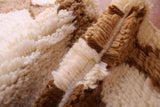
An Azilal rug may bring together an open ground, angular forms and shifts in colour, but no single arrangement defines every example. When looking closely at a handmade piece, notice where a line changes direction, where a motif occupies more space than its neighbour, or where a colour returns with a slightly different weight. These are observations to make about the individual rug, not a code that reveals what its maker intended.
Variation can be part of the visual character of handwork. It should not be treated as automatic proof of age, origin or authenticity. Those questions require attention to the rug itself and, where available, reliable information about its maker and provenance.
Looking Beyond the Finished Rug
Weaving asks for repeated, deliberate work: preparing material, building the textile and responding to what is already there. The precise materials, methods and decisions differ from piece to piece. Without a documented account from a particular maker, it would be misleading to assign a daily routine, a private memory or a meaning to a motif on a maker’s behalf.
That restraint does not make the work less personal. It makes room to see the qualities that can be examined: the construction, the relationships between forms, the changes in rhythm and the evidence of decisions held in the textile. The village photograph situates this account; the individual rug must still be read on its own terms.
For a broader introduction to Moroccan weaving traditions, read our guide to Moroccan rugs, or explore the Moroccan rug collection.