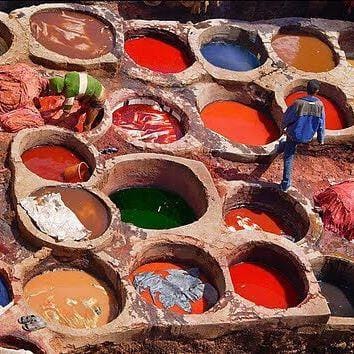
The tanneries of Fès are one of the oldest continuously operating industrial sites in the world. They have been producing leather in the same location, using the same methods, for over a thousand years. No factory has replaced them. No machine has made them obsolete. They remain because what they produce cannot be replicated any other way.
A City Built on Leather
Fès was founded in the 9th century, and leather was part of its economy almost from the beginning. By the 14th century, the historian Ali Ibn Abi Zar recorded 86 tanneries operating within the medina. The craft was so lucrative that a local proverb captured it precisely: Dar Dbagh, Dar Dhab — "the tannery is a house of gold."
That proverb still holds. The tanneries of Fès — Chouara, Sidi Moussa, and Ain Azliten — remain the primary source of the full-grain goatskin and sheepskin leather that defines Moroccan craft. When a leather good is described as maroquinerie — the French word for leather goods — it is named after Morocco. That etymology is not accidental.
The Chouara Tannery
Chouara is the largest and oldest of the three tanneries. Seen from the terraces of the surrounding leather shops, it looks like a painter's palette — dozens of stone vats filled with dyes in saffron yellow, poppy red, indigo blue, and the natural tan of undyed leather. Workers move between the vats, treading the hides underfoot, turning them by hand, guiding them through a process that takes weeks from raw skin to finished leather.
The vats closest to the entrance hold the preparatory baths — a mixture of water, quicklime, and pigeon droppings, which softens the hide and removes the hair. Further in, the tanning vats contain a solution of water and tannin derived from tree bark, which transforms the raw skin into stable, durable leather. The final vats hold the natural dyes — saffron, poppy, indigo, cedar — that give Moroccan leather its characteristic depth of colour.
All of it is done by hand. All of it has been done this way for a thousand years.
The Craft of Tanning
Preparation — Lime and Pigeon Droppings
Raw hides arrive at the tannery stiff, salted, and still carrying hair. They are soaked first in a bath of water and quicklime — a caustic solution that loosens the hair and begins to break down the outer layers of the skin. Pigeon droppings, rich in ammonia, are added to soften the hide further. The process takes several days.
Tanning — Bark and Time
Once prepared, the hides move into the tanning vats. Traditional Moroccan tanning uses vegetable tannins — compounds extracted from the bark of oak, mimosa, or sumac trees — rather than the chromium salts used in industrial tanning. Vegetable tanning is slower, taking weeks rather than hours, but produces leather of exceptional quality: firm, breathable, and capable of developing a rich patina over decades of use.
Dyeing — Natural Pigments
The final stage is dyeing. Traditional Moroccan leather dyes are derived from natural sources: saffron for yellow, poppy petals for red, indigo for blue, henna for orange, and cedar bark for the warm tan that characterises undyed Moroccan leather. The hides are worked into the dye by hand and foot, then dried on the rooftops of the medina in the sun.
Who Does This Work
The men who work in the Chouara tannery learn their craft through apprenticeship — years spent alongside experienced tanners before being trusted to work independently. The knowledge is passed from father to son, from master to apprentice, in an unbroken chain that stretches back centuries.
The work is physically demanding and chemically harsh. The lime baths are caustic; the ammonia is sharp; the dyes stain everything permanently. Workers wear minimal clothing and move through the vats barefoot, treading the hides with their full body weight. It is one of the most ancient forms of industrial labour still practiced in its original form anywhere in the world.
Moroccan Leather and the World
More than 90% of Morocco's exported leather goes to Europe — France first, then Spain, Germany, Italy, and the United Kingdom. The leather produced in Fès supplies some of the world's most respected luxury goods houses, though the connection is rarely advertised.
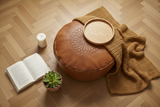
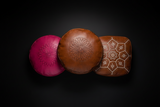
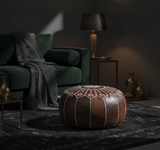
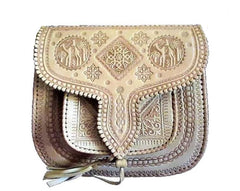
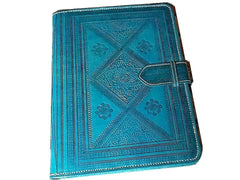
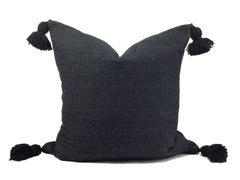
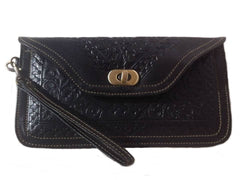
At Moroccan Corridor, we work directly with artisans in Fès, Tétouan, and Marrakesh — sourcing full-grain leather tanned using traditional methods and crafted into poufs, bags, and accessories by hand. No intermediaries. Full traceability from tannery to finished piece.
Explore our leather pouf collection →
Frequently Asked Questions
Where are the tanneries of Fès located?
The three main tanneries — Chouara, Sidi Moussa, and Ain Azliten — are located in the medina of Fès el-Bali, the old city of Fès. Chouara is the largest and most visited, situated in the Andalusian quarter near the Saffarin Madrasa. The tanneries can be viewed from the terraces of the surrounding leather shops.
How old are the Fès tanneries?
The tanneries of Fès date back to the 11th century. The Chouara tannery is believed to be one of the oldest continuously operating tanneries in the world, with records of leather production in Fès dating to the 14th century and earlier.
What is Moroccan leather made from?
Authentic Moroccan leather is made from the hides of goats, sheep, cows, and camels. Goatskin is the most prized — it is fine-grained, supple, and exceptionally durable. The hides are tanned using traditional vegetable tanning methods, using natural tannins derived from tree bark rather than industrial chemicals.
Why does Moroccan leather smell different?
The distinctive smell of Moroccan leather comes from the vegetable tanning process — natural tannins, plant-based dyes, and the absence of synthetic chemicals give it a warm, organic scent that deepens with age. This is one of the markers of authentic, traditionally tanned Moroccan leather.
What is the difference between Moroccan leather and regular leather?
Moroccan leather is vegetable-tanned using centuries-old methods, producing leather that is firmer, more breathable, and longer-lasting than chrome-tanned industrial leather. It develops a rich patina over time rather than degrading. The craft tradition behind it — from tannery to finished object — is also fundamentally different from mass production.
Why is Moroccan leather called maroquinerie?
The French word maroquinerie — meaning leather goods — derives directly from Maroc, the French name for Morocco. The term reflects Morocco's historical dominance in leather production and craft, which was so significant that the country's name became synonymous with the craft itself across Europe.