There are places in the world where time moves differently. Where a craft practiced today is the same craft practiced a thousand years ago — not as a revival, not as a tribute, but as an unbroken continuation. The tanneries of Morocco are such places.
To hold a piece of Moroccan leather is to hold something that carries this continuity. Not as metaphor. As fact.
Every bag, pouf, sandal, and accessory that leaves Moroccan Corridor carries leather from one of three cities: Fès, Tétouan, or Marrakesh. What follows is an account of what that means.
Fès — Where the Craft Began
Fès was founded in the 9th century. By the 11th century, its tanneries were already established. By the 14th century, historian Ali Ibn Abi Zar counted 86 tanneries operating within the medina. The proverb of the time said it plainly: Dar Dbagh, Dar Dhab — "the tannery is a house of gold."
That reputation spread across the Mediterranean. By the 16th century, Moroccan goatskin — tanned with sumac and gallnut, supple and richly coloured — was being imported into European markets under the name Maroquin. The French word maroquinerie, meaning leather goods, derives directly from Morocco. So does the expression un maroquin de ministre — a minister's portfolio — still used in French political life to describe a cabinet position.
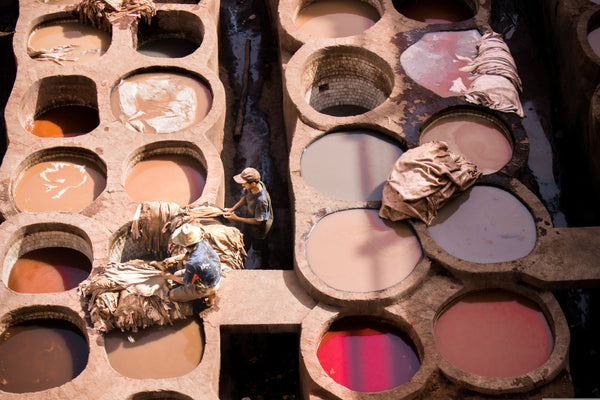
Three tanneries remain in Fès today: Chouara, Sidi Moussa, and Ain Azliten. The leather they produce — full-grain goatskin, vegetable-tanned using methods unchanged since the medieval period — is the foundation of everything Moroccan Corridor makes. For a closer look at how that leather is made, see our guide to Chouara Tannery.
Tétouan — The Andalusian Thread
Five hundred years ago, the fall of Granada changed the map of the Mediterranean world. The Mudéjars — Muslims who had lived under Christian rule in Andalusia — were expelled from Spain, and many settled in Tétouan, a city in the northern Rif region, where they rebuilt what they had lost.
Among the crafts they brought with them was leatherwork — a tradition refined over centuries in the workshops of Córdoba, Seville, and Granada. In Tétouan, this Andalusian heritage took root. Tanneries were established on the outskirts of the medina. The craft passed from generation to generation, absorbing Berber influences while retaining its Andalusian precision.
The leather workshops of Tétouan are known today for their fine embossing and hand-tooling — geometric patterns pressed into the surface of the hide using hand-carved stamps, a vocabulary of motifs inherited directly from the Nasrid tradition of southern Spain. It is in these workshops that many of the Moroccan Corridor bags are made: the Heritage, the LSSAN, the Médaillon. The leather of Tétouan carries two civilisations in its grain.
Marrakesh — The Berber Tradition
Further south, in the imperial city of Marrakesh, a different leather tradition has developed — one rooted in the Berber cultures of the Atlas Mountains and the Saharan trade routes that once made Marrakesh one of the great commercial crossroads of the medieval world.
Marrakesh leather is known for its warmth of colour and its suppleness. The natural dyes used here — derived from henna, saffron, pomegranate rind, and mineral pigments — produce the rich ochres, deep reds, and warm tans that have become synonymous with Moroccan craft. The cooperatives of Marrakesh work as they always have: cutting, tanning, dyeing, and finishing carried out by craftsmen who have learned their trade from their fathers, who learned it from theirs. Nothing is wasted. Every piece of hide is used.
What Full-Grain Leather Actually Means
The leather produced in the tanneries of Fès, Tétouan, and Marrakesh is full-grain — the highest grade of leather, cut from the outermost layer of the hide, the part that faced the world during the animal's life.
Full-grain leather retains the natural surface of the hide: its grain, its subtle variations in texture, the marks that make each piece unique. It is not sanded, buffed, or corrected. It is not coated with a uniform finish to hide imperfections. What you see is what the hide is.
Most leather sold today is not full-grain. It is corrected-grain — sanded smooth, embossed with an artificial texture, coated with polyurethane to create a uniform surface. It looks like leather. It does not age like leather.
Full-grain leather develops a patina over time. As it is used — carried, handled, exposed to light and air — it darkens at the points of contact, softens at the folds, deepens in colour and character. It becomes, over years, irreplaceable. An object that is unmistakably yours. The difference is not aesthetic. It is a question of what an object is made to do: last for a season, or last for a life.
Why We Source This Way
At Moroccan Corridor, we work directly with artisans in Fès, Tétouan, and Marrakesh — sourcing full-grain leather tanned using traditional methods, crafted into bags, poufs, and accessories by hand. No intermediaries. Full traceability from tannery to finished piece.
We source this way not for the story — though the story is extraordinary — but for the leather itself. Because nothing produced industrially comes close to what a craftsman in Fès, Tétouan, or Marrakesh produces by hand, with knowledge accumulated over ten centuries.
This is the leather in every piece we carry. This is what you carry when you carry one of ours.
Explore the Bag Collections Explore the Pouf Collection
Frequently Asked Questions
Where does Moroccan Corridor source its leather?
Directly from artisans and tanneries in Fès, Tétouan, and Marrakesh — three cities where leather craft has been practiced continuously for over a thousand years. No intermediaries. Full traceability from tannery to finished piece.
What is full-grain leather?
Full-grain leather is cut from the outermost layer of the hide, retaining its natural surface and grain. It is the highest grade of leather and develops a rich patina over time — unlike corrected-grain leather, which is sanded and coated to create a uniform finish.
What makes Moroccan leather different from industrial leather?
Moroccan leather is vegetable-tanned using natural tannins derived from plant bark, rather than the chromium salts used in industrial production. The process takes weeks rather than hours, producing leather that is firmer, more breathable, and longer-lasting. The entire process — from tannery to finished object — is performed by hand.
Which Moroccan city produces which type of leather goods?
Fès is the primary source of vegetable-tanned goatskin — the foundation of poufs, bags, and accessories. Tétouan is known for fine hand-tooling and embossing, used in the Heritage, LSSAN, and Médaillon bag collections. Marrakesh is known for warm natural dyes and supple leather suited to softer goods.
Does Moroccan leather improve with age?
Yes — full-grain leather develops a patina over time, darkening at points of contact and deepening in colour and character with use. This is one of the defining qualities of vegetable-tanned leather and one of the primary reasons it is worth the investment over corrected-grain or bonded leather alternatives.