Morocco produces more distinct styles of decorative pillow than any other single craft tradition — a consequence of its geographic diversity, its multiple regional weaving cultures, and the range of materials available across its territory. A pompom pillow from the Atlas Mountains, a cactus silk cushion from the Saharan south, a Handira pillow reconstructed from a Berber wedding blanket, and a kilim cushion made from a recycled tribal rug are all Moroccan objects — but they share almost nothing in terms of material, technique, or cultural origin. This guide maps the differences.
The Moroccan Pillow Tradition
The decorative pillow has a specific place in Moroccan domestic culture. In the traditional Moroccan salon — the formal reception room that anchors the domestic interior — low banquette seating runs along the walls, covered with a textile known as the tlamet and dressed with bolsters and cushions that are as much a statement of craft knowledge as of comfort. The quality of the pillows in a Moroccan salon is a direct expression of the household's relationship to craft tradition.
Beyond the salon, pillows appear throughout the Moroccan domestic interior — on beds, on floor seating, on outdoor terraces and courtyard furniture. The same textiles that have been used for centuries as blankets and floor coverings are repurposed into cushion covers, carrying their patterns and their cultural associations into a new format. This continuity between textile traditions and domestic objects is one of the defining characteristics of Moroccan craft.
For centuries, Moroccan culture has regarded the loom as an object of particular significance — believed to carry baraka, a form of divine blessing or grace, that is transmitted from the loom to the weaver, from the weaver to the textile, and from the textile to the person who uses it. This belief is not merely symbolic: it shapes the care with which weavers approach their work and the seriousness with which handwoven objects are treated in Moroccan domestic life.
Salon Pillows and Bolsters
The traditional Moroccan salon pillow is a distinct object — larger than a standard throw pillow, often in a bolster format, and made from upholstery-weight textiles with rich colours and metallic thread. The palette is typically built around two harmonising colours, coordinated with the tlamet that covers the banquette seating. Common combinations include a pale or white ground with floral or arabesque patterns in a highlight colour — burgundy, gold, deep blue, or forest green.
The fabrics used for salon pillows — brocaded silk, embroidered velvet, metallic jacquard — are produced in the urban workshops of Fès and Marrakesh, where the tradition of luxury textile production has been continuous since the medieval period. These are not folk objects: they are the product of a sophisticated urban craft tradition with centuries of refinement behind it.
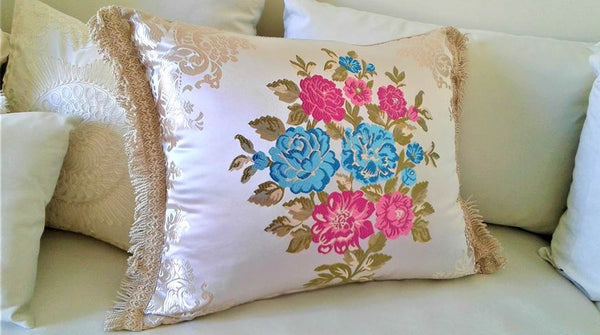
Salon pillows and bolsters work equally well on floor seating in a low-level arrangement, on a lounge or daybed, or as an accent on a bed. Their scale and visual weight make them most effective as anchor pieces — one or two large bolsters that establish the palette, supported by smaller accent cushions in complementary textures.
Pompom Pillows
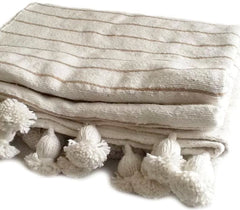
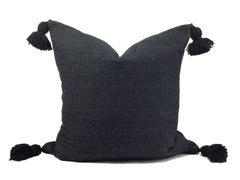
The pompom is one of the most immediately recognisable elements of Moroccan textile craft — a finishing detail that appears across the full range of Moroccan woven objects, from wedding blankets to market bags. In pillow form, it functions as a textural accent: the woven body provides the structure, and the pompoms at the corners or edges introduce a three-dimensional quality that softens the geometry of the weave. Each pompom is made by hand — wound, tied, and trimmed individually — and no two are identical.
From the Atlas — Marrakesh
The pompom pillows produced in Marrakesh and the surrounding Atlas villages are made from 100% organic wool, hand-spun and hand-dyed using traditional methods. The wool is sourced from indigenous sheep raised in the Atlas Mountains, purchased daily in the souks, and taken to the dyers' quarter where it is coloured using natural vegetable pigments before being brought to workshops for weaving.
The weaving is done on traditional wooden looms — the same loom structures that have been used in the region for centuries. A single pillow can take more than a day to complete. The palette tends toward warm, earthy tones — natural wool, terracotta, ochre, deep red — with occasional brighter accents in blue or green.
From the Rif — Chefchaouen
Chefchaouen, the blue city of the Rif Mountains in northwest Morocco, has its own distinct weaving tradition. The city is known for its Riffi blankets — blue, white, and red-striped textiles worn by rural women across the Rif — and for a broader textile culture that has historically used silk as well as wool. The mulberry trees in Uta el-Hammam square are a legacy of the city's silk-weaving past; today, most production uses wool, one of the region's primary agricultural products.
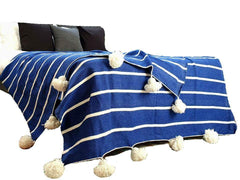
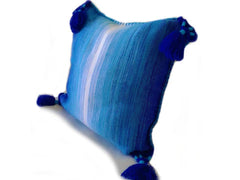
Chefchaouen pompom and tassel pillows are made from the same striped wool textiles as the Riffi blankets — bright primary colours in bold horizontal stripes, with pompom or tassel finishes at the corners. The colour palette is more saturated and more graphic than the Atlas variants: these are objects designed to be seen, to introduce colour and energy into a space rather than to blend with it.
View Chefchaouen Pompom Pillows
Berber Pillows
The category of Berber pillows encompasses several distinct objects that share a common cultural origin — the Amazigh textile tradition of the Atlas Mountains and the Saharan south — but differ significantly in material, technique, and visual character.
Cactus Silk / Sabra Pillows
Cactus silk — known in Morocco as sabra — is a fibre derived from the agave plant, a succulent that grows abundantly in the Saharan south of Morocco. The production process is entirely manual: the spiky leaves of the agave are harvested, hammered to break down the cellular structure, and soaked to release the long, lustrous fibres within. These fibres are then hand-spun using traditional techniques to produce a thread with a natural sheen that resembles silk — hence the name.
The spun sabra thread is dyed using vegetable pigments and then woven on a loom, often combined with camel wool to add body and warmth. The resulting textile has a distinctive iridescent quality — the sabra fibres catch light differently depending on the angle of view, producing a subtle shimmer that no synthetic material can replicate.
Cactus silk pillow covers are made from sabra textiles that have been cut and assembled by hand. Each piece has a unique embroidered or woven pattern, and no two are identical. The palette tends toward jewel tones — deep teal, burnt orange, saffron yellow, forest green — that reflect the natural dye tradition of the Saharan south.
Handira Pillows
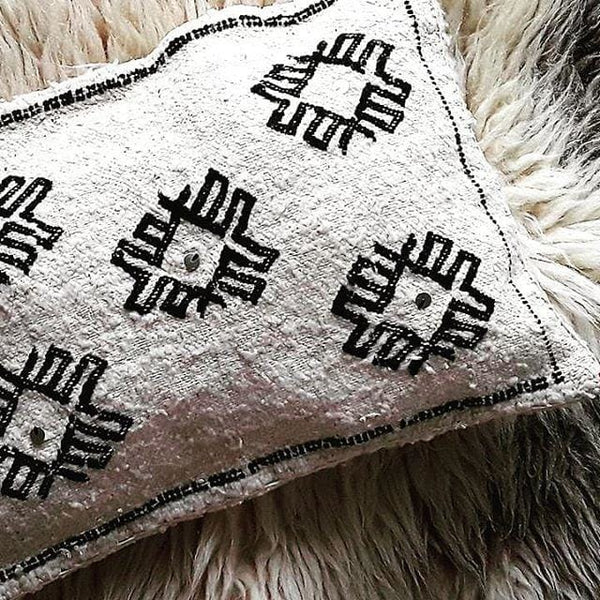
The Handira is a traditional Berber wedding blanket — a textile made by Amazigh women for a bride to wear on her wedding day. Handiras are woven from wool and cotton and adorned with metallic sequins that catch the light as the bride moves. They are objects of significant cultural weight: made with care over weeks or months, worn once, and then kept as a family heirloom.
Handira pillows are made by carefully deconstructing vintage Handira blankets and reconstructing the textile into pillow covers, preserving the sequin embellishment and the original weave structure. Each pillow is therefore a unique object — a fragment of a specific blanket, made for a specific occasion, carrying the history of the textile it came from. No two Handira pillows are the same, and the supply is finite: as vintage blankets become rarer, so do the pillows made from them.
Tribal Kilim Pillows
Kilim pillows are made from recycled Moroccan tribal rugs — flat-woven textiles with geometric patterns in organically dyed wool that have been used as floor coverings, blankets, and saddle bags across the Atlas and Saharan regions for centuries. When a rug reaches the end of its useful life as a floor covering, the intact sections of the textile are cut and assembled into pillow covers, preserving the pattern and the material while giving the object a new function.
The result is a pillow with a visual density and a material richness that new production cannot replicate. The colours have mellowed through years of use and light exposure; the wool has softened; the pattern carries the irregularities of hand-weaving accumulated over decades. Kilim pillows are adorned with tassels, sequins, and traditional ornaments that reflect the decorative vocabulary of the original textile tradition.

How to Style Moroccan Pillows
The range of Moroccan pillow styles is wide enough to work across almost any interior aesthetic — but the approach to styling differs depending on which type you are working with.
Salon bolsters and structured cushions work best as anchor pieces — placed at the ends of a sofa or banquette to establish the palette, with smaller accent cushions filling the centre. Use odd numbers: three or five cushions read more naturally than pairs.
Pompom pillows are most effective in groups of the same type — three Atlas pompom cushions in complementary colours, or a set of Chefchaouen stripe pillows in different widths. Mixing pompom styles from different regions can work, but requires a shared colour thread to hold the composition together.
Cactus silk pillows are best treated as neutrals despite their jewel-tone palette — their iridescent surface reads differently in different lights, which means they integrate more easily than their colour suggests. Pair them with more graphic patterns, such as kilim pillows, for a composition that has both depth and structure.
Handira pillows are statement pieces — the sequin embellishment and the vintage textile quality mean they work best as a single focal point rather than as part of a larger group. One Handira pillow on a plain linen sofa is more effective than three competing for attention.
Kilim pillows are the most versatile of the group — their geometric patterns and muted, mellowed palettes integrate with almost any interior. They work particularly well in rooms with natural materials — wood, stone, linen — where their tribal character feels at home rather than incongruous.
House of Pillows — The Moroccan Corridor Collection

Frequently Asked Questions
What is the difference between a Moroccan salon pillow and a throw pillow?
A Moroccan salon pillow is a specific object — typically a large bolster or structured cushion made from upholstery-weight brocaded or embroidered textile, designed for the formal banquette seating of the traditional Moroccan salon. A throw pillow is a smaller, more casual decorative cushion used on sofas, beds, and floor seating. Both are produced in Morocco, but they belong to different craft traditions and serve different functions.
What is cactus silk?
Cactus silk — known in Morocco as sabra — is a natural fibre derived from the agave plant. The leaves are harvested, hammered, and soaked to release long, lustrous fibres that are then hand-spun and dyed using vegetable pigments. The resulting thread has a natural sheen that resembles silk. Cactus silk is woven on traditional looms, often combined with camel wool, to produce textiles used for rugs, blankets, and pillow covers.
What is a Handira pillow?
A Handira pillow is made from a vintage Moroccan Berber wedding blanket — a textile woven by Amazigh women for a bride to wear on her wedding day, adorned with metallic sequins. Handira pillows are created by carefully deconstructing these vintage blankets and reconstructing the textile into pillow covers, preserving the sequin embellishment and the original weave. Each piece is unique and the supply is finite.
What is a kilim pillow?
A kilim pillow is made from a recycled Moroccan tribal rug — a flat-woven textile with geometric patterns in organically dyed wool. When a rug reaches the end of its useful life as a floor covering, intact sections are cut and assembled into pillow covers. The result is a pillow with mellowed colours, softened wool, and the visual density of a textile that has been used and aged over decades.
Are Moroccan pillow covers sold with inserts?
No — Moroccan Corridor pillow covers are sold without inserts as standard. This keeps international shipping costs reasonable and allows you to use inserts of your preferred firmness. Standard insert sizes are widely available in most markets.
How do I care for a Moroccan wool pillow cover?
Hand-wash in cold water with a gentle detergent, or dry-clean. Do not machine wash or tumble dry — heat and agitation can distort the weave and shrink the cover. Lay flat to dry. For cactus silk covers, handle with particular care — the sabra fibre is strong but can be damaged by prolonged soaking. For Handira covers with metallic sequins, dry-clean only.