
Moroccan interior design is one of the most distinctive and enduring decorative traditions in the world. It is not a trend — it is a living craft culture, shaped over centuries by the convergence of Amazigh, Arab, Andalusian, and sub-Saharan African influences. The result is an interior language that is simultaneously ancient and entirely contemporary: rich in pattern, generous in texture, and grounded in the beauty of natural materials made by hand.
This guide covers the essential elements of authentic Moroccan decor — from the architecture of the traditional salon to the textiles, lighting, and leather goods that define the Moroccan interior — and offers practical guidance on how to bring this aesthetic into your own home.
This guide covers the essential elements of authentic Moroccan decor — from the architecture of the traditional salon to the textiles, lighting, and leather goods that define the Moroccan interior — and offers practical guidance on how to bring this aesthetic into your own home. For a curated selection of the finest pieces available this season, see our luxury edit for 2026.
The Cultural Roots of Moroccan Design
Morocco sits at the crossroads of continents and civilisations. Nestled between Europe and Africa, between the Atlantic and the Mediterranean, it has absorbed and synthesised influences from every direction — Amazigh Berber traditions from the Atlas Mountains, Arab and Islamic art from the east, Andalusian refinement from the north, and sub-Saharan craft traditions from the south.
This cultural layering is what gives Moroccan design its extraordinary depth. No single tradition dominates — instead, they coexist and enrich one another. Geometric zellige tilework sits beside hand-carved cedar wood. Berber kilim rugs share a room with silk-embroidered cushions. Vegetable-tanned leather poufs anchor a space furnished with sabra silk throws. The result is an interior that feels both rooted and alive.
The Moroccan Salon — Heart of the Home
In Moroccan domestic architecture, the salon is the most important room in the house. It is the space of hospitality — where guests are received, mint tea is served, and the full decorative ambition of the household is expressed. Moroccans are renowned for their hospitality, and the salon is its physical embodiment.
Architecturally, the salon is typically the largest room, positioned on the ground floor of a riad or traditional house to receive guests independently from the private quarters. In the great Fassi houses of Fez, a single home may contain multiple salons, each more elaborately decorated than the last.
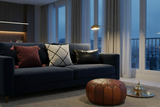
The traditional Moroccan salon is built around a central principle: benches (banquettes) line the walls, upholstered in rich velvet or brocade and piled with cushions and bolsters. A low carved cedar table sits at the centre, arranged on a Moroccan rug. Every surface carries decoration — the ceiling in painted or carved wood, the lower walls in zellige tilework, the upper walls in carved plaster (tadelakt or gypsum), and the doorways framed by horseshoe arches.

The atmosphere is one of enveloping warmth: soft indirect light, the scent of incense, the sound of mint tea being poured from height. It is a room designed for lingering.
Moroccan Lighting — The Art of Indirect Light
Light is one of the defining elements of Moroccan interior design. Unlike Western interiors that often favour bright, direct illumination, Moroccan spaces are lit indirectly — through perforated metal lanterns, coloured glass pendants, and wall sconces that cast patterned shadows across walls and ceilings.
Traditional Moroccan light fixtures are crafted by hand from iron, copper, brass, and tin — and occasionally from nickel silver for the most luxurious pieces. Many incorporate coloured glass panels — red, amber, green, blue, or clear — that transform light into colour as it passes through. The effect is theatrical and intimate simultaneously.
A well-appointed Moroccan salon may have ten or more light sources: pendants suspended from the ceiling, sconces mounted on the walls, floor lanterns in the corners, and small table lamps on pedestal tables. No single source dominates — the light is layered, warm, and diffuse.
Key Moroccan lighting forms include the fanous (hanging lantern), the tarbouche (conical pendant), the wall sconce in pierced brass, and the floor lantern in coloured glass. Each casts a different quality of light and shadow.
Moroccan Rugs — The Foundation of the Interior
No element of Moroccan decor is more foundational than the rug. In Moroccan interiors, the floor is not an afterthought — it is the starting point from which the entire room is composed. The rug defines the space, anchors the furniture, and introduces the palette and pattern that the rest of the room responds to.
Morocco's rug-weaving traditions are among the richest in the world, spanning multiple regional styles and tribal lineages:
Beni Ourain — woven by the Amazigh tribes of the Middle and High Atlas from undyed natural wool, these rugs are characterised by their ivory ground and bold geometric motifs in dark brown or black. They are among the most sought-after Moroccan rugs internationally and work equally well in traditional and contemporary interiors.
Azilal — from the High Atlas, Azilal rugs are more colourful than Beni Ourain, featuring abstract geometric patterns in natural wool combined with cotton or recycled fibres. Each rug is unique, encoding the symbolic visual language of the weaver.
Kilim — flat-woven on traditional looms, kilim rugs have no pile. Their bold geometric patterns in earthy reds, ochres, and indigos make them versatile and durable. They work well as both floor rugs and wall hangings.
Boucherouite — woven from recycled textile scraps, Boucherouite rugs are the most colourful and spontaneous of the Moroccan traditions. No two are alike.
Moroccan Cushions & Pillows — The Styling Layer
If the rug is the foundation of the Moroccan interior, cushions and pillows are its finishing touch — the layer that brings colour, texture, and personality to a space. In the traditional Moroccan salon, the banquette benches are piled high with cushions and bolsters in velvet, brocade, and embroidered textiles. In a contemporary home, Moroccan cushion covers bring the same richness to a sofa, bed, or reading nook.
Moroccan cushion traditions span several distinct textile cultures:
Handira — woven by Amazigh women of the Middle Atlas as wedding blankets, Handira fabric is characterised by its ivory wool ground and hand-sewn metallic sequins. As a cushion cover, it brings warmth, history, and quiet luxury. The sequins catch light differently at every angle.
Sabra Silk — woven from plant-based fibres derived from the agave plant, sabra silk cushion covers have a distinctive lustre and a slightly irregular texture that is the mark of genuine handcraft. They are available in a wide range of colours, from deep jewel tones to soft naturals.
Berber Kilim — flat-woven cushion covers in bold geometric patterns, using the same visual language as kilim rugs. Dense, durable, and deeply patterned.
Pompom Cushions — handwoven from wool and cotton on traditional wooden looms in Marrakech and surrounding villages, pompom cushion covers are characterised by their playful tassels and soft texture. They bring a bohemian warmth to any interior.
Moroccan Rug Pillows — crafted from sections of authentic Moroccan rugs, these covers bring the full richness of Moroccan pile weaving to your sofa or bed.
How to Style Moroccan Cushions
The most compelling cushion arrangements mix textile traditions rather than matching them. Pair a Handira cover with a kilim lumbar and a sabra silk accent. Work in odd numbers — three or five cushions always look more considered than two or four. Let one statement piece lead and build the rest of the arrangement around it in quieter tones.
Moroccan Leather Poufs — Function and Beauty
The Moroccan leather pouf is one of the most versatile and enduring pieces of Moroccan craft. Handmade from vegetable-tanned leather in the tanneries of Fez and Marrakech, poufs serve simultaneously as seating, footrests, side tables, and decorative objects. They are the piece that grounds a Moroccan interior and gives it weight.
Authentic Moroccan poufs are crafted from full-grain leather — the highest grade available — processed using traditional plant-based tannins in the same tanneries that have operated in Fez for over a thousand years. The leather is then hand-stitched and hand-embossed or embroidered with geometric and floral patterns.
Poufs are available in a wide range of colours — from natural tan and cinnamon brown to saffron, midnight blue, and fuchsia — and in several forms: the classic round embossed pouf, the tabouret (cylindrical ottoman), and the square tile-design ottoman.
In a Moroccan interior, poufs are typically grouped in pairs or threes around a low table, or used singly as a footrest beside a sofa or armchair. They work equally well in contemporary interiors, where their craft quality and natural materials provide a counterpoint to modern furniture.
EXPLORE MOROCCAN LEATHER POUFS
Not sure which piece to start with? Read our complete buyer's guide to Moroccan home accessories.
Colour & Pattern in Moroccan Decor
Moroccan colour is not timid. The traditional palette draws from the natural dyes of the Moroccan landscape — saffron yellow from the crocus fields of Taliouine, indigo blue from the dye pits of Fez, terracotta red from the iron-rich earth of Marrakech, and the deep greens of henna and mint. These are colours with history and geography embedded in them.
In practice, Moroccan interiors balance bold colour with natural neutrals. A room might anchor itself in the warm ivory of a Beni Ourain rug and the terracotta of tadelakt walls, then introduce colour through cushions, lanterns, and ceramic vases. The effect is rich without being overwhelming.
Pattern in Moroccan design is geometric and symbolic. The most characteristic motifs — the eight-pointed star, the interlocking diamond, the arabesque — derive from Islamic geometric art and Amazigh symbolic weaving. They appear across every medium: zellige tilework, carved plaster, woven textiles, embossed leather, and painted wood. The repetition of these motifs across different scales and materials creates the visual coherence that makes a Moroccan interior feel complete.
How to Bring Moroccan Decor into Your Home
You do not need to redesign your entire home to introduce Moroccan decor. The most effective approach is to layer authentic pieces into an existing interior, letting their craft quality and material richness do the work.
Start with a rug. A Beni Ourain or kilim rug is the single most impactful Moroccan piece you can introduce. It anchors the room and sets the palette for everything else.
Add a pouf. A leather pouf beside a sofa or armchair immediately introduces the warmth and craft quality of Moroccan leather. It is functional, beautiful, and requires no commitment to a particular style.
Layer cushions. Replace generic cushion covers with Moroccan handwoven alternatives — Handira, kilim, sabra silk, or pompom. Mix two or three different textile traditions for depth.
Introduce a lantern. A single Moroccan brass or copper lantern — on a side table, hung from a hook, or placed on the floor — transforms the quality of light in a room.
Use natural materials throughout. Moroccan decor is grounded in natural materials — leather, wool, silk, cedar, brass, terracotta. Avoid synthetic substitutes. The authenticity of the material is inseparable from the beauty of the object.
For a seasonally curated selection built around this approach, explore our Autumn/Winter 2026 selection.
Frequently Asked Questions
What are the key elements of Moroccan interior design?
The defining elements are: the traditional salon with banquette seating and low tables; zellige tilework and carved plaster on walls; hand-knotted or flat-woven Moroccan rugs; indirect lighting through perforated metal lanterns; handwoven cushions and textiles; and leather poufs. Natural materials — wool, leather, silk, cedar, brass — are central to the aesthetic.
What colours are typical in Moroccan decor?
The traditional Moroccan palette draws from natural dyes: saffron yellow, indigo blue, terracotta red, henna green, and ivory. These are balanced with warm neutrals — natural tan, sand, and the warm white of tadelakt plaster. Bold colour is introduced through textiles and ceramics rather than walls.
What is a Moroccan riad?
A riad is a traditional Moroccan house built around a central courtyard garden. The word derives from the Arabic ryad, meaning garden. Riads are characterised by their inward-facing architecture — blank exterior walls opening onto an interior courtyard with a fountain, citrus trees, and surrounding rooms on multiple levels. They are the quintessential form of Moroccan domestic architecture.
How do I style a Moroccan living room?
Begin with a Moroccan rug as the foundation. Add low seating — a sofa or banquette — piled with cushions in mixed Moroccan textiles (Handira, kilim, sabra silk). Introduce a leather pouf as a footrest or side table. Layer lighting with a Moroccan lantern or pendant. Keep the palette warm and grounded in natural materials throughout.
What is the difference between Moroccan and Bohemian decor?
Bohemian decor draws heavily from Moroccan aesthetics but is more eclectic and less rooted in a specific craft tradition. Authentic Moroccan decor is grounded in specific regional craft traditions — Amazigh weaving, Fassi leather, Marrakchi zellige — each with its own history and visual language. Bohemian style borrows these elements freely and mixes them with influences from other cultures.
Where can I buy authentic Moroccan decor?
At Moroccan Corridor, we source directly from artisan workshops in Fez, Marrakech, and Chefchaouen — ensuring that every piece is genuinely handmade using traditional materials and techniques. Our collection includes leather poufs, handwoven cushion covers, Moroccan blankets, leather bags, and sandals.