
Morocco produces more distinct styles of handwoven rug than any other single country — a consequence of its geographic diversity, its multiple tribal weaving traditions, and the range of materials available across its territory, from the high-altitude pastures of the Atlas Mountains to the agave-rich Saharan south. A Taznakht rug knotted from Siroua mountain wool, a Bouchaouite rug woven from recycled clothing, a Beni Ourain rug in thick ivory pile, and a Sabra rug made from cactus silk are all Moroccan objects — but they share almost nothing in terms of material, technique, or cultural origin. This guide maps the differences.
A Craft Rooted in Tribal Identity
The Berber rug is not primarily a decorative object. It is, or was, a functional one — used as floor insulation, bedding, blanket, and saddle covering by the nomadic and semi-nomadic Amazigh tribes of the Atlas Mountains and the Saharan south. Its patterns are not ornamental in the conventional sense: they are a graphic language, a system of symbols that encodes the identity of the tribe that made it, the beliefs of the woman who wove it, and the specific cultural moment of its production.
Nearly fifty distinct tribal groups weave their own variant of the Moroccan rug, each with a recognisable palette, pattern vocabulary, and technical approach. The rug is one of the primary ways in which Amazigh cultural identity is transmitted across generations — from mother to daughter, on the same loom, using the same symbols, in the same sequence of colours that has characterised the tribe's production for centuries.
When a Moroccan rug wears out, it is not discarded. It is cut down and repurposed — as a doormat, a saddle covering, a smaller rug — and the process continues until the material is entirely consumed. This relationship to the object — as something that is used, maintained, and recycled rather than replaced — is fundamental to understanding what a genuine Moroccan rug is and why it is priced the way it is.
How Moroccan Rugs Are Made
Wool and Natural Dyes
In Moroccan craft tradition, wool is regarded as a material of particular significance — a gift from heaven, as the traditional formulation has it, with a sacred character that demands careful treatment. The preparation of wool for rug-making is a long and labour-intensive process: washing, carding, and combing to separate long fibres from short ones; spinning to produce warp threads of different weights and tensions; and dyeing, which has historically been done using entirely natural vegetable sources.
The traditional dye palette of Moroccan rug-making is derived from plants and minerals found across the country: madder root for red, pomegranate bark for intense yellow-beige, saffron for light yellow, indigo for deep blue, henna for brown, walnut bark for dark tones, and eucalyptus for warm greens. These natural dyes produce colours of a specific quality — rich, slightly muted, harmonious with each other in a way that synthetic dyes rarely achieve — and they age differently from synthetic alternatives, mellowing and deepening over time rather than fading uniformly.
Today, many producers use synthetic dyes for consistency and cost efficiency. The distinction between natural and synthetic dye is visible to an experienced eye — natural dyes produce slight variations in tone across the surface of the rug that synthetic dyes do not — and it is one of the primary indicators of quality and authenticity.
The Loom and the Knot
Moroccan rugs are woven on simple vertical looms — frames of wooden beams, reed stems, and ropes that are easy to set up and transport, and that have remained substantially unchanged for centuries. The loom is a domestic object as much as a production tool: in the weaving communities of the Atlas Mountains, it is a standard feature of the household, and weaving is integrated into the daily rhythm of domestic life rather than confined to a dedicated workshop.
The patterns are established in the warp — the vertical threads stretched on the loom before weaving begins — and reinforced or modified by the knotting. The density of the knots is the primary technical indicator of quality: a higher knot count per square metre produces a finer, more detailed pattern and a more durable surface. The Taznakht rug, for example, can reach up to 480,000 knots per square metre — a density that requires months of work and produces a surface of extraordinary precision and richness.
Pattern and Symbol
The patterns used in Moroccan rugs are based on a vocabulary of basic geometric forms — the line, the square, the diamond, the triangle — arranged and combined according to conventions that vary by tribe and region. These are not arbitrary decorative choices: each motif carries a specific meaning within the Amazigh symbolic system, referring to protection against the evil eye, to fertility, to baraka (divine blessing), or to the specific identity of the tribe that produced it.
The diamond is the most widely used protective symbol in Amazigh textile art — its four points are understood to deflect negative energy from all directions. The repeating geometric border that frames most Moroccan rugs serves a similar protective function, enclosing the domestic space within a symbolic boundary. These meanings are not always consciously articulated by contemporary weavers, but they are present in the pattern vocabulary as a form of cultural memory transmitted through the act of weaving itself.
The Major Rug Traditions
Taznakht Rugs
Taznakht — the name means "quiet" in Amazigh — is a small town in the Draa-Tafilalet region of southern Morocco, at the foot of the Jbel Siroua massif. It is the centre of one of Morocco's most technically demanding rug traditions, producing knotted pile rugs of extraordinary density and chromatic richness that have made the region's production internationally recognised.
The wool used in Taznakht rugs comes from the Aït Barka breed of sheep, raised on the high-altitude pastures of Jbel Siroua. The specific characteristics of this breed — combined with the vegetation of the high pastures, which is dependent on snowmelt water — produce a wool that is silky, lustrous, and fine-fibred: the raw material that gives Taznakht rugs their distinctive surface quality.
The palette of Taznakht rugs is immediately recognisable: where the rugs of the Middle Atlas are dominated by dark red, the Taznakht tradition is characterised by yellow in all its registers — bright yellow, straw yellow, saffron yellow — combined with the warm tones of natural wool and the deep reds and blues of the traditional dye palette. The colours are derived from the same natural products that define the region's agricultural economy: saffron, henna, dates, and the plants of the Siroua mountain.
Taznakht rugs are made exclusively by women, working at home on individual looms, in competition with each other — each weaver guards her technique carefully, working out of sight of her neighbours. A single rug can take up to nine months to complete. The production is promoted annually through the National Festival of Taznakht Rugs, held in Ouarzazate each May and June.
Bouchaouite Rugs
The Bouchaouite — the name comes from the Moroccan Arabic word for torn or repurposed clothing — is Morocco's rag rug: a textile made not from spun wool but from strips of recycled fabric, cut from discarded clothing and woven or knotted into a surface of extraordinary chromatic energy and visual inventiveness.
Bouchaouite rugs are produced primarily in the Amazigh villages near Marrakesh, Beni Mellal, and Azilal, by women who weave them as domestic furnishings and as a source of supplementary income. The materials are whatever is available — wool, nylon, cotton, synthetic fabrics — cut into strips and combined without a predetermined colour plan. The result is a surface that is genuinely unpredictable: no two Bouchaouite rugs are alike, and the pattern that emerges from the weaving process is as much a product of the available materials as of the weaver's intention.
Once considered purely functional objects — affordable floor coverings for households that could not afford knotted pile rugs — Bouchaouite rugs have been recognised internationally as significant examples of outsider art and sustainable craft practice. They are now collected by design galleries and interior designers across Europe and North America.
Buying tip: Look for loops of yarn and fabric strips that are wild and appear to be sprouting from the surface, as opposed to flat with a machine-woven feel. This irregularity is a sign of authenticity. The Bouchaouite Museum in Marrakesh hosts exhibitions of significant pieces and is worth visiting for context before buying.

Sabra / Cactus Silk Rugs
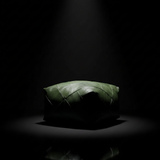
Sabra — also known as cactus silk or vegetable silk — is a fibre derived from the agave plant, a succulent that grows abundantly in the Saharan south of Morocco. The production process is entirely manual and has remained unchanged for centuries: the leaves of the agave are harvested, crushed, and stripped of their green residue; the long white filaments within are then separated, washed, combed, and hand-spun into thread. The resulting fibre has a natural lustre that resembles silk — hence the name — and a strength that makes it exceptionally durable as a rug material.
The spun sabra thread is dyed using botanical pigments — typically derived from flowers and spices — and then hand-woven on traditional looms, sometimes combined with wool or cotton to add body and warmth. The finished textile has a distinctive iridescent quality: the sabra fibres catch light differently depending on the angle of view, producing a subtle shimmer that no synthetic material can replicate.
Sabra rugs are decorated with free-hand embroidered patterns that draw on the Amazigh symbolic vocabulary — geometric forms, tribal motifs, and scenes from Moroccan daily life. Each piece is unique, and the embroidery is worked by hand after the weaving is complete. The agave plant, after its fibres have been extracted, can be used as an organic fertiliser — making sabra production one of the most genuinely zero-waste craft processes in Morocco.

For a more detailed guide to sabra textiles, see: Moroccan Sabra Cactus Silk Rugs, Carpets, Blankets and Pillows.
Beni Ourain Rugs
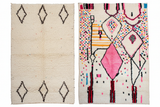
The Beni Ourain rug is the most internationally recognised Moroccan textile — the thick ivory pile rug with minimalist black geometric lines that has become a fixture of contemporary interior design across Europe and North America. Its current popularity is the result of a specific set of characteristics that happen to align precisely with the aesthetic preferences of contemporary minimalist interiors: a neutral base colour, a geometric pattern that is bold without being busy, and a pile depth that makes it one of the most physically comfortable rugs available.
The Beni Ourain are a confederation of seventeen Amazigh tribes living in the northern Middle Atlas Mountains, at altitudes where winters are severe and the need for insulating textiles is practical rather than decorative. The thick pile of the traditional Beni Ourain rug — made from the undyed natural wool of the local sheep, in its natural ivory and dark brown tones — was developed as a response to this climate: a rug that functions simultaneously as floor insulation, bedding, and blanket.
Because the tribes lived in remote mountain locations with limited contact with the Arab-influenced urban craft centres of Fès and Marrakesh, the Beni Ourain aesthetic developed in relative isolation — which explains the distinctive minimalism of its pattern vocabulary. The geometric lines and diamond forms of the Beni Ourain rug are not influenced by the arabesque tradition of urban Moroccan craft; they are the product of an entirely separate visual culture.
Buying tip: To verify authenticity, examine the reverse side of the rug. In a genuine hand-knotted Beni Ourain, the knotting on the back will be irregular — slightly uneven in spacing and tension, with small variations that reflect the hand of the weaver. Machine-made imitations have perfectly regular knotting on the reverse. Authentic Beni Ourain rugs are expensive because they are made by hand, from quality wool, and are built to last a lifetime.
Azilal Rugs
Azilal rugs come from the Azilal region of the High Atlas Mountains, northeast of Marrakesh — a remote area where the rug-making tradition has been transmitted from mother to daughter for generations, largely without external influence. They are among the most visually distinctive Moroccan rugs: a lighter background — natural ivory or cream — overlaid with graphic abstract patterns in bold, sometimes neon colours, combining virgin sheep wool with dyed wool in a palette that can include electric blue, fuchsia, and acid yellow alongside more traditional earth tones.
The patterns of Azilal rugs are more abstract and more personal than those of other Moroccan traditions — they are less governed by tribal convention and more by the individual weaver's visual imagination. This gives each piece a specific character that is immediately apparent: an Azilal rug looks like it was made by a particular person, not by a tradition.
Azilal rugs are not perfectly symmetrical — one side may be slightly larger or more irregular than the other. This is not a defect: it is the natural consequence of hand-weaving on a simple loom without mechanical guides, and it is one of the characteristics that distinguishes a genuine handmade piece from an industrial imitation. The irregularity adds to the charm rather than detracting from it.
How to Buy an Authentic Moroccan Rug
The Moroccan rug market — both in Morocco and internationally — contains a wide range of products sold under the same labels. "Berber rug", "Beni Ourain", and "Moroccan carpet" are applied to everything from genuine hand-knotted tribal pieces to machine-made imitations produced outside Morocco. The indicators of authenticity are consistent across all types.
Examine the reverse side of the rug. Hand-knotted rugs have irregular knotting on the back — small variations in spacing, tension, and alignment that reflect the hand of the weaver. Machine-made rugs have perfectly regular knotting. This is the single most reliable indicator of authenticity and cannot be faked.
For pile rugs, assess the density of the knots. A higher knot count produces a finer, more detailed pattern and a more durable surface. Run your hand against the pile: a well-made rug will spring back; a poorly made one will stay compressed.
For natural dyes, look for slight variations in colour tone across the surface of the rug — a phenomenon known as abrash, caused by small differences in the dye bath between batches of wool. Synthetic dyes produce perfectly uniform colour; natural dyes do not. Abrash is a sign of authenticity, not a defect.
Price is a reliable indicator. A genuine hand-knotted Moroccan rug of any significant size represents weeks or months of skilled labour. If the price seems too low for what is being claimed, it almost certainly is.
Frequently Asked Questions
What is a Berber rug?
A Berber rug is a hand-woven textile produced by Amazigh (Berber) tribes of Morocco, using wool from local sheep and patterns drawn from the tribal symbolic vocabulary. The term encompasses a wide range of distinct regional traditions — including Beni Ourain, Azilal, Taznakht, and Bouchaouite — each with its own palette, pattern vocabulary, and technical approach. Nearly fifty distinct tribal groups produce their own variant of the Moroccan rug.
What is the difference between a Beni Ourain and an Azilal rug?
Beni Ourain rugs are made from undyed natural wool in ivory and dark brown tones, with minimalist geometric patterns on a thick pile. They come from the northern Middle Atlas Mountains. Azilal rugs are made from a combination of natural and dyed wool, with a lighter background and more abstract, colourful patterns that can include neon tones. They come from the High Atlas Mountains northeast of Marrakesh. Both are hand-knotted, but they have distinct visual characters and cultural origins.
What is a Bouchaouite rug?
A Bouchaouite rug is a Moroccan rag rug — made from strips of recycled clothing rather than spun wool. The name comes from the Moroccan Arabic word for torn or repurposed fabric. Bouchaouite rugs are produced primarily near Marrakesh, Beni Mellal, and Azilal, by Amazigh women who weave them as domestic furnishings. They are characterised by unpredictable colour combinations and a wild, sprouting texture that is the direct result of the recycled materials used.
What is cactus silk?
Cactus silk — known in Morocco as sabra — is a natural fibre derived from the agave plant. The leaves are harvested, crushed, and processed to release long, lustrous filaments that are hand-spun into thread. The resulting fibre has a natural sheen that resembles silk and exceptional durability. Sabra rugs are hand-woven and decorated with free-hand embroidered patterns. The production process is entirely zero-waste: the agave plant can be used as organic fertiliser after its fibres have been extracted.
How can I tell if a Moroccan rug is genuinely handmade?
Examine the reverse side: hand-knotted rugs have irregular knotting on the back, with small variations in spacing and tension. Machine-made rugs have perfectly regular knotting. For natural dyes, look for slight colour variations across the surface (abrash) — synthetic dyes produce perfectly uniform colour. Price is also a reliable indicator: a genuine hand-knotted rug of significant size represents weeks or months of skilled labour and cannot be produced cheaply.
How long does it take to make a Moroccan rug?
It depends on the type and size. A Taznakht rug of significant size can take up to nine months to complete, given its knot density of up to 480,000 knots per square metre. A Beni Ourain or Azilal rug of medium size typically takes four to eight weeks, depending on the number of weavers working on it simultaneously. A Bouchaouite rug is faster to produce because it uses strips of fabric rather than individual knots, but still represents significant hand labour.