
The LSSAN bag is a hand-tooled leather bag made in Morocco — but to understand what makes it distinctive, it helps to understand the design tradition it draws from. The geometric patterns carved into its surface, the fluid lines of its silhouette, the absence of right angles in its original form: none of these are arbitrary design decisions. They are the direct translation of a visual language that has been developed over more than a thousand years in Moroccan architecture, tilework, stucco carving, and manuscript illumination. This article traces that language and explains how it shapes every aspect of the LSSAN bag.
LSSAN: The Name and the Object
The word LSSAN comes from the Arabic lissan, meaning tongue. In the dialects of North Africa — and particularly in Moroccan Darija — lissan is pronounced lssan, with the first vowel compressed. The name was chosen for the bag because of the distinctive shape of its front panel: the lower section curves outward and downward in a form that resembles a tongue, giving the bag its most immediately recognisable visual characteristic.

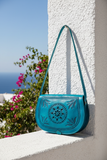
The LSSAN collection is inspired by the Moroccan tradition of leather craft — specifically by the artisan practice of decorating leather surfaces with geometric signs, Amazigh (Berber) alphabet characters, and motifs drawn from the natural landscape of Morocco. The bag is made from full-grain goatskin, hand-tooled by artisans in Fès and Tétouan, and takes over 36 hours to complete from start to finish.


The Art of Leather Tooling
The decorative technique used on the LSSAN bag is derived from a traditional Moroccan craft called leather tooling — a method of embellishing leather surfaces with carved and stamped patterns that has been practiced in Morocco since the medieval period. Historically used to decorate saddles, book covers, and ceremonial objects, tooling was one of the primary ways in which Moroccan artisans expressed the visual vocabulary of Islamic art on a portable, functional surface.
The LSSAN designers chose to apply this technique to the entire exterior surface of the bag — an ambitious decision that transforms the object from a functional carryall into a hand-crafted artwork. The patterns are drawn by hand directly onto the leather before tooling begins, and no two bags are identical.

Stamping
Stamping is the simpler of the two tooling techniques. A metal stamp — which may carry a letter, a number, a geometric shape, or a decorative motif — is pressed into the dampened leather surface to leave a three-dimensional impression. The stamp compresses the leather fibres rather than cutting them, producing a raised or recessed mark that is permanent and precise. Stamps range in size from a few millimetres to several centimetres, and a single bag may incorporate dozens of different stamp designs applied in sequence.

Carving
Leather carving is the more demanding technique. Using a swivel knife — a specialised cutting tool with a rotating blade that allows the artisan to follow curved lines with precision — the craftsman cuts directly into the surface of the dampened leather to create the outlines of the design. He then returns to these cut lines with stamps and modelling tools, deepening and refining the shapes, adding texture and shadow, and building up the three-dimensional quality of the finished surface.


The end result is a hand-embossed, sculpted surface in which the design has become part of the leather itself — not applied to it, but worked into it. The process takes over 36 hours per bag and cannot be accelerated without compromising the quality of the result.
The Design Vocabulary of the LSSAN Bag
The patterns used on the LSSAN bag are not invented. They are drawn from a design vocabulary that has been developed over more than a thousand years in Islamic art and architecture — a vocabulary that appears on the walls of the Alhambra in Granada, the tilework of the Bou Inania madrasa in Fès, the carved stucco of the Hassan II Mosque in Casablanca, and the illuminated manuscripts of the Marinid period. Understanding this vocabulary is essential to understanding what the LSSAN bag is.
Islamic Geometric Patterns
Geometric pattern is the most fundamental element of Islamic visual art. Because the depiction of human and animal figures is discouraged in traditional Islamic artistic practice, the decorative energy that in other traditions goes into figurative representation is channelled instead into geometry — into the construction of patterns of extraordinary complexity and precision from a small number of basic elements: the line, the circle, the polygon, and their combinations.
The defining characteristic of Islamic geometric pattern is repetition — the same motif tiled across a surface in a way that suggests infinite extension. This is not merely a decorative choice: it reflects a theological idea. The repeating arabesque, in Islamic thought, is a symbol of the infinite and the eternal — a visual meditation on the nature of God that is accessible to anyone who looks at it, regardless of whether they can read the calligraphic inscriptions that often accompany it.


The characteristics of Islamic geometric art that are most directly relevant to the LSSAN bag are: the absence of empty space — every surface is filled with pattern; the use of flat rather than relief motifs as the primary decorative element; the abstraction from nature — patterns are constructed mathematically rather than observed from the natural world; and the systematic use of repetition and overlap to create compositions of apparent complexity from simple underlying structures.
Floral Patterns — Tawriq
Tawriq — from the Arabic word for leaf — refers to the floral and vegetal patterns that appear alongside geometric designs in Islamic decorative art. Where geometric patterns are constructed from mathematical principles, tawriq patterns are derived from the observation of plant forms: leaves, tendrils, flowers, and stems, abstracted and stylised into repeating decorative motifs.
In the context of Islamic art, tawriq serves a similar symbolic function to geometric pattern: the endless growth and branching of plant forms is read as a metaphor for divine abundance and the generative power of creation. On the LSSAN bag, tawriq elements appear alongside geometric patterns, softening the mathematical rigidity of the geometry with organic curves and natural forms.
Tastir and Arabesque
Tastir refers specifically to the geometric tiling patterns — the arrangements of polygons that cover a surface without gaps or overlaps — that are one of the most technically demanding and visually striking elements of Moroccan decorative art. Tastir patterns appear on the zellij tilework of Moroccan fountains and courtyards, on the carved plaster of mosque interiors, and on the painted wood of palace ceilings. They are the product of a mathematical tradition that, in the medieval Islamic world, was significantly more advanced than its European contemporary.
The arabesque — the repeating interlaced pattern that is perhaps the most internationally recognised element of Islamic art — is a specific form of tastir in which geometric and vegetal elements are combined into a continuous, self-similar pattern. On the LSSAN bag, arabesque patterns are used to fill the larger surface areas of the front panel, creating a visual density that rewards close examination.
Calligraphy
Arabic calligraphy is considered the highest art form in the Islamic tradition — the visual representation of the word of God, and therefore an act of devotion as much as an act of craft. The proportions of calligraphic letterforms are governed by mathematical relationships: the height of a letter is determined by the width of the pen nib used to write it, and the relationships between letters within a word follow precise geometric rules.
The LSSAN brand logo is itself a calligraphic representation of the word LSSAN in Arabic script — a design decision that places the brand identity within the calligraphic tradition rather than treating it as a separate graphic element.

Angles and Fluid Lines
One of the most immediately noticeable characteristics of Moroccan architectural design is the near-absence of right angles. Doors and windows are arched — in the traditional Islamic keyhole form, with a pointed apex above a semicircular curve. Entries are U-shaped. Domes replace flat ceilings. The overall effect is of a built environment in which straight lines and sharp corners are the exception rather than the rule.

This preference for curves over angles is directly reflected in the silhouette of the original LSSAN bag — the fluid lines of the front panel, the curved base, the absence of hard corners. The bag reads as a soft, organic form even though it is made from a rigid material.


Colour
The Moroccan design palette is built on contrast — the juxtaposition of bold, saturated colours with the neutral tones of the desert and the medina. Fuchsia, royal blue, deep purple, and vibrant red appear alongside sand, taupe, natural leather, and white. This is not a palette of harmony in the conventional Western sense: it is a palette of energy, of visual richness, of the kind of chromatic intensity that characterises Moroccan tilework, textile, and architecture.
The LSSAN bag collection reflects this palette in its colourway range — from the natural and tan tones that reference the desert and the tannery, to the deeper, more saturated colours that reference the dyed leather tradition of Fès and Marrakesh.
The LSSAN 23 — A New Direction
The LSSAN 23 is an evolution of the original bag — a rectangular, structured form that departs from the fluid, curved silhouette of the standard LSSAN while maintaining the same commitment to hand-tooled surface decoration. The name references the year of its introduction: 2023.
Where the original LSSAN bag uses the full range of the design vocabulary — geometric patterns, Amazigh alphabet characters, floral motifs, and nature-inspired forms — the LSSAN 23 uses exclusively geometric patterns. The decision to restrict the decorative vocabulary to geometry alone gives the bag a more formal, architectural character that suits its rectangular structure. The silhouette may be simple, but the surface is not: the geometric tooling on the LSSAN 23 is as intricate and demanding as anything in the collection.

Made from full-grain goatskin, the LSSAN 23 is designed as a compact everyday carryall — sized to hold a phone, wallet, and keys, with room for a small notebook or paperback. Its architectural form and restrained decoration make it the most versatile piece in the collection, equally at home in a professional and a casual context.

Frequently Asked Questions
What does LSSAN mean?
LSSAN comes from the Arabic word lissan, meaning tongue. In Moroccan Darija and other North African dialects, lissan is pronounced lssan. The name was chosen because the lower section of the bag's front panel curves outward in a form that resembles a tongue — the defining visual characteristic of the original LSSAN silhouette.
What is leather tooling?
Leather tooling is a traditional craft technique in which decorative patterns are carved and stamped into dampened leather to create permanent three-dimensional surface decoration. It encompasses two main techniques: stamping, in which a metal stamp is pressed into the leather to leave an impression; and carving, in which a swivel knife is used to cut the outlines of a design into the leather surface, which is then refined with stamps and modelling tools. The LSSAN bag is entirely hand-tooled using both techniques.
How long does it take to make an LSSAN bag?
The artisanal process takes over 36 hours per bag from start to finish — including the preparation of the leather, the drawing of the pattern by hand, the carving and stamping of the surface decoration, and the assembly and finishing of the bag. This time cannot be significantly reduced without compromising the quality of the tooling.
What is the difference between the LSSAN bag and the LSSAN 23?
The original LSSAN bag has a curved, fluid silhouette with a distinctive tongue-shaped front panel. Its surface decoration draws from the full range of the Moroccan design vocabulary: geometric patterns, Amazigh alphabet characters, floral motifs, and nature-inspired forms. The LSSAN 23 has a rectangular, structured silhouette and uses exclusively geometric patterns for its surface decoration. Both are made from full-grain goatskin and hand-tooled by artisans in Morocco.
What is the arabesque?
The arabesque is a repeating interlaced pattern in which geometric and vegetal elements are combined into a continuous, self-similar design. It is one of the most recognisable elements of Islamic decorative art and appears throughout Moroccan architecture — on tilework, carved plaster, painted wood, and manuscript illumination. In Islamic thought, the arabesque is a symbol of the infinite and the eternal. On the LSSAN bag, arabesque patterns are used to fill the larger surface areas of the front panel.
What leather is used in the LSSAN bag?
All LSSAN bags are made from full-grain goatskin — the highest grade of natural leather, taken from the outermost layer of the hide where the fibre structure is tightest and most durable. The leather is vegetable-tanned using traditional methods and hand-tooled by artisans in Fès and Tétouan. Full-grain leather develops a patina over time, deepening in colour and acquiring a subtle sheen with use.