
Moroccan leather has been traded, imitated, and misrepresented for centuries. Here is what separates the genuine article from everything else — and why it matters before you buy. For a deeper look at materials, hide types, and construction standards, see our complete buyer's guide to authentic Moroccan leather bags.
Why Authenticity in Moroccan Leather Is Harder to Verify Than You Think
The global market for "Moroccan leather" is vast and largely unregulated. A bag, pouf, or accessory labelled Moroccan may have been made in Morocco — or it may have been produced in a factory elsewhere, finished with synthetic coatings, and sold at a price that reflects none of the craft it claims to represent.
This is not a niche problem. It is the central challenge facing anyone who wants to buy authentic Moroccan leather goods — whether for personal use, interior design, or as a considered gift. The signals that distinguish genuine handmade Moroccan leather from mass-produced imitations are real, learnable, and worth knowing.
1. The Smell Test — Literally
Authentic vegetable-tanned Moroccan leather has a distinctive, earthy smell — organic, slightly mineral, faintly reminiscent of the tannery itself. This is the smell of natural tannins: oak bark, mimosa, sumac, and other plant extracts that have been used in Moroccan tanneries for over a thousand years.
Chrome-tanned or synthetic leather — the kind used in mass production — smells chemical. Sometimes faintly of plastic. Sometimes of nothing at all, because the surface has been sealed with a synthetic coating that blocks any natural odour.
What to do: If you are buying in person, smell the leather before you touch it. If you are buying online, ask the seller directly: is this vegetable-tanned leather? A seller who knows their product will answer immediately and specifically.
2. The Surface — Grain, Variation, and What "Imperfection" Actually Means
Full-grain Moroccan leather retains the outermost layer of the hide — the surface that faced the world during the animal's life. This means it carries natural variation: subtle differences in texture, occasional marks, a grain that shifts from panel to panel.
These variations are not defects. They are the evidence of authenticity.
Mass-produced leather is corrected — sanded, buffed, and coated to achieve a uniform surface. The result looks perfect in a photograph and feels plasticky in your hands. Genuine full-grain leather feels alive: slightly warm, responsive to touch, with a surface that will develop a patina over years of use rather than peeling or cracking.
What to look for: Run your hand across the surface. If it feels identical everywhere — no variation in texture, no subtle grain — it has likely been corrected. Authentic leather will feel slightly different from one area to the next.
3. The Construction — How a Genuine Moroccan Leather Pouf Is Made
A genuine Moroccan leather pouf is constructed from 36 individual pieces of leather, cut by hand into geometric shapes and assembled edge to edge. The stitching is done using Sarma — a traditional wool thread hand-loomed into a robust cord — and the embroidery on the upper face is applied by hand, one stitch at a time. That embroidery alone takes approximately one hour per pouf.
A mass-produced pouf is made from fewer, larger panels — sometimes as few as four — cut by machine and stitched by industrial sewing equipment. The embroidery, if present, is applied by machine in minutes.
- Count the panels — a genuine pouf has many small geometric pieces, not a few large ones
- Examine the stitching — hand-stitching has slight irregularity; machine stitching is perfectly uniform
- Look at the embroidery — hand embroidery has depth and slight variation; machine embroidery is flat and identical across pieces
- Check the base — a genuine pouf has a leather base, not fabric or synthetic material
- Feel the weight — full-grain leather is heavier than split leather or bonded leather alternatives
4. The Leather Bags — What Distinguishes Handmade from Machine-Made
For leather bags, the signals are different but equally readable. For the complete four-step identification process — including how to examine a seam from the back — see How to Identify an Authentic Moroccan Leather Bag.
The edges
On a genuine handmade Moroccan leather bag, the edges are finished by hand — burnished, painted, or folded and stitched. They have a slight irregularity that reflects the craftsman's hand. On a machine-made bag, edges are often raw, sealed with a uniform bead of glue, or covered with synthetic binding.
The hardware
Authentic Moroccan leather bags typically use solid brass hardware — heavier than it looks, with a warmth that aluminium or zinc alloy cannot replicate. Press the clasp or buckle: if it feels light and hollow, it is not brass.
The stitching
Hand-stitching on a leather bag uses a saddle-stitch technique — two needles, one thread, each stitch locked independently. If one stitch breaks, the others hold. Machine stitching uses a chain stitch that can unravel from a single break point. Look at the stitch length: hand-stitching is slightly irregular; machine stitching is perfectly even.
The lining
Genuine Moroccan leather bags are often unlined or lined with natural fabric — cotton, linen, or a light canvas. Synthetic linings (nylon, polyester) are a common indicator of mass production.
5. The Price — What Authentic Moroccan Leather Actually Costs
This is the most reliable signal of all, and the one most buyers overlook.
A genuine handmade Moroccan leather pouf — 36 panels, Sarma embroidery, full-grain vegetable-tanned leather — requires several hours of skilled labour to produce. A genuine handmade leather bag — hand-cut, hand-stitched, hand-finished — requires more. The materials alone (full-grain hide, natural dyes, brass hardware, Sarma wool) have a cost that cannot be compressed below a certain threshold.
If a "Moroccan leather pouf" is priced at $30, it is not made the way described above. If a "handmade Moroccan leather bag" costs $25, the same applies. Authentic craft has a floor price — not because artisans are unwilling to work cheaply, but because the materials and time required make it impossible.
A useful benchmark: Genuine handmade Moroccan leather poufs typically start at $80–120 for a standard round pouf. Genuine handmade leather bags start at $120–180 for a small structured bag. For a detailed price breakdown by bag type — crossbody, tote, messenger, duffle — and a full comparison of souk vs. online pricing, see our fair price guide.
6. The Provenance — Where and How to Ask
A seller of authentic Moroccan leather goods should be able to tell you, specifically:
- Which city or region the piece was made in (Fez, Tetouan, Marrakech — not just "Morocco")
- What tanning method was used (vegetable-tanned, chrome-tanned, or combination)
- Whether the piece is full-grain, top-grain, or split leather
- Who made it — a cooperative, a family workshop, a named artisan
Vague answers ("made by Moroccan artisans", "traditional methods") without specifics are a signal to probe further. Sellers who know their supply chain answer these questions without hesitation.
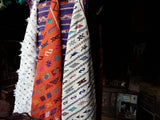
At Moroccan Corridor, every piece is traceable to its city of origin — leather bags from the workshops of Tetouan, poufs from the cooperative in Marrakesh, blankets from the weavers of Chefchaouen. We work directly with the artisans, without intermediaries, and we can answer every question above.
Frequently Asked Questions
Can I apply these tests when buying online?
The smell test and surface feel require physical contact — they cannot be replicated online. What you can do: ask the seller directly for the tanning method, leather grade, and city of production. A seller of authentic goods will answer immediately and specifically. If they cannot, that is itself a signal.
What if the seller claims the leather is "genuine" or "real"?
"Genuine leather" is a legal grade — it applies to any product containing real leather, including the lowest grades: split leather and bonded leather. It tells you nothing about quality, tanning method, or construction. Always ask specifically: full-grain or top-grain? Vegetable-tanned or chrome-tanned?
Is hand-stitching always a sign of authenticity?
It is one signal among several — not sufficient on its own. Some manufacturers apply hand-stitching selectively on visible seams while using machine stitching elsewhere. Check the back of every seam, not just the front. Saddle-stitching locks each stitch independently; machine chain-stitching unravels from a single break point.
Does the smell fade over time on genuine leather?
The intensity of the vegetable-tanning smell diminishes with age and use — this is normal and expected. What remains is a warm, organic quality that chrome-tanned leather never develops. A piece that smells chemical after years of use was never vegetable-tanned to begin with.
Are small imperfections on the surface a defect?
No — they are evidence of authenticity. Full-grain leather retains the natural surface of the hide: occasional marks, grain variations, subtle shifts in texture between panels. A perfectly uniform surface almost always indicates corrected-grain leather — sanded and coated to hide what the natural hide actually looked like.
What is the single most reliable test before buying?
Ask the seller to name the workshop or cooperative that made the piece, the city it was produced in, and the tanning method used. A seller with genuine sourcing relationships answers these questions without hesitation. Vague answers — "made by Moroccan artisans", "traditional methods" — are a signal to look elsewhere.
Every Moroccan Corridor piece is traceable to its city, its workshop, and its craft tradition.
Explore the Leather Collection