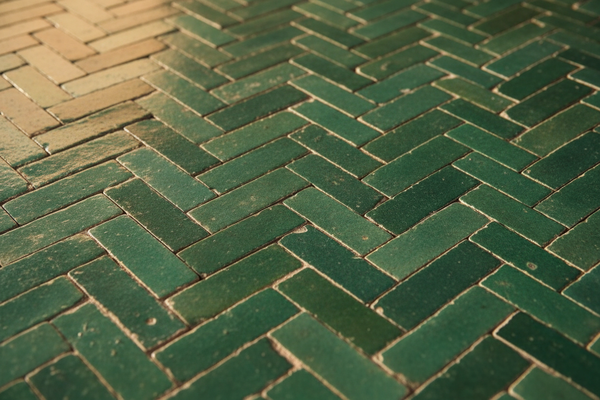
The ZigZag ottoman did not begin with leather. It began with tile.
The horizontal and vertical pleats that define the ZigZag's surface — the alternating ridges that catch light and cast shadow across the leather — are a direct translation of the geometric vocabulary of zellige, the hand-cut ceramic mosaic tradition that has been central to Moroccan decorative art since the eleventh century. Understanding zellige is understanding the ZigZag.
What Is Zellige?
Zellige is a form of geometric mosaic made from individually hand-cut ceramic tiles — called furmah — fitted together to form complex interlocking patterns that cover walls, floors, fountains, and courtyards. The word comes from the Arabic zulayj, meaning polished stone. Each tile is cut by hand from a larger fired ceramic piece using a pointed hammer called a menkach — a technique that has not changed in a thousand years.
The patterns of zellige are constructed from a limited vocabulary of geometric forms — squares, triangles, rhombuses, stars — combined and recombined according to mathematical principles to produce surfaces of extraordinary complexity. The same underlying geometry that governs a zellige panel on the wall of the Bou Inania Madrasa in Fès governs the surface of the ZigZag ottoman. The scale changes; the logic does not.
A Thousand Years of Geometry
Zellige emerged in the Islamic Maghreb around the eleventh century and reached its highest expression during the rule of the Marinid dynasty in Fès and the Nasrid dynasty in Granada. The madrasas, mosques, and palaces built under Marinid patronage — the Bou Inania Madrasa (1350–1357), the Attarine Madrasa (1323–1325), the Ben Youssef Madrasa in Marrakesh (1564–1565) — remain the canonical examples of the tradition, their lower walls covered in zellige panels of a precision and complexity that has never been surpassed.
The craft is transmitted through apprenticeship in family workshops in Fès and Meknès — the two cities that remain the primary centres of zellige production. A student begins with the simplest cuts, observing the master's technique before being trusted with more complex forms. The progression from apprentice to master takes years. The knowledge is embodied rather than written: it lives in the hand, not the book.
The tradition is not static. The Hassan II Mosque in Casablanca, inaugurated in 1993, features zellige work of a scale and ambition that places it alongside the great medieval examples — evidence that the craft remains alive and capable of producing work at the highest level.
From Tile to Leather — The ZigZag Design
The ZigZag ottoman translates the geometric logic of zellige into a three-dimensional leather surface. Where zellige achieves its pattern through the juxtaposition of differently coloured tiles, the ZigZag achieves its pattern through the juxtaposition of differently angled leather panels — horizontal and vertical pleats that create a surface of alternating ridges and recesses, light and shadow.
The result is a square ottoman — 30 cm high, 60 cm × 60 cm — whose surface reads differently depending on the angle of view and the quality of the light. In direct overhead light, the pleats flatten and the surface reads as a grid. In directional light from a window or lamp, the ridges cast shadows that deepen the pattern and give the surface a three-dimensional quality that no flat decoration can achieve. This is precisely the quality that zellige achieves on a wall: a surface that is alive to light, that changes through the day as the angle of the sun shifts.
The ZigZag is available in brown, tan, and blue — each colourway a different reading of the same geometric logic. The tan references the natural leather of the tannery; the brown references the earth tones of the medina; the blue references the indigo of Moroccan tilework and textile.
Frequently Asked Questions
What is zellige?
Zellige is a traditional Moroccan mosaic technique in which individually hand-cut ceramic tiles are fitted together to form complex geometric patterns. It has been practiced in Morocco since the eleventh century and remains a living craft tradition, produced primarily in the workshops of Fès and Meknès.
What is the connection between zellige and the ZigZag ottoman?
The ZigZag ottoman's surface pattern — alternating horizontal and vertical leather pleats that create a grid of ridges and recesses — is a direct translation of the geometric vocabulary of zellige into leather. The same mathematical logic that governs a zellige panel governs the ZigZag surface. The material changes; the underlying geometry does not.
What are the dimensions of the ZigZag ottoman?
The ZigZag ottoman measures approximately 30 cm high × 60 cm × 60 cm (H12" × L22" × W22"). It is square in plan and ships unfilled — a zip on the underside allows you to fill it with your preferred material.
What leather is used in the ZigZag ottoman?
The ZigZag ottoman is made from 100% full-grain goatskin, vegetable-tanned using traditional Moroccan methods. The leather is cut and stitched by hand by artisans in Morocco. Each piece is unique — minor variations in colour and stitching are a characteristic of authentic handcraft, not a defect.
Which colourway of the ZigZag ottoman works best in a neutral interior?
Tan is the most versatile — it references natural leather and works with almost any palette. Brown adds warmth and depth to neutral rooms. Blue works as a deliberate accent in otherwise neutral spaces, referencing the indigo tones of Moroccan tilework and textile.