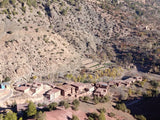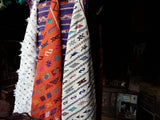

In the Berber villages of the Middle Atlas, a wedding does not begin with the ceremony. It begins, weeks earlier, at the loom.
A female member of the bride's family — her mother, her aunt, an elder woman of the household — sits down to weave a blanket. The wool is lamb's wool, hand-spun and hand-loomed. The loom itself is treated as a living thing in Berber culture, an object that commands reverence. The care and prayer invested in the weaving process are understood to pass into the fabric itself — infusing it with baraka, the Arabic word for divine blessing, and with a talismanic power to bring good fortune to the marriage, fertility to the bride, and protection against the evil eye.
This blanket is the Handira. It is one of the most significant objects in Moroccan Berber material culture.
What a Handira Is
The Handira — also written Hanbel or Handira depending on the region — is a flat-woven blanket made from undyed, untreated lamb's wool. Its surface is studded with sequins: small discs of metal or shell sewn across the weave in irregular patterns. The sequins serve a dual purpose. During the day, they catch sunlight and scatter it across the room. In the evening, they reflect firelight and candlelight, warming the space around them. They are decorative and functional simultaneously — a characteristic of Berber craft that rarely separates the two.
The wool is left in its natural state — cream, ivory, or warm white — or combined with undyed dark wool to create simple geometric patterns. The weave is dense and heavy. A finished Handira is a substantial object: it has weight, presence, and a texture that changes under different light.
The Wedding Ritual
From a young age, a girl grows up knowing that a Handira is being made for her. The weaving begins early — sometimes years before the wedding — with the finer details completed in the weeks leading up to the ceremony. On her wedding day, the bride is wrapped in the Handira and carried to her future husband's home. By tradition, her feet should not touch the ground until she crosses the threshold of her new home. The blanket she is wrapped in is both her protection and her gift — part of the family dowry, a physical embodiment of the blessings woven into it by the women who made it.
The Craft Tradition
Handira weaving is a women's tradition, transmitted within families and communities across the Berber villages of the Middle Atlas — particularly in the regions around Azrou, Khénifra, and Beni Mellal. The loom used is a horizontal ground loom, one of the oldest weaving technologies in the world. The weaver works from memory, not from a written pattern: the geometric vocabulary of the design is carried in the hand and the eye, passed from mother to daughter across generations.
The sequins — traditionally made from shell, bone, or hammered metal — are sewn individually by hand after the weaving is complete. Their placement is not random, but it is not rigidly prescribed either: each Handira reflects the individual judgment of the woman who made it. No two are identical.
The Handira Today
Vintage Handira — blankets woven for actual weddings, sometimes decades old — are among the most sought-after objects in the Moroccan craft market. Their age, the quality of the wool, the density of the sequins, and the evidence of use all contribute to their value. Caution is warranted when purchasing vintage pieces: the market for fakes is active, and an authentic vintage Handira requires a knowledgeable eye to identify.
Contemporary Handira are woven by women who have revived or maintained the tradition specifically for the market — producing blankets of good quality that carry the same craft vocabulary as the originals, without the ceremonial history. These are the pieces that have found their way into Western interiors: as wall hangings, bed throws, and the source material for cushions and upholstered objects.
At Moroccan Corridor, we source contemporary Handira directly from Morocco — good quality, authentic craft, without the uncertainty of the vintage market.
Explore the Handira Collection
Frequently Asked Questions
What is a Handira?
A Handira is a hand-loomed Berber wedding blanket made from undyed lamb's wool and studded with sequins. It is woven by a female member of the bride's family in the weeks before the wedding, and is believed to carry baraka — divine blessing — that protects the bride and brings good fortune to the marriage.
Where does the Handira come from?
The Handira tradition originates in the Berber villages of the Middle Atlas mountains of Morocco, particularly in the regions around Azrou, Khénifra, and Beni Mellal. It is a women's craft tradition, transmitted within families across generations.
What are the sequins on a Handira for?
The sequins serve both a decorative and a functional purpose. During the day they catch sunlight; in the evening they reflect firelight, warming the space around them. They are also understood to have a protective, talismanic function — deflecting the evil eye and amplifying the baraka woven into the blanket.
What is the difference between a vintage and a contemporary Handira?
A vintage Handira was woven for an actual wedding ceremony and carries the ceremonial history of that occasion. A contemporary Handira is woven using the same craft tradition and materials, produced specifically for the market. Vintage pieces are rarer and more variable in quality; the market for fakes is active. Contemporary pieces from a reliable source offer consistent quality without the uncertainty.
How do I use a Handira in an interior?
The most common uses are as a wall hanging, a bed throw, or a sofa drape. The sequins and the weight of the wool make it a strong visual statement in any of these positions. It can also be used as the source material for cushions — several cushions can be made from a single blanket. The natural wool tones work with almost any palette; the sequins add light and texture without colour.
How do I care for a Handira?
Spot clean only — do not machine wash. The wool is untreated and the sequins are hand-sewn; both require gentle handling. Air the blanket periodically and store flat or loosely rolled, away from direct sunlight and moisture. A Handira that is well cared for will last for decades.