
Few places in Morocco carry the weight of Aït Benhaddou. Perched above the Ounila River in the Drâa-Tafilalet region, this ancient ksar — a fortified earthen village — has stood for centuries as both a crossroads of trade and a crucible of craft. Today, it is a UNESCO World Heritage Site. But long before the designation, it was simply home: to potters, weavers, leather workers, and the families who passed their skills from hand to hand across generations.
What Is a Ksar — and Why Does It Matter?
A ksar (plural: ksour) is a traditional Moroccan fortified village built from pisé — a compressed mixture of earth, straw, and water. These structures are not merely architectural achievements; they are living records of how Moroccan communities organized trade, protected knowledge, and sustained craft economies across the Saharan and pre-Saharan routes.
Aït Benhaddou is among the finest surviving examples. Its towers, granaries, and communal spaces were designed not just for defense, but for the storage and exchange of goods — including the textiles, leather, and woven goods that defined the region's economic identity.
A Crossroads of the Trans-Saharan Trade Routes
For centuries, Aït Benhaddou sat at the intersection of caravan routes connecting sub-Saharan Africa to the imperial cities of Marrakech and Fès. Merchants passed through carrying gold, salt, spices — and raw materials that fed the craft workshops of the south.
This geographic position had a direct impact on the crafts that flourished here:
- Leather tanning — hides from livestock raised on the arid plains were processed using traditional vegetable tanning methods, producing the supple, durable leather still associated with southern Moroccan goods.
- Berber weaving — wool from the Atlas highlands was spun and dyed using natural pigments: saffron, henna, pomegranate rind, and indigo traded along the same routes.
- Earthenware and pottery — local clay, shaped by hand and fired in communal kilns, produced functional and ceremonial objects that traveled far beyond the ksar's walls.
The Craft Traditions That Survived
What makes Aït Benhaddou remarkable is not just its age — it is the continuity. Many of the craft techniques practiced here today trace directly to pre-Islamic Berber traditions, later refined through Arab, Andalusian, and sub-Saharan influences carried by the caravans.
Leather goods remain the most economically significant craft of the broader Drâa-Tafilalet region. The process — soaking, scraping, tanning with natural agents, and hand-finishing — has changed little in its essentials. What has changed is the market: where once these goods served local and caravan trade, today they reach buyers across Europe, North America, and beyond.
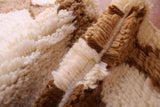
Handwoven textiles — blankets, cushion covers, and flat-weave rugs — carry the geometric vocabulary of Amazigh (Berber) visual culture. Each pattern is a form of encoded meaning: protection symbols, fertility motifs, tribal identifiers. A blanket from this region is not decoration; it is a document.
Sabra silk — derived from the agave cactus — is another regional specialty. Lightweight, lustrous, and entirely plant-based, sabra has become one of the most sought-after sustainable textile materials in contemporary design. Its roots are here, in the workshops of southern Morocco.
UNESCO Recognition: Preservation and Its Tensions
Aït Benhaddou was inscribed on the UNESCO World Heritage List in 1987, recognized for its outstanding example of southern Moroccan earthen architecture. The designation brought international visibility — and with it, the familiar tensions of heritage tourism.
On one hand, recognition has helped fund restoration efforts and brought economic activity to a region that had seen significant rural depopulation. On the other, the pressure of tourism has shifted some craft production toward volume over quality — a challenge that artisan cooperatives and ethical sourcing partnerships are actively working to counter.
The families who remain in the ksar — a small but committed community — continue to practice traditional crafts, often in direct partnership with brands and buyers who prioritize provenance and process over price.
The Living Craft Economy Today
The craft economy of Aït Benhaddou and its surrounding villages does not exist in isolation. It is part of a broader network that includes:
- Ouarzazate — the regional capital, home to cooperative workshops and the gateway to the ksar
- Zagora — a key node on the old caravan routes, still producing distinctive woven goods
- Skoura — known for its palm groves and the leather goods produced in its surrounding villages
Together, these towns form a craft corridor — a living geography of making that stretches from the High Atlas foothills to the edge of the Sahara.
What to Look for When Buying from This Region
If you are sourcing or purchasing crafts connected to the Aït Benhaddou tradition, these are the markers of authenticity and quality:
- Natural dyes — look for the slight irregularity and depth of color that synthetic dyes cannot replicate
- Hand-finishing — seams, edges, and closures on leather goods should show the slight variation of hand stitching
- Provenance transparency — reputable sellers will name the region, cooperative, or artisan behind the piece
- Material honesty — genuine sabra silk has a subtle sheen and a slightly coarser hand than synthetic alternatives
FAQ
Is Aït Benhaddou still inhabited? Yes — a small number of families continue to live within the ksar, maintaining both the structures and the craft traditions associated with the site.
What crafts come from the Drâa-Tafilalet region? The region is known for leather goods, Berber flat-weave textiles, sabra silk products, earthenware pottery, and carved wooden objects. These crafts reflect centuries of trade route influence and Amazigh cultural heritage.
Why is Aït Benhaddou a UNESCO World Heritage Site? It was inscribed in 1987 as an outstanding example of southern Moroccan earthen architecture (pisé construction) and for its role in preserving the built heritage of the pre-Saharan trade routes.
How does buying Moroccan crafts support artisans? Purchasing directly from brands with verified artisan partnerships — rather than mass-market intermediaries — ensures that a meaningful share of the sale price reaches the maker. Look for transparency around sourcing, cooperative partnerships, and fair pricing.
What is the difference between a ksar and a kasbah? A ksar is a fortified village housing an entire community. A kasbah is typically a single fortified residence or administrative building. Aït Benhaddou contains both within its walls.
Explore Crafts from This Region
The leather bags, woven blankets, and sabra silk cushions in our collection are sourced from artisan workshops in and around the Drâa-Tafilalet region — the same craft corridor that Aït Benhaddou has anchored for centuries.
→ Shop Leather Goods from Southern Morocco
→ Explore Handwoven Blankets & Textiles
→ Discover Sabra Silk Cushions