
A Moroccan pouf is a specific type of low upholstered furniture, traditionally handcrafted in Morocco from leather and rooted in North African craft traditions. An ottoman is the broader furniture category — a padded or upholstered piece that can serve as a footrest, seat, table, storage unit or decorative accent.
The two terms are often used interchangeably online, which can create confusion when shopping. This guide explains what the terms actually mean, where they overlap, and which type of piece may work best in your home.
What Is a Moroccan Pouf?
A Moroccan pouf is a low, compact piece of furniture traditionally made from leather and handcrafted in Morocco.
Depending on its construction and shape, it can function as a footrest, occasional seat, low table or decorative accent.
Moroccan poufs are commonly found in round, square and rectangular forms. Their surfaces may be plain or decorated using techniques such as hand-tooling or embroidery.
Several characteristics distinguish the traditional Moroccan pouf:
- Moroccan craft origin — the form is rooted in local leatherworking traditions.
- Leather construction — traditional examples are commonly made from natural leather.
- Low profile — poufs are designed for floor-level or low seating arrangements.
- Flexible function — a single pouf can serve as a footrest, occasional seat or low table.
- Individual character — handmade leather can display natural variations in colour, grain and texture.
For a more complete introduction to the object itself, see our complete guide to Moroccan leather poufs.
What Is an Ottoman?
Ottoman is a much broader furniture term.
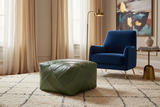
In contemporary English, an ottoman generally refers to a padded or upholstered piece without a back or arms. Depending on its design, it may function as a footrest, seat, coffee table, decorative accent or storage unit.
Ottomans can be made from many different materials, including:
- fabric;
- leather;
- faux leather;
- velvet;
- linen;
- wood and upholstered combinations;
- synthetic or mixed materials.
They can also vary considerably in shape, height and construction.
Some are mass-produced. Others are handmade or custom-made.
This is an important distinction:
"Ottoman" describes a category of furniture, not a particular manufacturing method or material.
A Moroccan pouf can therefore function as an ottoman, but the word ottoman does not necessarily tell you anything about where a piece was made or how it was produced.
Why Are Moroccan Poufs and Ottomans Often Confused?
The confusion comes largely from the way furniture is described online.
A Moroccan leather pouf can serve exactly the same basic functions as many ottomans:
- putting your feet up;
- providing occasional seating;
- supporting a tray;
- adding a decorative element to a room.
Retailers and marketplaces may therefore use pouf, ottoman, Moroccan ottoman and Moroccan pouf to describe similar products.
From a shopping perspective, however, the terms are not identical.
Moroccan pouf tells you more about the object’s cultural and craft identity.
Ottoman tells you more about its furniture category and function.
This distinction is particularly useful when searching online because the same type of object may appear under several different names.
Key Differences: Moroccan Pouf vs Ottoman
| Characteristic | Moroccan Pouf | Ottoman |
|---|---|---|
| Category | A specific Moroccan furniture form | A broad furniture category |
| Origin | Rooted in Moroccan craft traditions | Origin varies |
| Typical material | Often genuine leather | Fabric, leather, synthetic or mixed materials |
| Construction | Traditionally handmade | Handmade or manufactured |
| Filling | Often sold unstuffed or filled with natural materials | Usually supplied ready to use |
| Shape | Commonly round, square or rectangular | Highly variable |
| Height | Generally low | Varies considerably |
| Decoration | Often hand-tooled, embroidered or otherwise handcrafted | Highly variable |
| Function | Footrest, occasional seat, low table or accent | Footrest, seat, table, storage or accent |
| Cultural identity | Strong Moroccan craft identity | No single cultural identity |
The most important difference is therefore not simply leather versus fabric.
It is:
A Moroccan pouf is a culturally specific form of furniture, while an ottoman is a broad functional category.
Can a Moroccan Pouf Be Considered an Ottoman?
Yes.
From a functional perspective, a Moroccan pouf can be considered an ottoman because it can perform many of the same roles.
If you use a leather pouf as a footrest, for example, it is functioning as an ottoman.
If you place a tray on top and use it as a low table, it is still functioning as an ottoman.
But calling it simply an ottoman loses some of the information carried by the term Moroccan pouf — particularly its connection to Moroccan craftsmanship, materials and decorative traditions.
This is why both terms are useful.
Pouf describes the specific object.
Ottoman describes the broader furniture function.
Moroccan Pouf vs Ottoman: Material and Construction
The difference becomes particularly clear when looking at how the two categories are constructed.
A traditional Moroccan leather pouf is generally associated with natural leather and artisan production. Cutting, stitching, tooling, embroidery and finishing may all involve manual work.
An ottoman, by contrast, has no single construction method.
It may be:
- handmade;
- factory-produced;
- upholstered;
- leather-covered;
- synthetic;
- foam-filled;
- storage-based;
- or custom-designed.
Therefore, it would be inaccurate to say that every ottoman is factory-made or that every Moroccan pouf is constructed in exactly the same way.
The distinction is one of specific craft tradition versus broad furniture category.
For a closer look at the making process, see our guide to How Are Moroccan Leather Poufs Made?
And if your main concern is evaluating leather, construction and authenticity, our guide to Moroccan leather pouf pricing, quality and authenticity goes into those questions in greater detail.
Moroccan Pouf vs Ottoman: Shape and Function
Shape is another useful distinction, although there is considerable overlap.
Round Moroccan Poufs
Round poufs are among the most recognisable Moroccan forms.
Their compact shape makes them particularly useful as:
- footrests;
- occasional seats;
- flexible accent pieces.
Square Moroccan Poufs
Square forms provide a more structured appearance.
Depending on their dimensions and firmness, they can also work with a tray as an alternative to a conventional low coffee table.
Rectangular Moroccan Poufs
Rectangular forms can function as longer low seating or bench-style pieces.
They can work particularly well at the end of a bed or alongside a sofa.
Ottomans can take all of these forms — and many others.
They may also include features such as:
- internal storage;
- hinged lids;
- wheels;
- integrated trays;
- higher seating heights.
For a deeper look at Moroccan pouf shapes and how to select between them, see our guide to Moroccan pouf history, types and how to choose.
Which One Should You Choose?
There is no universally better choice.
The right option depends on what you are looking for in the piece.
Choose a Moroccan pouf if:
- you value Moroccan craftsmanship;
- you prefer natural leather;
- you appreciate handmade objects and natural variation;
- you want a low-profile piece of furniture;
- you like furniture that can serve several functions;
- you want a strong connection between the object and its place of origin;
- you appreciate a piece that can develop character with use.
Choose another type of ottoman if:
- you need built-in storage;
- you require a specific height;
- you need a particular technical configuration;
- you want to match an existing upholstered furniture set;
- you prefer a highly uniform industrial finish;
- a specific functional feature matters more to you than craft provenance.
The choice is therefore less about deciding which category is objectively better and more about deciding which characteristics matter most in your home.
If your main question is whether a Moroccan leather pouf represents good long-term value, see Are Moroccan Poufs Worth It? What to Look For.
What About Price?
There is no meaningful universal price comparison between a Moroccan pouf and an ottoman.
The category ottoman covers an enormous range of products, from inexpensive mass-market furniture to high-end designer and custom pieces.
Likewise, Moroccan poufs vary in price according to:
- leather;
- dimensions;
- construction;
- decoration;
- craftsmanship;
- provenance;
- selling context.
Price alone therefore does not establish whether one piece is better than another.
If you want to understand how to evaluate those factors before purchasing, see our guide to Moroccan leather pouf pricing, quality and authenticity.
The more useful question is:
What are you getting for the price you are paying?
Can a Moroccan Pouf Replace a Coffee Table?
Sometimes.
A sufficiently firm square or rectangular pouf can serve as a low table when paired with a stable tray.
This can be particularly effective in relaxed, low-profile interiors.
However, a pouf is not a direct replacement for every coffee table.
A conventional coffee table may provide:
- a rigid flat surface;
- greater height;
- more storage;
- greater stability for heavier objects.
A pouf offers something different:
- softness;
- flexibility;
- additional seating;
- a more informal atmosphere.
The decision therefore depends on how you use your living space.
Can a Moroccan Pouf Be Used as Seating?
Yes, provided the pouf is properly constructed and filled for that purpose.
A low leather pouf can provide useful occasional seating when entertaining or when additional seating is needed temporarily.
It is not, however, equivalent to a conventional armchair or dining chair.
The height is lower and the support depends considerably on the construction and filling.
If you intend to use your pouf primarily for seating, the dimensions, firmness and filling should be considered before purchase.
For practical information on filling an unstuffed pouf, see our complete guide to stuffing a Moroccan pouf.
Which Is Better for a Footrest: A Pouf or an Ottoman?
Both can work well.
A Moroccan pouf has an advantage if you want:
- a compact form;
- natural leather;
- handmade character;
- easy movement around the room;
- a decorative object that also serves a practical purpose.
A conventional ottoman may be preferable if you need:
- a particular height;
- a larger surface;
- built-in storage;
- a design that matches an existing furniture collection.
Again, the choice depends on the function and aesthetic you are prioritising.
The Terminology Matters — But the Object Matters More
The distinction between pouf and ottoman is useful, particularly when shopping online.
But terminology should never replace looking at the actual object.
When comparing two pieces, consider:
What is it made from?
How is it constructed?
Where was it made?
What will I use it for?
Does its design and construction suit that use?
A product described as an "ottoman" can be beautifully handcrafted.
A product described as a "Moroccan pouf" can also vary considerably in quality.
The name tells you what category or tradition the seller is invoking.
The object itself tells you whether it is right for your home.
Moroccan Pouf or Ottoman: Which One Is Right for You?
A Moroccan pouf and an ottoman are not competing categories in the strictest sense.
They overlap.
A Moroccan pouf can be an ottoman in terms of function, while remaining a distinctly Moroccan object in terms of craft tradition, material and cultural identity.
Choose a Moroccan pouf when craftsmanship, natural materials, provenance and individual character are important to you.
Choose another type of ottoman when specific dimensions, storage, height or coordinated upholstery matter more.
And if you are considering a Moroccan leather pouf specifically, the most useful next step is to look beyond the name and evaluate the individual piece.
Frequently Asked Questions
Is a Moroccan pouf the same as an ottoman?
Not exactly. A Moroccan pouf is a specific form of low furniture rooted in Moroccan craft traditions, while an ottoman is a broader furniture category. A Moroccan pouf can function as an ottoman, but not every ottoman is a Moroccan pouf.
Why is a Moroccan pouf sometimes called a Moroccan ottoman?
Because the two objects can perform similar functions as footrests, occasional seats or low tables. Retailers and shoppers therefore often use “Moroccan ottoman” and “Moroccan pouf” interchangeably, particularly in online searches.
What is the main difference between a pouf and an ottoman?
A pouf is generally a compact, low piece of furniture, while “ottoman” is a broader category that can include many shapes, materials, heights and functions. A Moroccan pouf is further distinguished by its connection to Moroccan craft traditions.
Can a Moroccan pouf be used as an ottoman?
Yes. A Moroccan pouf can function as a footrest, occasional seat or low table, which are all common ottoman functions. The term “ottoman” describes its function or furniture category rather than replacing its Moroccan craft identity.
Can a Moroccan pouf be used as a footrest or seat?
Yes. Moroccan poufs are commonly used as footrests and can provide occasional low seating when appropriately filled and constructed. Their low height makes them particularly suited to relaxed seating arrangements.
Can a Moroccan pouf replace a coffee table?
A firm square or rectangular Moroccan pouf can sometimes serve as a coffee-table alternative, especially when paired with a stable tray. It will not provide all the features of a conventional coffee table, such as rigid construction, storage or greater height.
Which should I choose: a Moroccan pouf or an ottoman?
Choose a Moroccan pouf if you value Moroccan craftsmanship, natural leather, low-profile furniture and individual character. Choose another type of ottoman if you need features such as built-in storage, a particular height, specific dimensions or coordinated upholstery.