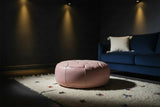

A Moroccan pouf is a handcrafted leather floor cushion, traditionally made by artisans in Morocco using hand-tooled sheep or goat leather. It functions as a footrest, extra seat, or decorative accent — and no two are exactly alike.
For anyone who has encountered one in a riad, a design magazine, or a well-styled living room, the question tends to follow quickly: where does this come from, and how is it made? This guide answers both — and explains what separates a genuine Moroccan pouf from the mass-produced versions that have flooded the market.
What Is a Moroccan Pouf?
A Moroccan pouf — also called a tabouret or pouf marocain — is a low, round or square floor cushion made from leather and filled with stuffing (typically cotton, wool, or recycled textiles). It originates from North African interior design, where low seating and floor-level living have been central to domestic life for centuries.
The defining characteristics of an authentic Moroccan pouf:
- Leather exterior — traditionally sheep or goat leather, hand-tooled with geometric or floral patterns
- Handmade construction — stitched and assembled by artisans using traditional tools, not machines
- Zip closure on the underside — allowing the pouf to be shipped unstuffed and filled locally
- Natural variation — slight differences in colour, size, and pattern are a mark of authenticity, not a defect
At Moroccan Corridor®, our round Tabouret Poufs measure approximately H32cm x D40cm and are made from sheep leather. Our square poufs (H40cm x L50cm x W50cm) are crafted from goat skin — a slightly firmer, more structured leather that holds its shape well over time.
How Is a Moroccan Pouf Made?
The process begins in the tanneries and workshops of Morocco — in cities like Fes, Marrakech, and Tetouan, where leather craft has been practised for over a thousand years.
1. Tanning
Raw hides are soaked in natural tanning agents — traditionally a mixture of pigeon droppings, quicklime, salt, and plant-based dyes. This process softens the leather and prepares it for tooling. The iconic coloured vats of the Fes tanneries are one of the most photographed sights in Morocco — and the source of the leather in every authentic pouf.
2. Cutting and Tooling
Once tanned and dried, the leather is cut into panels. Artisans then use hand tools — stamps, swivel knives, and mallets — to embroider, carve and emboss decorative patterns into the surface. Geometric motifs, arabesque patterns, and floral designs are the most common. This step alone can take several hours per piece.

3. Stitching and Assembly
The tooled panels are stitched together by hand, with a zip sewn into the underside. The stitching is tight and even — a sign of an experienced artisan. The exterior is then finished and, where applicable, dyed.

4. Stuffing (Optional)
Moroccan poufs are often sold unstuffed to reduce shipping weight and cost. Once received, they can be filled with cotton batting, old clothing, or recycled textiles. Moroccan Corridor® offers a stuffed option (available for the USA, Canada, Australia, and UK) for customers who prefer a ready-to-use piece.
The result is an object that carries the marks of the hands that made it — natural age marks in the leather, slight variations in colour, the occasional asymmetry. These are not flaws. They are the evidence of craft.
For a complete guide to filling materials, quantities, and technique, see How to Stuff a Moroccan Pouf: The Complete Guide.
For a step-by-step account of the full production process — from tannery to finished piece — see How Are Moroccan Leather Poufs Made? For families with young children, see also Why Leather Ottomans Are the Safer Choice for Families with Young Children.
Moroccan Pouf vs Ottoman: Is There a Difference?
The terms are often used interchangeably, and in practice, the distinction is mostly cultural rather than functional.
An ottoman is a Western term for an upholstered footrest or low seat — typically padded, fabric-covered, and factory-made. A Moroccan pouf is a specific type of ottoman: leather, handmade, and rooted in North African craft tradition.
When people search for a Moroccan ottoman, they are almost always looking for a Moroccan pouf. The two terms describe the same object — the difference is in origin, material, and how it was made.
If you are comparing the two for a purchase decision: a genuine Moroccan leather pouf will outlast a fabric ottoman by years, develops a patina over time, and is far more versatile in terms of styling.
Round Pouf vs Square Pouf: Which Should You Choose?
Both shapes are authentic to Moroccan craft tradition. The choice comes down to your space and how you intend to use it.
Round pouf
The classic form. Softer silhouette, works in almost any room. Easier to move around. Our round Tabouret Poufs start at $109 and are made from embossed sheep leather.
Square pouf
More architectural. Sits flush against furniture, works well as a coffee table alternative. Our square Lilya Pouf (H40 x L50 x W50cm) is made from goat skin and is available from $179 unstuffed or $249 stuffed.
For a detailed comparison of poufs and ottomans as furniture pieces — including use as coffee table alternatives — see Moroccan Pouf vs Ottoman: What's the Difference? and Leather Ottomans: The Stylish Alternative to Traditional Coffee Tables.
How to Style a Moroccan Pouf
A Moroccan pouf is one of the most versatile pieces in a room. A few approaches that work consistently:
- As a footrest — Place it in front of a sofa or armchair. A tan or natural leather pouf works with almost any colour palette; a fuchsia or red pouf becomes a deliberate accent.
- As extra seating — Low enough to be unobtrusive, sturdy enough to sit on. Useful in living rooms where occasional seating is needed without adding a permanent chair.
- As a coffee table — A square pouf at the right height can replace a coffee table entirely. Add a tray on top for drinks and books.
- Grouped — Two or three poufs of different colours clustered together create a relaxed, layered look. Common in Moroccan interior design, where mixing patterns and tones is intentional.
- In a reading corner — A single pouf beside a floor lamp and a low shelf is one of the simplest ways to create a defined space within a larger room.
For more detailed styling guidance by room and use case, see our dedicated guides: 10 ways to style a Moroccan pouf, creating a living-to-dining flow, and styling guides for the Black Tabouret and the Embossed Pouf.
What Makes a Moroccan Pouf Authentic?
With the market flooded by machine-made imitations, it is worth knowing what to look for:
- Leather, not faux leather — Genuine poufs use sheep or goat leather. Check the product description carefully.
- Hand-tooled patterns — Machine-stamped patterns are uniform and flat. Hand-tooled patterns have depth and slight variation.
- Natural variation — If every pouf in a product listing looks identical, it was not made by hand.
- Origin transparency — An authentic maker will tell you where and how the piece was made.
- Zip on the underside — Standard on authentic Moroccan poufs. Allows for local stuffing and easy cleaning.
At Moroccan Corridor®, every pouf is ethically handmade in Morocco and ships directly from our artisan partners. Natural age marks and slight variations in colour and size are expected — and documented in every product listing.
For a full breakdown of pricing, quality tiers, and how to spot imitations, see The Iconic Leather Pouf of Morocco: A Complete Guide to Pricing, Quality, and Authenticity and Are Moroccan Poufs Worth It? What to Look For.
Where to Buy an Authentic Moroccan Pouf
Browse the full Moroccan Pouf collection at Moroccan Corridor — including round Tabouret Poufs from $109 and square poufs from $179, available stuffed or unstuffed, in a range of colours from natural tan to fuchsia, red, black, orange, and yellow.
Frequently Asked Questions
What is a Moroccan pouf?
A Moroccan pouf is a handcrafted leather floor cushion made by artisans in Morocco. It is used as a footrest, extra seat, or decorative accent and is typically made from sheep or goat leather with hand-tooled patterns.
What is the difference between a Moroccan pouf and an ottoman?
The terms are often used interchangeably. An ottoman is a general Western term for an upholstered footrest; a Moroccan pouf is a specific type of ottoman made from leather, handcrafted in Morocco using traditional techniques.
Are Moroccan poufs sold stuffed or unstuffed?
Both options exist. Moroccan poufs are often sold unstuffed to reduce shipping costs — you fill them locally with cotton, old clothing, or recycled textiles. Some sellers, including Moroccan Corridor®, offer pre-stuffed options for select countries.
What leather is used in Moroccan poufs?
Authentic Moroccan poufs are made from sheep leather (softer, used for round poufs) or goat skin (firmer, used for square poufs). Both are tanned and tooled by hand in Morocco.
How do I fill a Moroccan pouf?
Unzip the underside and fill with cotton batting, old clothes, or recycled textiles until firm. Avoid overfilling — the pouf should be firm but not stretched.
How do I clean a Moroccan leather pouf?
Wipe with a dry or slightly damp cloth. Avoid soaking the leather. Apply a leather conditioner every few months to maintain suppleness and prevent cracking.
How long does a Moroccan leather pouf last?
With basic care, a genuine leather pouf will last 10-20 years and develops a richer patina over time. Faux leather versions typically last 2-5 years before cracking.
What size is a standard Moroccan pouf?
Round poufs are typically H30-35cm x D38-42cm. Square poufs are typically H38-42cm x L48-52cm x W48-52cm. Sizes vary slightly between artisans.